Judicial killing of Nazrul and Sweety, and Saudi Arabia’s ‘Master-Like’ Conduct
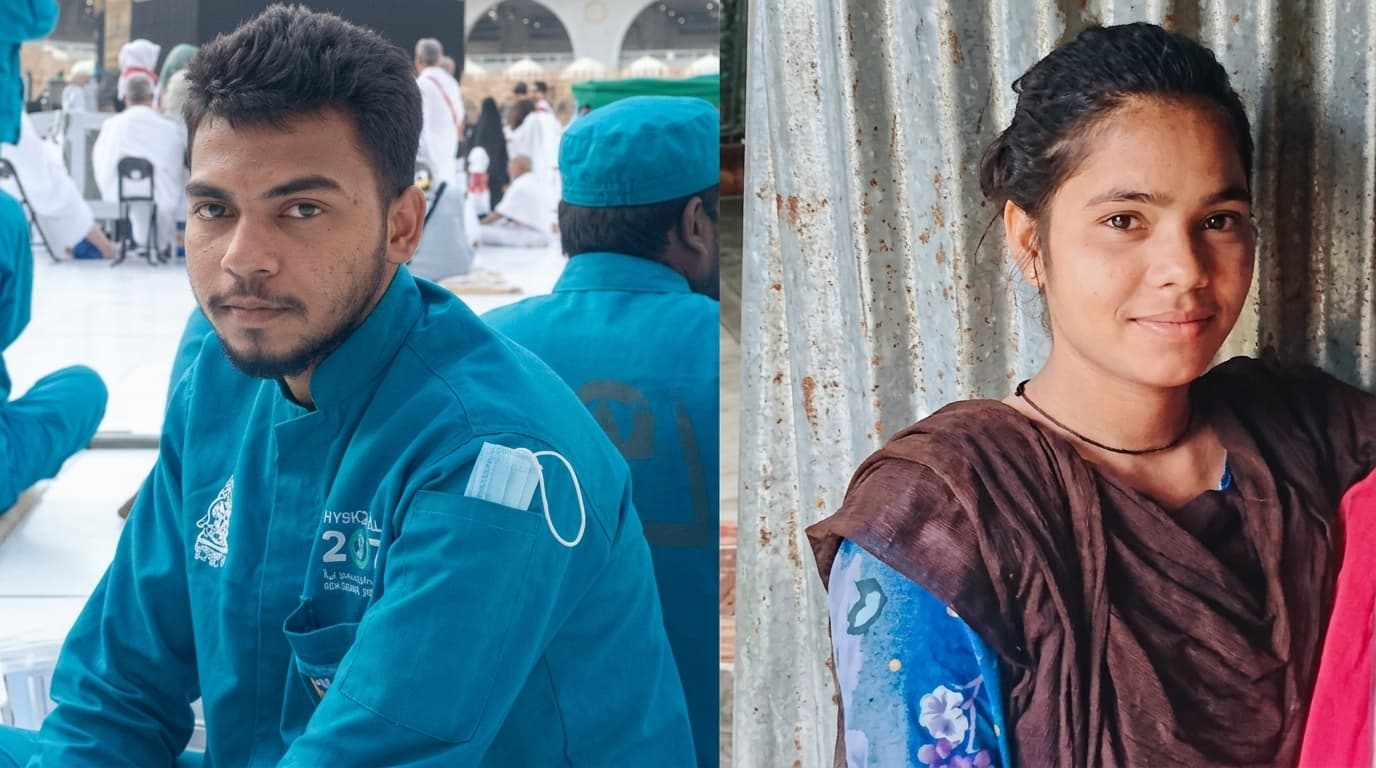
Photo: Nazrul and Sweety
Under Article 36 of the 1963 Vienna Convention, when a foreign national is detained and tried, informing their country’s embassy is mandatory. But from the trial process all the way to the execution, the Saudi government told neither the Bangladesh Embassy nor the family anything. In fact, Saudi Arabia has always behaved in this ‘master-like’ way with countries that have weak diplomacy.
It is still not clear what the real crime was of the two Bangladeshis executed in Saudi Arabia—Nazrul Islam and Sweety Akter. We also do not know what evidence the country’s investigators presented in the Saudi monarchy’s Sharia court to support the charges against them. Given a completely hostile environment, not knowing the language, and having no lawyer on their side, the country’s media knows nothing about what Sweety and Nazrul’s real crime was, or how much of it was proven in court. The country’s media did not even think it necessary to know, or to check, the simple fact that even in Saudi Arabia itself, kissing is not punishable by death. Yet without any verification, it was widely publicized that they had been sentenced to death for ‘immoral activities.’ Following this, BNP Member of Parliament Kamruzzaman Ratan commented, ‘These bodies are a shame,’ and said they did not want their bodies to come back to the country. In other words, before anyone knew what had actually happened, their character had already been assassinated, politically and socially, as completely as it could be.
A Tk 4.5 Lakh Debt and a Family’s Grief
While society and the media were busy assassinating their character without knowing the facts, there was nothing but mourning at Nazrul’s home in Brahmanbaria Sadar Upazila. His farmer father, Abdul Basir, who had himself lived abroad for 24 years without being able to change his fortunes, borrowed Tk 6 lakh in November 2022 to send his eldest son, Nazrul, to Saudi Arabia in the hope of a better life. Before he was arrested eight months later, the 25-year-old had managed to repay only Tk 1.5 lakh. The family is still carrying a debt of Tk 4.5 lakh. But before that debt could be repaid, Nazrul’s life came to an end on October 14. On hearing the news of his execution, his elderly aunt, Abeda Begum, 65, suffered a heart attack and died. And his destitute parents now have only one plea: that, beyond all the slander, they may at least see their son’s body one last time.
What Happened in Mecca, and Why So Much Secrecy Over Information?
After passing the Dakhil exam from a madrasa in 2020, Nazrul enrolled in college, but poverty forced him to give up his studies and go abroad. He went to Saudi Arabia through an agency called ‘Musa International’ and got a job as a cleaner at the Masjid al-Haram in Mecca.
His monthly salary was only 800 riyals. According to his relatives, a dispute arose there between him and a Pakistani national. After a video made by that Pakistani man spread, Saudi police detained Nazrul on August 1, 2023, and Sweety the next day. After nearly three years in prison, on October 11, Nazrul got the chance to speak with his parents for the last time, for just two minutes. Three days later, the death sentence was carried out without informing the family.
The biggest mystery surrounds the prisoner list provided by the Saudi authorities. On September 30, just two weeks before the execution, the list given to the Bangladesh Embassy mentioned ‘cybercrime’ as Nazrul’s offense and ‘adultery’ in Sweety’s case. But the fact that they had been given a sentence as extreme as death was kept completely hidden in that list. Yet there is no precedent of any Bangladeshi being sentenced to death in Saudi Arabia for cybercrime or adultery.
Under Article 36 of the 1963 Vienna Convention, when a foreign national is detained and tried, informing their country’s embassy is mandatory. But from the trial process all the way to the execution, the Saudi government told neither the Bangladesh Embassy nor the family anything. In fact, Saudi Arabia has always behaved in this ‘master-like’ way with countries that have weak diplomacy.
Let alone the United States, Britain or Europe—Saudi Arabia would not have dared to secretly carry out executions like this even in the case of citizens of India, Pakistan or Sri Lanka. They know that no strong diplomatic pressure will come from Bangladesh against this. And that is exactly what happened: after two of its citizens lost their lives, Dhaka simply asked for a copy of the verdict and considered its duty done.
Remittance Machines or Citizens of the State?
Nazrul was held in a Saudi prison for three long years. He spoke with his family on restricted phone calls of just one or two minutes a month. During this long period, the Bangladesh Embassy could not give him any effective legal assistance. Every year, 40,000 to 50,000 Bangladeshi workers return home empty-handed from Saudi prisons, a large share of whom are innocent.
The state sees migrant workers only as ‘remittance-sending machines,’ not as citizens with rights. When one’s own country, its media and its politicians, instead of valuing the lives of migrant workers, get busy assassinating their character, countries like Saudi Arabia also get the chance to lord it over them.
Today, the tears of his father, Abdul Basir, and his mother, Rahima Begum, raise just one question: does the life and dignity of a poor migrant worker have no value at all to Bangladesh?