31 Banks' 'Digital Rebellion' Puts Tk2 Lakh Crore at Risk

Policymakers have only confused ordinary depositors by putting on the colourful fake glasses of a 'cashless economy.' Corporate brokers lurking inside the banks are not allowing any minimum legal action or punitive measures to be taken against the banks. The shameless audacity shown by a consortium of 31 banks in stopping the blood circulation of Tk2,00,000 crore in the country clearly points to one reality—in Bangladesh, ordinary depositors do not even have the dignity of being human.
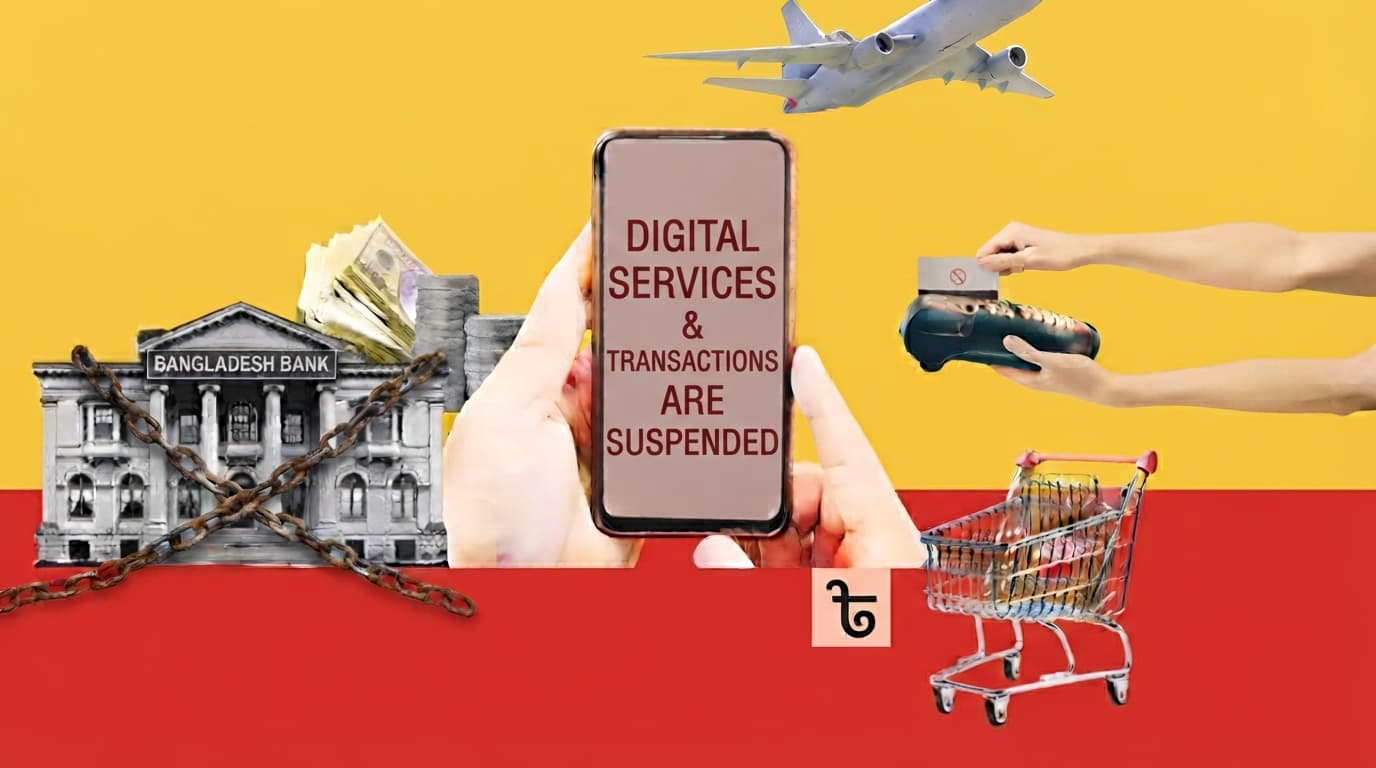
Thirty-one banks in the country have shut down all their digital services and transactions without informing the government. This shutdown, which began on October 4, will continue until 12 noon on October 10. As a result, daily online business transactions worth Tk35,000–37,000 crore—money moving from one bank to another or settling payments—have come to a complete halt. Although 31 banks have directly suspended services, other banks in the country cannot transact online with them either, effectively collapsing the entire banking sector. Just seven and a half months before the national election, these banks appear to have launched a terrifying and silent rebellion against a new government by pushing the country's entire business and economy to the brink.
When Digital Banking Stops, Commerce Stops
Digital banking is not merely a 'money transfer facility'—it is now the main driving force of the entire national production and supply chain. Updated data from Bangladesh Bank shows that through Real Time Gross Settlement (RTGS), an average of Tk25,000–30,000 crore is transacted daily on working days. Another Tk2,500–3,000 crore circulates through BEFTN, and a further Tk2,500 crore through NPSB and internet banking. Altogether, nearly Tk35,000–37,000 crore is transacted online every day. When this system shuts down, it means the wheels of import-export bill payments, business cash flow, daily supplies to dealers of large companies, and salary and pension payments for millions of officers and employees of government and private institutions all come to a complete standstill. In commerce today, no one hands over cash in bags anymore—everyone depends on these real-time switches of the banks.
Alongside the paralysis of large-scale trade, a terrifying hostage situation has emerged in the daily lives of ordinary people. Currently, 3.2 crore customers in the country hold more than 5 crore debit and credit cards. From salaried professionals to small business owners, everyone in urban life is deeply dependent on this plastic money. Nearly Tk42,000–45,000 crore changes hands through these cards every month. Of this, credit cards alone account for Tk30,000–34,000 crore in annual transactions. About 50 percent of the monthly average of Tk2,500–2,800 crore transacted through credit cards is paid at POS machines in supermarkets, pharmacies, and hospitals. That means at least Tk2,000 crore or more is transacted daily through these channels alone.
The question is: who gave these banks the power to cut off this essential financial lifeline of the country's people for seven days? Who Gave Them the Power? At least 31 banks in the country have their ATM, debit-credit card, and digital transaction controls operated by a payment consortium called IT Consultants PLC (ITC) or 'Q-Cash.' This organisation is effectively controlled by three interests—Labib Group Chairman Salauddin Alamgir, the company's main entrepreneur Dr. Kazi Saifuddin Munir, and the Hong Kong-based investment firm Regent Pacific Limited together with Singapore-based Sees Capital. Using a lame and unbelievable excuse of merely 'upgrading the system,' 31 banks backed by this consortium have shut down their transaction systems for seven days. The government knows nothing; Bangladesh Bank has been kept in the dark. Holding the country hostage through a unilateral decision is by no means an ordinary technical breakdown; it is equivalent to a meticulously executed act of digital sabotage.
Tk2 Lakh Crore in Seven Days! Just calculate the economic devastation of this extreme audacity. During this seven-day disaster, 5 days are regular banking working days. At Tk37,000 crore per day, at least Tk1,85,000 crore worth of online commerce has collapsed in these five days alone. Although the remaining two days are weekly holidays, at least Tk10,000 crore changes hands through cards and digital services during this time. Altogether, through ITC's unilateral action, nearly Tk2,00,000 crore worth of transactions have been disrupted and frozen in seven days.
Seven consecutive days of all digital financial services being shut down is equivalent to artificially stopping a country's blood circulation. This will create a container jam at Chattogram Port and Customs as RTGS payments for duties and VAT get stuck; exporters unable to release raw materials and with international LC transactions disrupted will find themselves on the brink. Salaries (payroll) of workers and employees in hundreds of factories will be stuck, spreading major discontent in industrial areas. The most terrifying consequence will be a 'severe cash crunch.' If cards stop working, crores of people will simultaneously line up at ATMs or bank branches for money. Banks do not have the logistics to handle this massive pressure, so within hours, cash counters and booths will run dry, creating major chaos. The biggest crisis will be one of public confidence. The trust that ordinary people have built in digital banking will shatter, people will go back to keeping money under their pillows, and international rating agencies will tag Bangladesh's financial system as extremely 'risky.'
Where Were the Banks' Warnings?
Did the banks inform customers about such a massive and catastrophic shutdown through even a simple text message or SMS? This cannot be called negligence; it is a cruel joke at the customer's expense. Your phone's inbox is now a massive dumpster for advertisements. If you bought shoes from Apex or Bata a decade ago, or ate pizza at Domino's, their ads fill your inbox all day. If you bought a toilet cleaner on Foodpanda one lazy afternoon, they are now sending messages trying to 'clean' your entire life. Meanwhile, inexperienced matchmakers propose marriage at every opportunity, and messages selling plots in the raging waters of the Padma from Narsingdi to Keraniganj or Mawa are daily occurrences.
Amid this deluge of garbage messages, was there even the slightest chance anyone would read a dry notice about banking transactions being closed for the next 7 days? Absolutely zero. If a customer, leaving his beloved wife or elderly parents in critical condition at the hospital, goes to pay the bill and discovers his card or payment app is not working, and that person deprived of treatment suffers a heart attack from this terrible helplessness—will the bank's board of directors pay for that tragic incident? If there is even a minimum sense of humanitarian responsibility, this liability should be borne by the banks themselves.
Seven Hours of Downtime, Not Seven Days
In today's digital world, keeping a nation's primary banking services shut for seven consecutive days is practically inconceivable. In developed countries, when core banking solutions or software upgrades are needed, only a few hours of 'downtime' is taken late at night, and during that time, fully redundant backup servers are kept running in parallel.
What Would Happen Elsewhere? If such extreme audacity were shown in India or any other country in the world, the consequences would be horrific. If such a disruption occurred in India, the country's central bank, RBI, would immediately take punitive measures. Due to digital negligence, even India's mighty HDFC Bank was strictly barred from selling new cards. If UPI and cards were down for seven days in that country, the entire retail market would collapse, public protests would spread across India, and the RBI would directly dissolve these banks' boards and install its own administrators.
In the United States, regulatory agencies (Federal Reserve, CFPB) would, following an emergency investigation, impose billions of dollars in fines on these banks for creating 'systemic risk' and collapsing the country's supply system. Depositors and businesses would build mountains of class-action lawsuits to recover compensation, devastating the banks financially. And in Europe or the UK, bank executives would be barred from the profession for life for such blatant violations of the law.
The Silence of Politics and Regulators
But in this extreme suffering—which would cause an earthquake in any other normal country in the world—the astonishing thing is that nothing has happened in our country. Where the economy is paralysed and gasping, our government and policymakers are completely silent; the scale of this disruption does not appear to have registered with the policymakers at all. The extreme disconnect of our political leadership has become equally evident. When people are gasping for breath due to lack of cash for urgent needs, perhaps Jamaat-e-Islami's Amir Dr. Shafiqur Rahman is sitting on some lavish stage delivering fine political sermons to the nation in polished Bengali. The words 'economic disaster' have found no place in anyone's political narrative.
Even after this hostage situation where nearly Tk2,00,000 crore worth of transactions have been blocked, the position of the regulatory body Bangladesh Bank's governor is toothless and disappointing. Instead of dissolving the banks' boards and showing the harshest form of the law, Bangladesh Bank has fulfilled its duty by issuing a laughable circular expressing its usual mild disapproval. Yet the governor holds ample legal power to pull the poisonous fangs of these mafia banks responsible for such extreme lawlessness as severing the country's financial lifeline.
Where Is the Law?
The central bank's own 'Payment and Settlement Systems Act' and 'Information Technology Security Guidelines' have been clearly violated. The law clearly states that to keep services uninterrupted during any disaster, banks must mandatorily operate a 'Business Continuity Plan' (BCP) and parallel 'Disaster Recovery Site' (DR). Deviating even slightly from this and depriving ordinary customers of digital services for even one minute is an extreme legal offense.
Even greater punishment lies hidden in the pages of the 'Bank Company Act, 1991.' Sections 45 and 46 of the law clearly state that if involved in activities extremely harmful to depositors and public interest, the central bank can cancel the entire board of directors of any bank and remove the MD and DMDs from their positions for life. Along with applying Section 109, the governor alone has unlimited jurisdiction to crush the business backbone of these whimsical banks and institutions by imposing massive financial penalties.
What Good Is Power Without the Will to Use It?
But what good is power if Bangladesh Bank lacks the courage to apply it? Policymakers have only confused ordinary depositors by putting on the colourful fake glasses of a 'cashless economy.' Corporate brokers lurking inside the banks are not allowing any minimum legal action or punitive measures to be taken against the banks. The shameless audacity shown by a consortium of 31 banks in stopping the blood circulation of Tk2,00,000 crore in the country clearly points to one reality—in Bangladesh, ordinary depositors do not even have the dignity of being human. Here, in the eyes of the state structure, they are nothing but living commodities to be plundered for profit by a few syndicates like Aslam, Nabil, or Labib Group.
---
*Author: Editor, Dhaka Papers
Email: [email protected]
Your contribution keeps investigative journalism fearless, transparent, and accessible to everyone. To support us securely donate from anywhere.