Harsh Reality Behind the Glossy Canvas: The Post-Uprising Elected Government's Maiden Budget
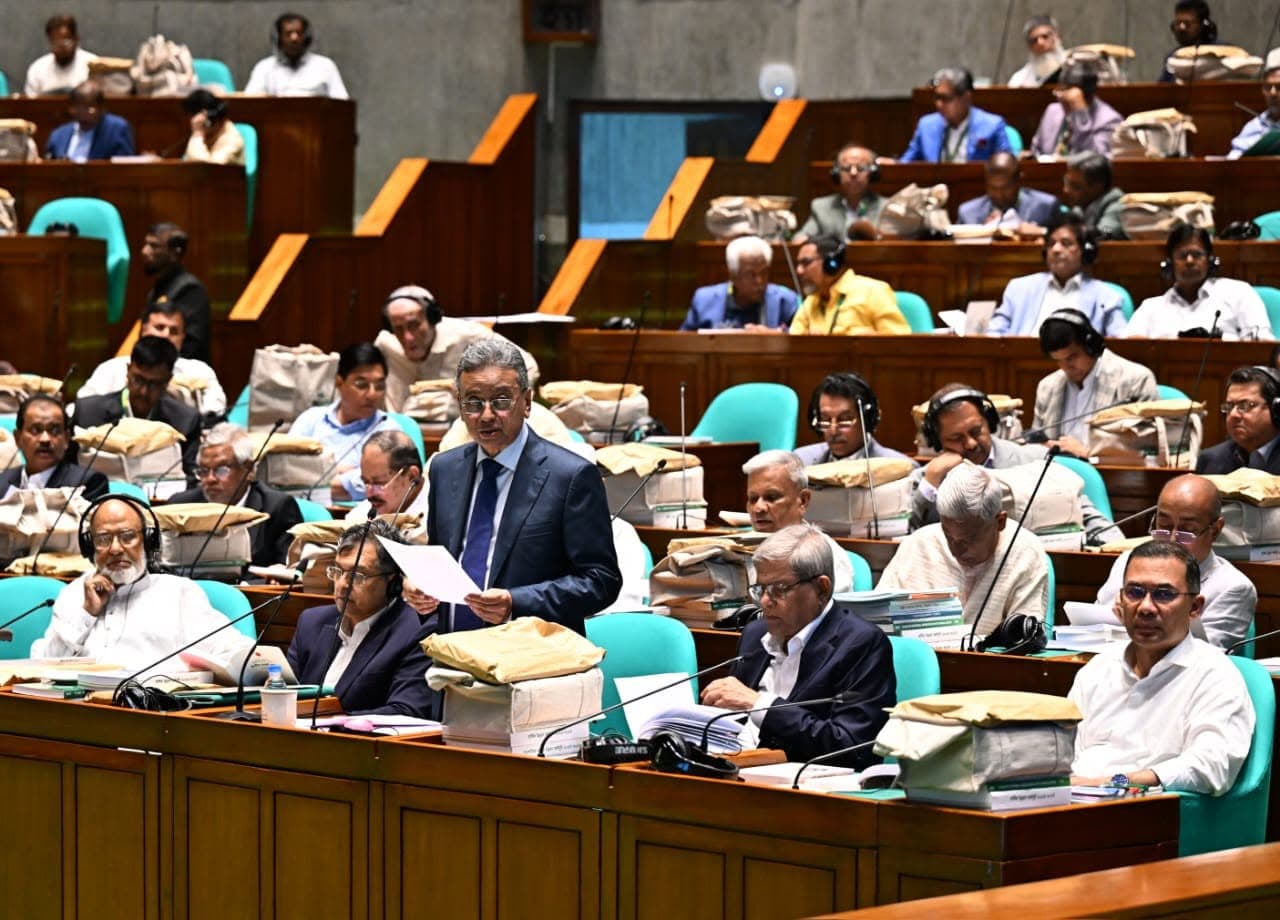
Photo: PMO
Yet, grounded in today's reality, these targets seem like pie in the sky. Currently, Bangladesh's real GDP growth stands at 4.14 percent, with general inflation hovering stubbornly around 9.5 percent. The labor market is flooded with newly unemployed people daily. Individuals on limited incomes are struggling desperately to cope with relentless inflationary pressures, while the number of people slipping below the poverty line is skyrocketing.
Amid a very critical political and economic landscape following the mass uprising, the BNP government unveiled the national budget yesterday on June 11. Having formed the government after a landslide victory in the national elections on February 12 this year—ending two decades out of power— its finance minister Amir Khosru Mahmud Chowdhury presented a mammoth budget of Tk 9.38 lakh crore for the fiscal year 2026-27.
Titled ‘The Journey of a Democratic, Humane, and Inclusive Economy,’ the budget is packed with glossy pledges like a ‘Creative Economy,’ ‘Startup Fund,’ and ‘Family Cards. Adorning these grand promises like fine jewels are the ambitious targets of boosting GDP growth to 6.5 percent and reining in inflation to 7 percent.
Yet, grounded in today's reality, these targets seem like pie in the sky. Currently, Bangladesh's real GDP growth stands at 4.14 percent, with general inflation hovering stubbornly around 9.5 percent. The labor market is flooded with newly unemployed people daily. Individuals on limited incomes are struggling desperately to cope with relentless inflationary pressures, while the number of people slipping below the poverty line is skyrocketing. Statistics from research institutions continue to paint increasingly alarming scenarios. Data shows that the first nine months of the outgoing fiscal year, the government managed to source only 19 percent or Tk 19,296 crore from external sources against a target of Tk 1.01 lac crore for the whole fiscal year.
Meanwhile, in the outgoing fiscal year 2025-26, the National Board of Revenue (NBR) managed to collect Tk 5.04 lakh crore. From almost a sluggish economy, the government has set a revenue target of Tk 6.04 lakh crore for the upcoming fiscal year—an aggressive leap of nearly 20 percent compared to the previous year.
Against this backdrop, the finance minister placed a massive deficit budget of Tk 2.43 lakh crore before the National Parliament, accounting for a record 26 percent of the total budget. To plug this gap, the government plans to borrow 46 percent, or Tk 1.12 lakh crore, from the domestic banking sector. Another 6 percent or Tk 15,000 crore is projected to come from the savings of the middle class, with the remaining 48 percent or Tk 1.16 lac crore sourced from foreign loans.
When analyzed cohesively rather than in isolation, these fragmented targets and promises reveal deep systematic contradictions. The financing strategies laid out to fund this proposed budget will ultimately sabotage the government’s core objectives of job creation and inflation control, making daily survival even more grueling for the common citizen.
Employment vs. Liquidity Crisis in the Banking Sector
Addressing the rise in unemployment and the recent spate of factory closures, the budget considers job creation as one of its primary pillars. A Tk 60,000 crore stimulus package has been announced to revive shuttered industries and restore credit flows. Concurrently, however, the government plans to siphon off nearly Tk 1.12 lakh crore from an already ailing domestic banking sector to finance its deficit. If the state borrows so aggressively from commercial banks, credit will inevitably dry up for private entrepreneurs and small businesses navigating the liquidity crunch. Consequently, for the vast majority of private enterprises left outside the stimulus package, soaring interest rates will choke off any scope for new employment right from the start.
The 7% Inflation Target vs. Pre-Budget "Energy Shock"
The government aims to slash inflation from the current 9.5 percent down to 7 percent. Yet, on the very eve of the budget announcement, it orchestrated an incredible paradox by hiking electricity and fuel prices. The Bangladesh Energy Regulatory Commission (BERC) raised wholesale power tariffs by 19.85 percent and retail rates by 16.8 percent. Simultaneously, the retail price of diesel—the lifeline of production and transport—were hiked by Tk 5 per liter. This energy shockwave has already triggered a chain reactions and inflated commodity transportation and agricultural irrigation costs. The glossy canvas of tariff cuts on rice, pulses, or life-saving medicines will swiftly be buried under the harsh weight of these energy costs, leaving the 7 percent inflation target as nothing more than a theoretical fairytale.
Taxing the Micro-Entrepreneurs
In its scramble to fund the deficit, the government has spared not even micro-entrepreneurs; instead, it has cast the VAT net even wider. The threshold for mandatory annual VAT registration has been slashed from Tk 30 lakh to Tk 20 lakh. This means any micro-enterprise with a modest monthly turnover of just Tk 1.67 lakh must now comply with the VAT regime. Previously, this ceiling stood at Tk 2.50 lakh per month. This move will not only paralyze the growth of cottage and small businesses but will also empty the pockets of consumers further under the weight of indirect taxation.
The 5% vs. 95% Disparity
The budget announces a pay raise for public servants, claiming it will boost purchasing power and stimulate economic growth. However, government employees constitute less than 5 percent of the country’s total workforce. Past experience serves as a stark reminder that a wage hike for this 5 percent minority triggers market syndicates to instantly jack up the prices of essentials nationwide. Meanwhile, the remaining 95 percent of the population working in the private and informal sectors receive no such raise. This discriminatory policy will only fan the flames of inflation, rendering basic survival impossible for low and irregular wage earners.
Social Safety Net: Mere Ointment on a Deep Wound
Perhaps to preempt severe social instability or economic catastrophe, the social safety net allocation has been increased to a proposed Tk 1.44 lakh 338 crore. This includes a somewhat comforting allocation of Tk 14,500 crore to provide 41 lakh marginalized women with direct cash transfers of Tk 2,500 per month via Family Cards. However, given the relentless inflation stoked by fuel price hikes and an expanded VAT net, this modest allowance will hardly suffice to protect the actual purchasing power of the most vulnerable.
The proposed budget for FY 2026-27 is fundamentally caught in a classic catch-22. On one side are the lofty speeches of economic recovery and job creation; on the other lies a strategy that starves the private sector of credit while burdening it with pre-budget energy price hikes. Together, these moves reduce the government’s 7 percent inflation and 6.5 percent GDP growth targets to mere paper rhetoric. Stripping away the glossy packaging reveals a harsh truth: the days ahead are bound to be significantly more expensive and grueling for the average citizen.
___
*Author: Joint Editor of Dhaka Papers.
Email: [email protected]