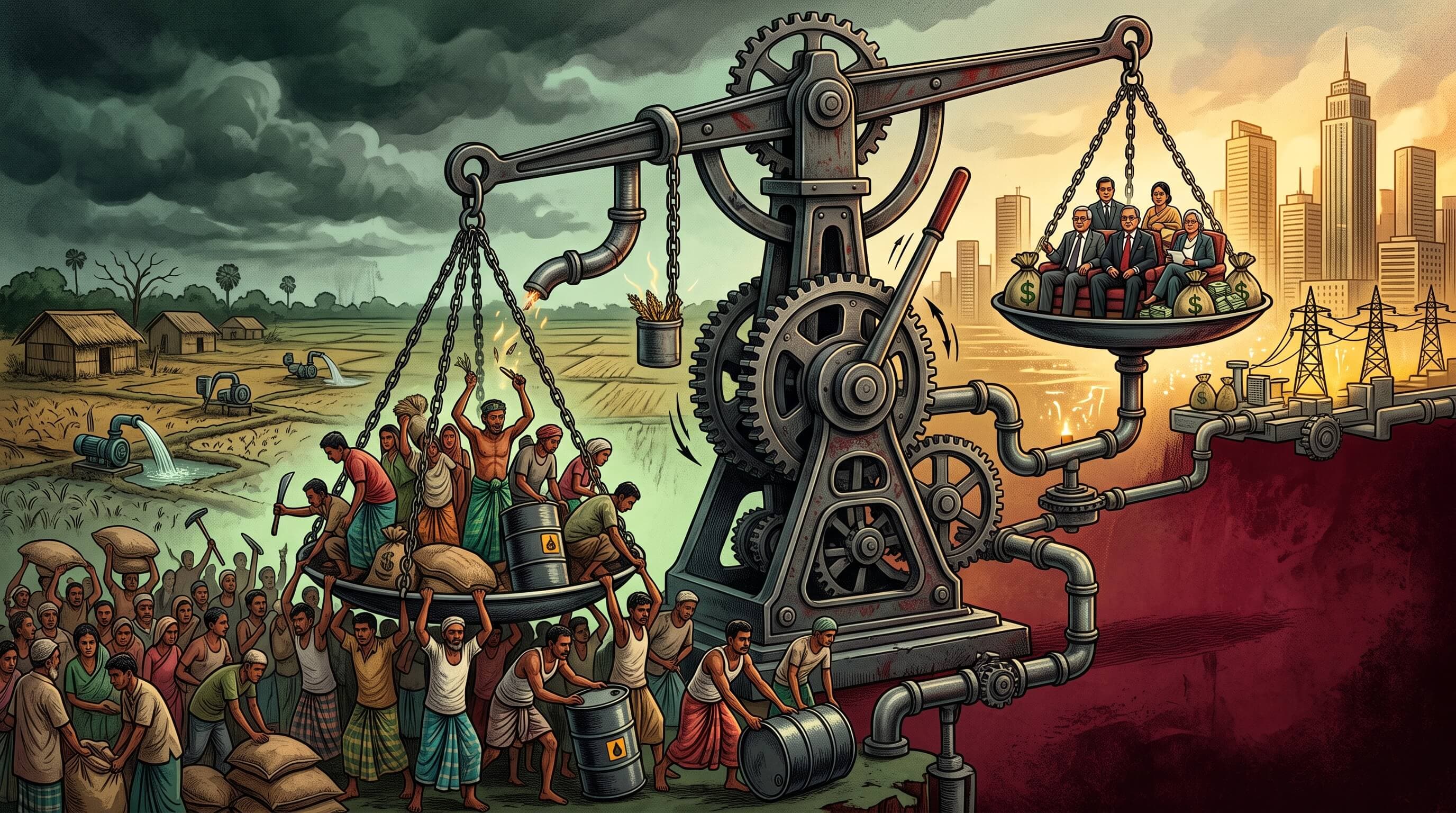
Bangladesh's Energy Crisis Is Not About Energy Alone—It Is About U.S. Control
An in-depth investigation into Bangladesh’s energy sovereignty, LNG terminal deals, rising generation costs, and actionable roadmaps for onshore gas revival.
Today, a country's sovereignty is not determined by borders alone. Foreign policy and trade policy are equally important. The ability to take a firm stance in one's own interest is fundamental to national sovereignty. Energy sovereignty is essential to Bangladesh's long-term security and stability.
The electricity generation and energy cost figures for August 13 in 2024, 2025 and 2026 provide a useful basis for comparison. On August 13, 2024, during the evening peak hour, total generation was 13,982 MW. Gas accounted for 5,777 MW (41.32%), coal 3,601 MW (25.76%), and oil 2,766 MW (19.78%). The remainder was met by imports from India and domestic renewable sources.
On August 13, 2025, total generation rose to 14,980 MW. Gas accounted for 5,644 MW (37.68%), coal 4,174 MW (27.86%), and oil 2,015 MW (13.45%). The balance came from imports, solar and hydropower.
On August 13, 2026, total generation reached 16,280 MW. Gas accounted for 5,930 MW (36.43%), coal 5,194 MW (31.90%), and oil 2,102 MW (12.91%). The remainder was met by imports and renewable sources.
Generation costs are also important. On August 13, 2024, per-unit costs were: gas Tk 2.99, coal Tk 6.90, and oil Tk 18.25. In 2025, gas rose to Tk 3.55, coal dropped to Tk 5.96, and oil stood at Tk 18.62. In 2026, gas cost Tk 3.59, coal Tk 6.73, and oil Tk 18.62.
The figures show that gas-based generation costs have increased. This is largely due to growing reliance on imported LNG. The per-unit cost of oil-based generation has not risen significantly; in fact, oil usage has gradually declined while coal usage has increased. In other words, no abnormal shift has occurred in the energy mix.
This summer, a gap of about 2,000 MW has opened up between demand and generation. Yet gas-based plants have generated more electricity than last year, and total generation has also increased—still, load-shedding continues. One reason is rising demand, which grows by roughly 10 percent annually on average. The government cannot meet all of this additional demand.
Demand pressure is highest during the evening peak hour—from 6 PM to midnight—largely due to widespread air conditioner use. Some blame battery-run rickshaws, but the figures tell a different story. After midnight, total demand falls below 12,000 MW.
The roughly 4,000 MW difference between evening and midnight load is largely attributable to air-conditioner use. Rickshaw charging typically begins after midnight, so they cannot be directly linked to peak-hour load-shedding. Rather, substandard non-inverter ACs imported from China are consuming excessive electricity.
Our distribution companies are struggling to cope with the additional load from these ACs. The government must immediately ban imports of these low-quality non-inverter ACs. If such imports are stopped, the evening-to-midnight summer load would become more manageable.
Addressing the crisis requires short-, medium- and long-term planning, additional generation capacity and greater national control over energy supply.
Bangladesh does not face a major shortage of energy resources. Over the past three years, domestic gas production and imports have remained at roughly the same level. Much of the confusion has centred on the two floating LNG terminals offshore.
The government says that adverse weather has prevented Summit's terminal from supplying LNG, and that the Excelerate-operated terminal stopped supplying after a fire. In 2018, Summit was given a lease for one terminal. However, Summit chartered the vessel from U.S. company Excelerate and also contracted Excelerate to operate it. The other terminal is also operated by Excelerate. Petrobangla pays the charter fees for both.
Recently, an LNG carrier was turned away from Summit's terminal on the grounds that it could not berth there—even though the same model of vessel had previously offloaded LNG at that terminal. During the summer peak, when electricity demand is highest, both terminals have halted supply. Both are linked to Excelerate. This raises a broader question about the role of foreign companies in Bangladesh's energy security.
Excelerate's Country Head is Peter Haas, a former U.S. ambassador. He resigned on September 24, 2024, and joined Excelerate just four days later. This also raises questions about whether U.S. "cooling-off" rules were violated.
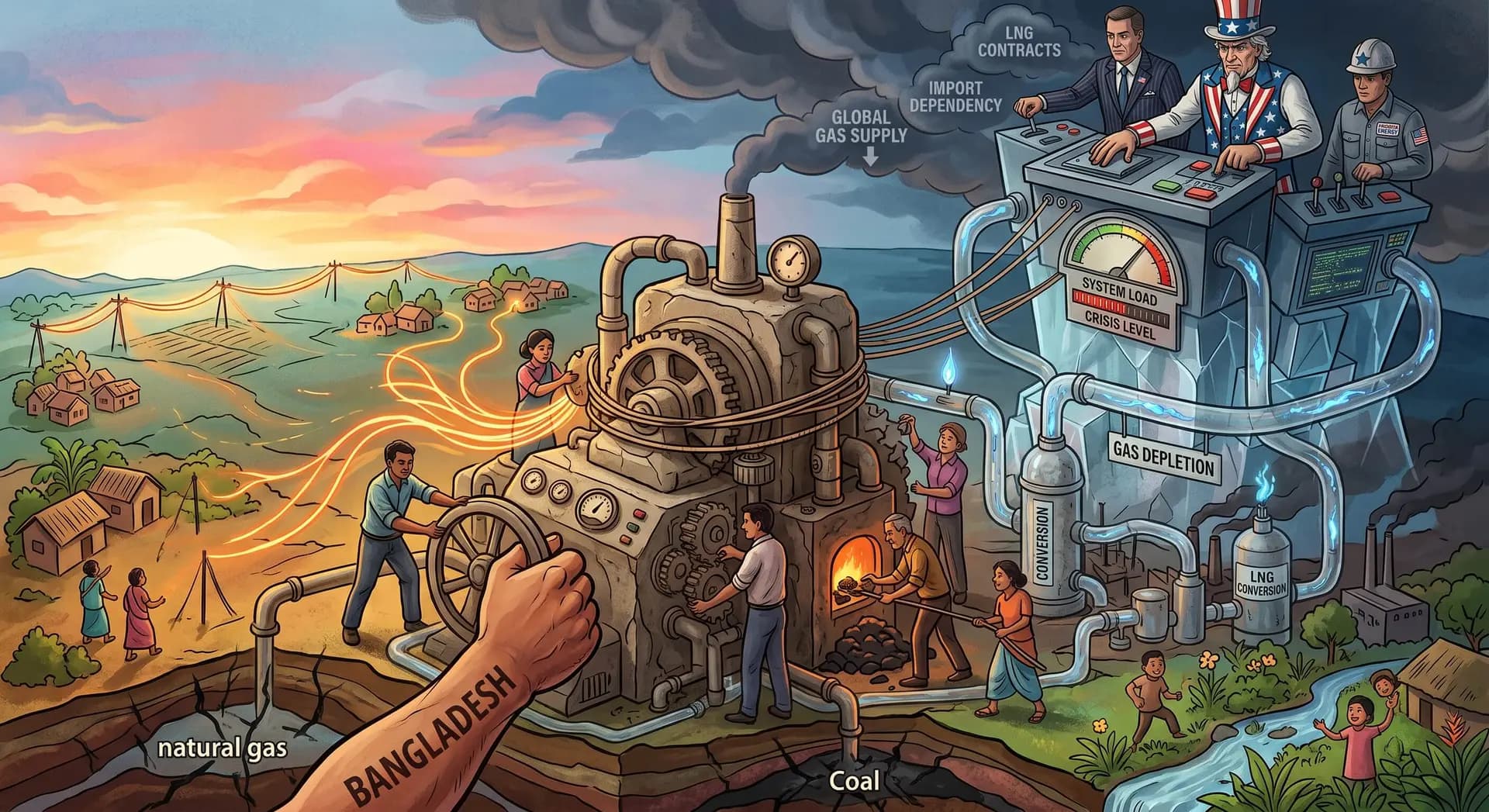
Bangladesh's energy sector is becoming increasingly dependent on the United States. Recently, Bangladesh initiated a 13-year LNG import deal worth about $4 billion (approximately Tk 47,000 crore) with U.S. private firm Gunvor US. This could pose economic risks. Existing law provides for government-to-government (G2G) agreements, but a private U.S. company is being given a role normally associated with government-to-government arrangements through a long-term deal without an open tender. This raises transparency concerns.
The financial structure of the deal is also worrying. Gas from Qatar or Oman is priced against stable oil benchmarks. Gunvor's pricing, however, is tied to the Japan-Korea Marker (JKM), a volatile index. Sharp changes in international markets could cause the gas price to rise quickly. Any major increase in the dollar-denominated price would impose long-term financial strain on Bangladesh. LNG from Qatar or Oman takes a few days to arrive; from the United States, it takes about 40 to 45 days. Longer transport routes increase shipping and insurance costs. There is also a "take-or-pay" clause, which may require Bangladesh to pay for the contracted LNG volume even if market prices fall. This could create significant financial pressure in the future.
Both of Bangladesh's LNG terminals are operated by a U.S. company. Supply from these terminals has been disrupted recently. At the same time, the government is pursuing long-term LNG purchases from the same country. There is a real risk of dependence on the same foreign interests for both supply and procurement.
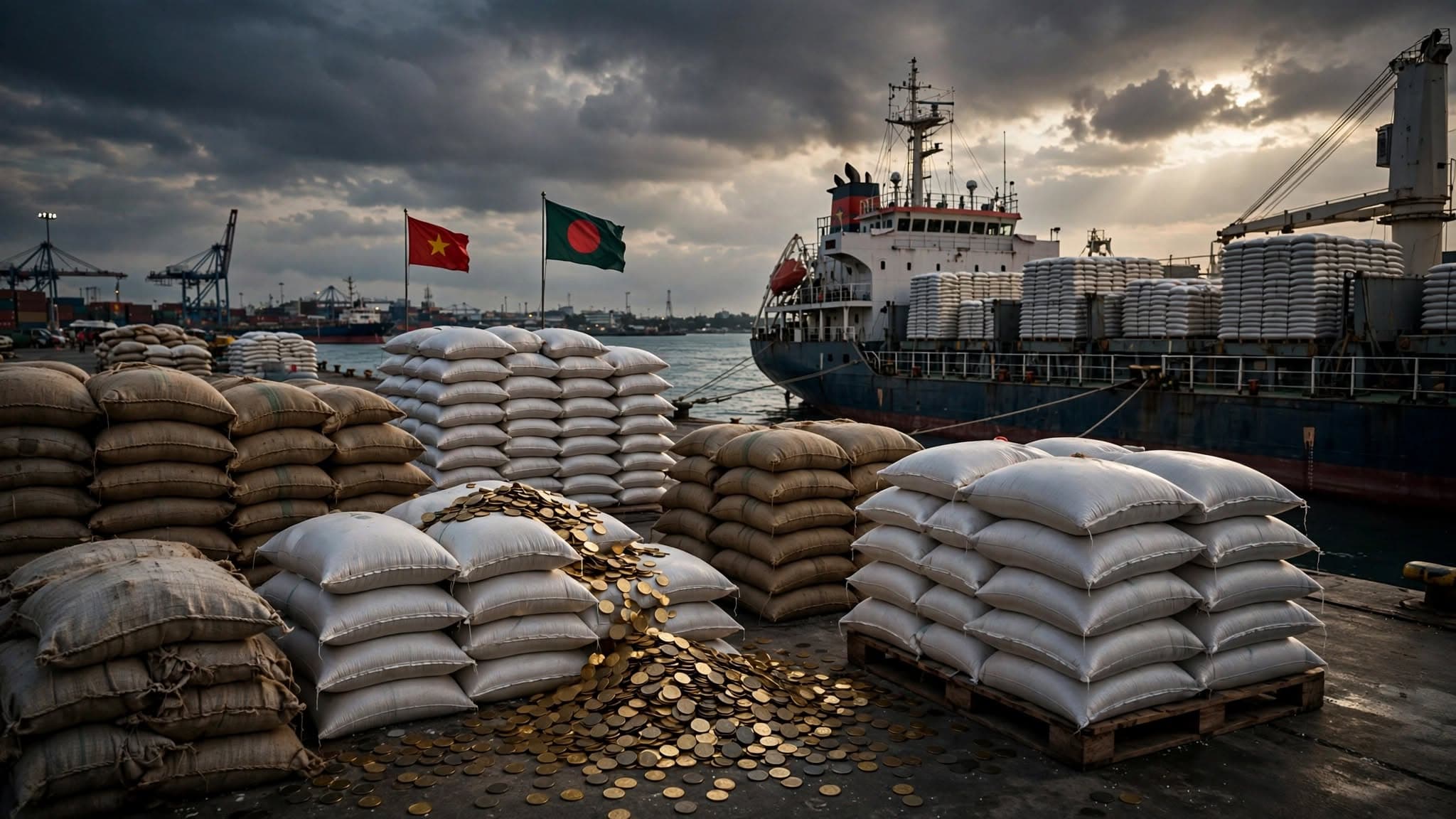
Bangladesh faced similar supply problems in food imports from the United States after independence. That history is another reason to diversify energy sources and supply systems.
We propose an alternative. Petrobangla could lease an older LNG vessel for five years in the short term, potentially at a lower cost. The two current floating terminals are about 20 years old. The vessel could be placed in the sea near Matarbari, with necessary skilled crew hired from various countries. In emergencies, it would serve as an alternative LNG supply source. In normal times, it could operate at 25 to 30 percent capacity. This would allow rapid supply increases during major crises.
Many countries convert LNG carriers into floating terminals. Bangladesh could consider such an arrangement. This would reduce dependence on any single foreign company and increase domestic backup supply capacity in emergencies.
But an alternative floating terminal alone will not be enough. Domestic gas production must also be increased. If domestic production rises, the crisis will ease significantly in the long term. Import dependence will decrease, and the impact of international price fluctuations will also be reduced.
Currently, Summit and Excelerate are being paid about Tk 2,000 to Tk 2,200 crore per year in charter fees. With that amount, even the purchase of an older LNG vessel could be considered.
The central question of energy security is not just how many megawatts are being generated. It is about how much control the country has over energy sources, supply and pricing. To ensure energy sovereignty, domestic production must be increased alongside imports. Multiple supply sources must be maintained. Emergency backup systems must be in place. The financial risks of long-term contracts must be rigorously assessed.
If we see the current crisis simply as an energy shortage, the real issue remains hidden. Electricity generation has increased. Gas-based generation has also increased. Oil-based generation has declined. Coal-based generation has risen. But peak-hour demand has grown even faster. At the same time, dependence on specific foreign companies has been built into the LNG supply system. Bangladesh's real challenge is not finding energy—it is establishing control over energy. Without energy sovereignty, national sovereignty itself remains incomplete.
The Rooppur Crisis and Sovereignty
Rooppur Nuclear Power Plant is expected to supply 1,200 MW to the grid. Despite this huge potential, grid integration is facing problems. A major reason is international sanctions. After the Ukraine war, sanctions on Russia were tightened, severely disrupting international banking transactions. This has affected repayment of Russian loans and other payments for the Rooppur project. Restrictions on dollar-based transactions have made it difficult for Bangladesh to complete payments related to the project and bring this low-cost nuclear power to the grid.
Even as an independent country, Bangladesh cannot fully take independent decisions on its energy interests due to the sanctions regime of a superpower. The Rooppur experience shows that generation capacity alone does not guarantee energy sovereignty. The ability to make effective decisions about payment routes, technology, supply chains and trade arrangements is the true foundation of energy sovereignty.
Short-Term Plan
Bangladesh's territory holds significant undiscovered gas potential. Various studies suggest there may be 32 to 42 trillion cubic feet (TCF) of undiscovered gas onshore. If this gas is found, Bangladesh could secure long-term energy security.
Several U.S. and Norwegian geological institutions have reported this potential in their studies. In Sylhet's Bibiyana area, there are large gas reserves. Chevron has extracted most of the field's gas, leaving about three-quarters of a TCF. Chevron has recently been given permission to explore a new area, where there is potential for gas.
Older gas field Titas also has new potential. It is thought that about 5 TCF of gas may still remain there. French company Schlumberger conducted a study on the potential of older gas fields. According to them, with modern rehabilitation, production could be increased within one year. This could add 600 MMCFD.
In other words, even without waiting for new discoveries, production from existing fields can be increased. Modernising existing infrastructure could reduce import dependence in the short term.
Norwegian multinational company Statoil, now Equinor, conducted a joint study with the Military Institute of Science and Technology, with government funding. The study found that there is significant recoverable gas in 30 currently shut-in wells. From these wells alone, at least 1,000 MMCFD could be obtained, according to the study.
To address the gas crisis, alongside building new import infrastructure, older wells can be reactivated. This would take less time and could also be more cost-effective.
In Sunetra, one well was drilled but no gas was found, so no further wells were drilled. Experts believe there is still gas potential in Sunetra, and at least 9 to 10 wells should be drilled there. In Cumilla's Bangura, five wells were drilled, of which one is closed; the other four are producing, but their output has declined sharply. In the same geological formation, just two kilometres from Bangladesh's border, ONGC has drilled nearly 100 wells. India uses gas from this field to generate electricity at the Palatana power plant, from which Bangladesh imports 110 MW. No government has made a serious effort to extract gas from Bangladesh's side of Bangura. At least 10 wells must be drilled urgently.
Medium-Term Plan : Mountains and Plains Hold Vast Potential
The three hill districts have significant gas potential. Khagrachhari's Kachalong is one example. U.S. company United Meridian had almost completed drilling preparations there. The well site had also been identified. Later, the company pulled out of Asia, and the work stopped. According to Petrobangla geologists, there is gas potential in Kachalong. Exploration should begin there quickly.
About 98 percent of the gas discovered in Bangladesh has been found in the Sylhet region. Geologically, this area is part of the Surma Basin's upper anticline. Most of the gas in this structure has already been extracted. Some therefore say there is no more gas in the country. But the country's geologists do not agree.
They say there are "deltaic stratigraphic structures" across the country's vast plains. From greater Barishal to Khulna, it extends up to North Bengal. The gas found in Pabna's Mobarakpur and in Bhola is related to this geological formation. Exploring along this structure could lead to the discovery of large gas fields. Bapex has already completed 3D seismic surveys of this area. Drilling is now needed in promising locations.
A practical example is India's Ichhapur, about 100 kilometres from Pabna's Mobarakpur structure. There, ONGC has drilled wells and found gas and oil. According to the U.S. Geological Survey, there is potential for up to 6.5 TCF of gas in the Pabna-Khulna belt.
The previous government had a programme to drill 50 wells by 2025 (exploration, development and workover combined). After August 5, this plan was halted. The plan must be urgently revived. If implemented, about 64.8 million cubic feet of gas per day could be added to the national grid.
The priority now is to move quickly from identifying geological potential to drilling and production. Bhola's gas can be an important medium-term solution. An estimated 8 TCF of gas is believed to be there. To use this gas, a gas pipeline could be built from Bhola to Khulna. If the pipeline is installed, it would be possible to build at least 800 MW of power generation capacity in Khulna. It could also revive the struggling industries there.
A Khulna-Bheramara transmission line already exists. Through this line, gas could be supplied directly to the large power plants in Bheramara and Sirajganj. This would reduce pressure on the Dhaka-centred transmission system for gas supply to power plants. It would also create an alternative gas supply system for industry and power generation in the western and south-western regions.
Separately, the previous government had planned to drill 100 wells. Under this, 69 new exploration and development wells and 31 workover wells were to be completed by 2028. According to the plan, 69 new wells could produce about 98.5 MMCFD. The 31 workover wells could sustain another 40 million cubic feet per day. This programme must be revived.
Over the past 50 years, only 104 wells have been drilled for oil and gas in Bangladesh. That means exploration has been very limited. Despite a record of discovering one gas field per 4.25 exploration wells, only 26 wells have been drilled in the last 20 years. By contrast, the much smaller Indian state of Tripura has drilled more than 150 exploration wells. The figures point to serious neglect of oil and gas exploration in Bangladesh.
Long-Term Plan: Gas Must Come from the Sea
Bangladesh's maritime boundary saw its first gas discovery in 1977 at Kutubdia, but it was not extracted due to low reserves. After gas was discovered at Sangu in 1996, extraction also began from shallow sea areas. Later, wells were drilled at Sonadia, South Sangu and Magnama, but no gas was found. Not a single exploration well has ever been drilled in Bangladesh's vast deep sea.
At one point, U.S. company ConocoPhillips was given a contract to explore in the deep sea. The company claimed it had found about 5 TCF of gas there. The contract set the price at $4.02 per thousand cubic feet. But the company demanded $7. As they could not agree on price, they left. Although there were objections to raising domestic gas prices, Bangladesh later bought LNG in long-term contracts at prices above $12, and spot market prices even rose to $37.
Despite pricing concerns, Bangladesh has had to import energy at much higher prices than it could have developed its own offshore resources. Failure to explore these offshore resources means losing an opportunity while increasing dependence on imports. Across the sea, Myanmar has discovered large gas fields and is producing. In Bangladesh, foreign companies have left exploration blocks for various reasons. A strong initiative is needed now for oil and gas exploration in the sea.
Deep sea exploration is a long-term task. It requires both time and investment. But if exploration is not started, the foundation for future energy security will not be built. Along with onshore areas, the deep sea must be placed at the top of the national energy exploration agenda.
Stop Gas Theft Disguised as 'System Loss'
In gas distribution, a term often heard is "system loss." Yet in many gas supply systems around the world, "system gain" of 2 to 3 percent can be seen—minor measurement differences. In Bangladesh, Titas alone shows about 7.67 percent "system loss." A large portion of this loss is believed to be gas theft. If this theft can be stopped, that gas could keep an 800 MW gas-fired power plant running year-round. At the JKM price in the Gunvor contract, the recovered gas would be worth roughly $1 billion, or could instead provide fuel for an 800 MW plant. Stopping theft is relatively straightforward. The question now is how serious the government is about doing it.
Technical monitoring, metering systems and accountability at every stage of supply must be improved. If there is an abnormal gap between gas produced and gas delivered to consumers, the cause must be identified. On one hand, enormous funds will be spent on new exploration; on the other, a significant portion of produced gas is being lost—such a system cannot be sustainable.
Solar Power in Six Months
In 2016, during the Chinese President's visit to Bangladesh, major investment initiatives in solar power were taken. A 50-50 Bangladeshi-Chinese joint venture, Bangladesh-China Renewable Energy Limited, was formed with a plan to generate 3,000 MW of solar power. Work had progressed to some extent. The interim government is reported to have cancelled this solar power deal, despite keeping other deals in place.
As a result, Bangladesh has lost the opportunity to get about 1,500 MW of low-cost daytime electricity, with an estimated market value of about $4 billion (approximately Tk 42,000 crore). If the government wishes, it can revoke the cancellation letter, allowing the project to resume. That would unlock about $4 billion (approximately Tk 40,000 crore) in Chinese investment.
Large solar plants can be built quickly. Kaptai Lake covers about 750 square kilometres. Using less than 1 percent of that area, a large floating solar project could be built. About 1,200 acres could generate 600 MW of power. The World Bank had shown interest in such a project. Payra Port Authority has about 1,000 acres of unused land, where 500 MW of solar power could be generated. The two banks of the Padma Bridge could also produce another 400 MW. A major advantage of these projects is that they require no gas or LNG imports.
If daytime solar generation is increased, pressure on gas-based plants can be reduced. At the same time, additional power in the system before evening could help manage peak-hour pressure. Battery storage and grid management improvements must be added over time. These projects can be implemented quickly. With China or suitable foreign investors, significant progress is possible within six months.
Gas Reallocation: From Captive to Combined Cycle
Due to gas shortages, about 3,800 MW of combined-cycle power plant capacity—with about 55 percent efficiency—is idle. At the same time, gas is being supplied to less efficient captive plants with about 30 percent efficiency and low plant factors. This means the same amount of gas produces much less electricity. In FY 2024–25, if the gas supplied to captive plants had been directed to combined-cycle plants, gas-based generation could have increased by about 40 percent. Captive plants waste the equivalent of at least 450,000 tons of LNG annually.
At current market prices, this is worth over $500 million (more than Tk 6,000 crore). There are also allegations that captive generators receive low-pressure gas, further reducing their plant factor. In this situation, gas use priorities must be redefined. More efficient plants should be prioritised. Factories can be given reliable grid power instead. The gas they use could be redirected to combined-cycle plants. This would produce more electricity from the same gas and reduce per-unit costs below Tk 2.
Restore Nepal's 500 MW Deal
Construction of Nepal's Upper Karnali hydropower plant is nearing completion. The Power Development Board signed a deal to import 500 MW from this plant. Under the deal, the electricity price was 7.5 cents per unit, with no planned future increase. Even with 0.25 cents for transmission, total costs would remain relatively low. This could have brought long-term stability to Bangladesh's electricity supply, providing low-cost power similar to imports from India. But the interim government cancelled the power purchase agreement with the developer (GMR).
The cancellation should be withdrawn and the deal renewed. This would secure low-cost supply for 20 years or more, creating a stable foundation for the grid. Bangladesh's electricity demand peaks in summer, when Nepal's hydropower is abundant. In winter, when Bangladesh's demand is lower, Nepal's generation also declines.
At that time, Bangladesh could supply surplus electricity to Nepal through the same transmission system, reducing idle capacity. The two countries' power systems could complement each other. Bangladesh should also invest in Bhutan's hydropower projects. This would increase access to low-cost power and strengthen the energy mix and energy security. Expanding regional electricity trade could be a key strategy for Bangladesh in the long term.
Single Point Mooring (SPM) Should Be Commissioned Quickly
Currently, refined and crude oil from large ships is transferred to smaller lighters and brought to Chittagong port, then sent via pipeline to Eastern Refinery. This system involves lighter vessel costs, carries theft risks, and adds time and operational expenses through ship-to-ship transfers. To reduce these problems, a project for direct discharge from mother vessels was undertaken and has been completed. Under this system, oil goes directly from the mother vessel through subsea pipelines to Matarbari storage tanks, and from there through pipelines to the Chittagong refinery and Dhaka.
This system is called Single Point Mooring (SPM). The project was piloted in 2023 but has not yet been commercially commissioned. It should be brought into commercial operation quickly. This would significantly reduce oil-handling costs and also lower the risk of theft. With SPM operational, dependence on lighters would decrease. Discharge time and operational costs would fall, while security risks would be reduced.
The issue ultimately comes down to whether Bangladesh can make its own energy decisions—from bringing Rooppur's power to the grid to managing every cubic foot of gas and every shipment of oil. Energy sovereignty will depend not on political declarations, but on concrete control over energy policy, supply and infrastructure.