State Tools for Reducing Disparity Now Work in Reverse

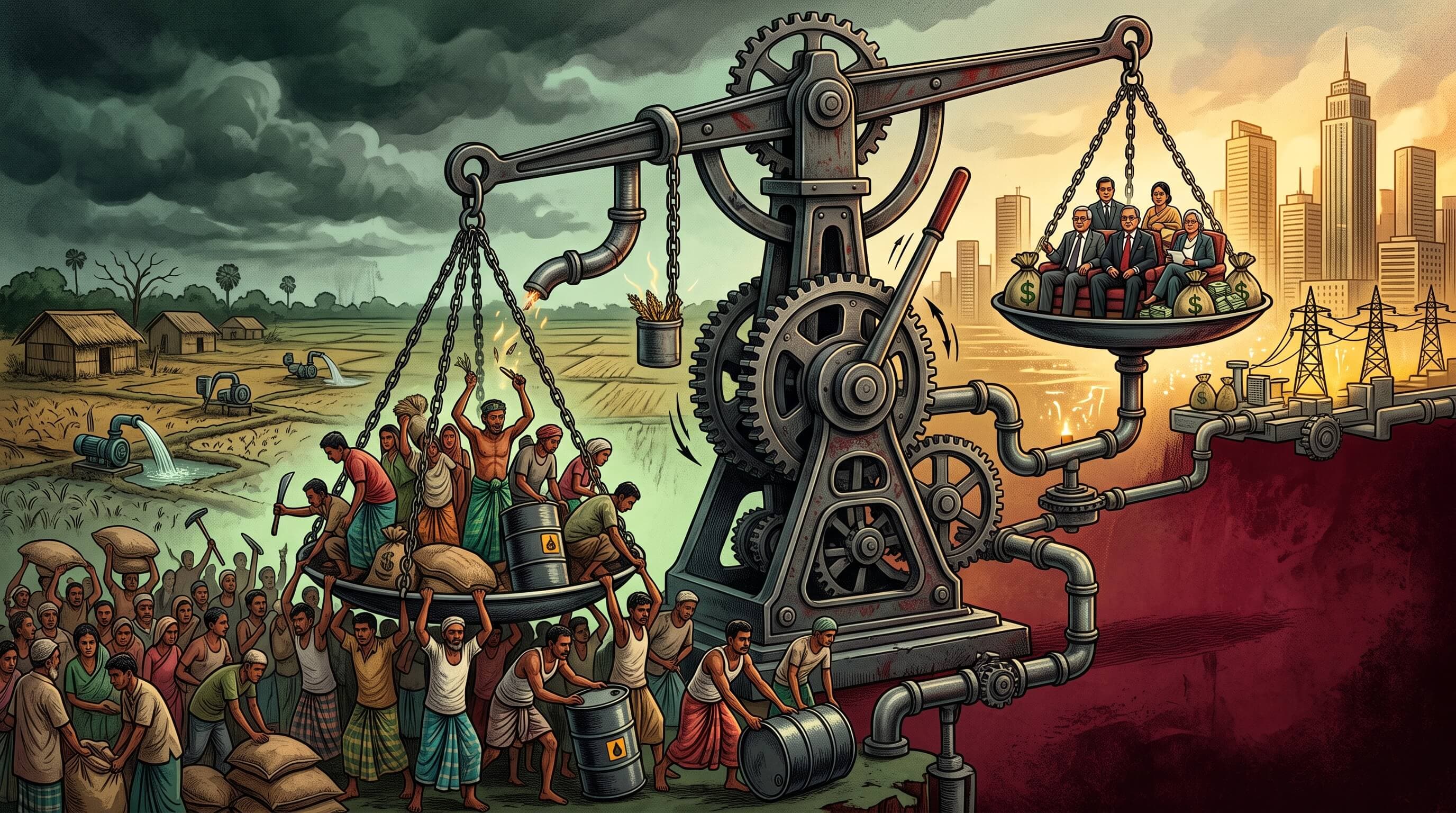
Higher energy prices raise production and household costs across the economy. The new public sector pay scale provides substantial income increases to a relatively small section of the workforce, while informal workers, farmers, and daily wage earners receive no comparable increase in income.
Major policy decisions by the government in Bangladesh increasingly work against the interests of ordinary citizens. The gap between rich and poor, as well as between urban and rural life, continues to widen. In major areas of state intervention—energy, agriculture and public sector compensation—the benefits and burdens are increasingly unevenly distributed.
Yet the state is constitutionally required to address such disparities. Article 16 of the Fundamental Principles of State Policy states:
“The State shall adopt effective measures to bring about a radical transformation in the rural areas through the promotion of an agricultural revolution, the provision of rural electrification, the development of cottage and other industries, and the improvement of education, communications and public health, in those areas, so as progressively to remove the disparity in the standards of living between the urban and the rural areas.”
A closer look at recent policies shows how some of these state interventions are placing a disproportionate burden on working people.
Fuel and Power Price Hikes: A Direct Hit on Low-Income Communities
Between April and September 2026, the government raised diesel prices in three phases, resulting in a cumulative increase of nearly 35 percent over seven months. Diesel powers roughly 80 percent of irrigation pumps and fuels almost all freight transport on roads and inland waterways.
The remaining 20 percent of irrigation depends on electricity. Agricultural power tariffs were increased by 15 percent, effective June 1. At the same time, electricity tariffs for lower-middle-income households and auto-rickshaw charging stations were raised by 18 percent.
These increases came at a time when ordinary citizens were already struggling with high inflation. Higher fuel and electricity costs feed into transport, farming and production costs, ultimately raising the prices of essential goods and putting further pressure on household purchasing power.
Government Pay Scale: Benefits for 2%, Pressure on the Remaining 98%
On September 19, 2026, the government gazetted the National Pay Scale 2026, with retrospective effect from July 1. Under the new structure, basic pay rises by 100 percent for Grades 1 through 10, taking the Grade 1 basic salary to Tk 156,000, and by up to 142 percent for Grades 11 through 20, with the minimum Grade 20 basic salary set at Tk 20,000.
Civilian and military government employees together number about 2.4 million, with another 925,000 pensioners.
In a national workforce of more than 70 million, government employees account for less than 2 percent of total employment. Full implementation of the pay scale is estimated to cost Tk 1,05,580 crore over three years, while the initial basic pay adjustment alone will require Tk 37,372 crore in the current fiscal year.
To ease the immediate pressure on liquidity and inflation, the government has opted for a phased implementation. About 40–50 percent of the increase is to be implemented in 2026, followed by 70–75 percent in early 2027, with full implementation by July 2027.
Even with a phased rollout, however, the additional spending will add demand-side pressure to an economy already facing high inflation.
Public sector employees are receiving substantial salary increases, while informal workers and many private sector employees have no comparable wage adjustment or targeted price relief. The result is a wider gap between those receiving the pay-scale benefits and the much larger workforce that must absorb higher prices.
The Wage-Price Squeeze
For working families, the central problem is simple: wages are not rising as fast as prices.
In June 2026, headline inflation stood at 9.16 percent, while average national wage growth was 8.18 percent. The gap could widen further as recent fuel price increases and arrears under the new pay scale feed through the economy.
A recent World Bank report highlighted the same pressure on low-income workers, noting that wage growth has not kept pace with prices and has eroded purchasing power. In FY2025–26, average inflation was 8.68 percent, compared with wage growth of 8.11 percent—a gap of 0.57 percentage points. Real wage growth has lagged behind inflation for four consecutive years.
Agriculture: High Input Costs and Procurement Imbalances
The state intervenes in agriculture through fertilizer subsidies and public procurement of paddy and rice. Yet these interventions do not always translate into benefits for small and marginal farmers.
Taxpayer money finances large fertilizer subsidies, but farmers often pay more than the official retail price. Urea is officially priced at Tk 27 per kg, while reports indicate that farmers have paid as much as Tk 50 per kg on the open market. In Kurigram’s Nageshwari and Ulipur upazilas, farmers protested over alleged artificial shortages and irregularities involving fertilizer dealers.
The government also conducts annual procurement drives covering more than one million tonnes of husked rice and several hundred thousand tonnes of raw paddy. But two problems limit the direct benefit to farmers.
First, procurement targets and prices are often announced after small and medium farmers have already sold their crops to traders (beparis) or creditors (mohajons), often at prices below their production costs.
Second, direct paddy procurement accounts for only about 10 percent of the total procurement target, with roughly 90 percent sourced as husked rice directly from commercial millers. Official cost assessments also often underestimate the actual cost of production.
As a result, although the state spends around Tk 28,000 crore a year on agricultural subsidies, a significant share of the benefit can end up with intermediaries and large millers rather than the farmers who produce the crops or the consumers who buy them.
Disparity Is Growing
Higher energy prices raise production and household costs across the economy. The new public sector pay scale provides substantial income increases to a relatively small section of the workforce, while informal workers, farmers, and daily wage earners receive no comparable increase in income.
The result is a continuing squeeze on real wages for a large part of the population.
Article 16 of the Constitution directs the state to progressively reduce disparities in living standards between urban and rural populations. The recent pattern of policy interventions raises a different concern: measures intended to reduce economic pressure are, in some cases, adding to the burden on those with the least protection from rising prices.
.. ..
The writer is Joint Editor of Dhaka Papers.
Email: [email protected]