Tension grips garment hubs over Tk 30,000 wage demand; one worker dead in seven days
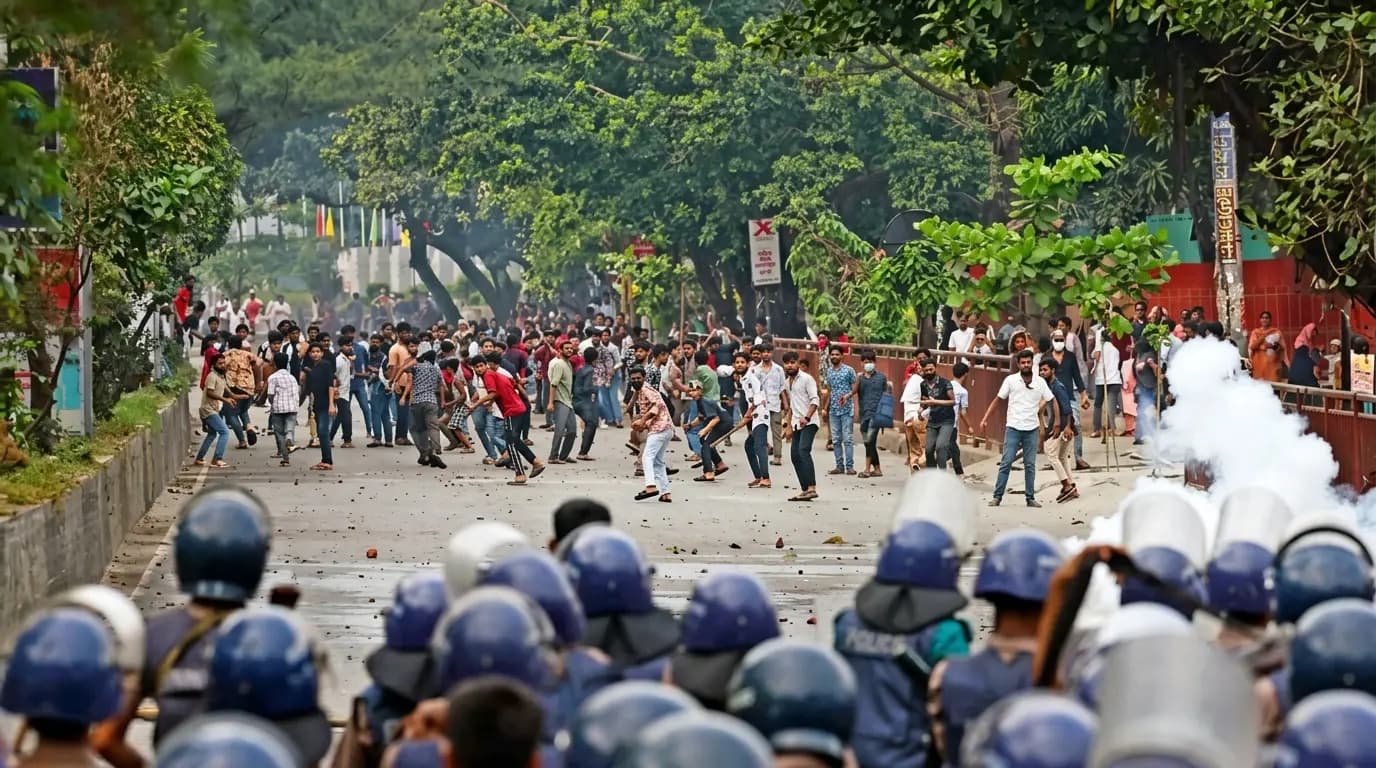
Photo: Collected
Bangladesh garment workers protest for a Tk 30,000 minimum wage for a seventh day. One worker dead, 100+ arrested; wage board says new pay from December.
Garment workers have been protesting on the streets for seven straight days over three demands, including a minimum monthly wage of Tk 30,000. The demonstrations began in Gazipur and have spread to four other industrial areas: Mirpur, Savar, Ashulia, and Narayanganj. Following its first meeting on Wednesday, the newly formed wage board assured workers that a revised pay structure would take effect in December. However, street tensions have not eased, as no specific wage figure was announced. One worker has died in clashes over the past few days. More than 100 people have been arrested, while cases have been filed against thousands of unidentified people.
Along with higher pay, the workers are demanding an end to blacklisting and the reinstatement of laid-off staff. The current minimum monthly wage for garment workers is Tk 12,500, last raised in 2023 from Tk 8,300. Workers say their main concern is the rising cost of living. Garment worker Abdul Hakim said house rents have already doubled, and landlords have hinted at raising rents by another Tk 500 to Tk 1,000.
Calm did not return to the industrial zones on Wednesday. Around 9:30 am, between 2,000 and 4,000 workers blocked the Dhaka-Mymensingh highway in Gazipur. They gathered at Signboard, Banglabazar, and Mirzapur. Police later fired tear gas to disperse the workers. Border Guard Bangladesh (BGB) troops have been deployed in Gazipur, Narayanganj, and nearby industrial areas to maintain order.
The broader unrest began in Gazipur, where workers in Konabari, Mouchak, and nearby areas had already been demonstrating for higher pay for nearly two weeks. On October 27, workers of Essential Clothing protested at the Mouchak intersection in Kaliakair and blocked the Dhaka-Tangail highway. Workers took to the streets in Dhaka’s Mirpur on Thursday, October 29. Work stoppages and demonstrations took place inside several Mirpur factories on Saturday, followed by three straight days of street blockades starting Sunday.
On Sunday, protests spread from the Mirpur 10 roundabout to Mirpur 11, Mirpur 12, and surrounding areas. Police and protesters clashed repeatedly over road blockades, during which vehicles were vandalized and set on fire. Authorities temporarily closed the Mirpur 10, Mirpur 11, and Pallabi metro stations around noon that day. On Tuesday, police used tear gas and sound grenades in Mirpur. A police officer was also brutally beaten after protesters found him alone on Kalshi Road. In Gazipur, thousands of workers blocked highways at Chandra, Palli Bidyut, Shafipur, Mouchak, Konabari, Naojor, and Bhogra Bypass on Monday and Tuesday, triggering heavy clashes with police.
Toufiq Sheikh, a garment worker injured in an attack during the Gazipur protests, died while undergoing treatment. His body reached his village home in Gobindaganj, Gaibandha, on Tuesday night. The Daily Ittefaq reported that he was attacked while recording a video of the protests. Police and labor leaders have blamed each other for the assault. Separate clashes in Gazipur, Ashulia, and Narayanganj have left several hundred people injured, including workers, police, BGB personnel, and journalists. Police say more than 100 of their officers have been injured since the unrest began; up to the evening of November 2, police had put the number of injured officers at over 58.
Several cases have been filed in Dhaka and Gazipur over vandalism and clashes. Five cases were filed at police stations under the DMP’s Mirpur division over the weekend violence. A bdnews24.com report put the arrest tally at 29 by Monday noon. Another report the same day quoted police as saying 60 people had been arrested in those cases in the previous 24 hours. Sixteen more were arrested in Mirpur on Tuesday, though police did not disclose their identities. Courts have sent 26 people to jail in connection with three cases. In Gazipur, three cases were filed over arson and vandalism.
Media reports say around 4,000 unidentified people have been accused in the cases. Industrial Police-2 Superintendent Amjad Hossain said at least 30 people have been arrested there. In Chattogram, the metropolitan president of Biplobi Chhatra-Jubo Andolan was arrested on Wednesday while putting up posters in support of the workers. Although no official total has been released, media tallies show more than 100 arrests so far.
Labor and Employment Minister Ariful Haque Choudhury announced a six-member wage board on November 1 amid the protests. He said forming a new wage board was one of the workers’ main demands, and the government, BGMEA, and BKMEA had agreed to it. He also urged protesting workers to return to the factories. Factory owners had also called for the board to meet quickly. BGMEA President Mahmud Hasan Khan said they had requested an early meeting of the board.
The wage board announced after Wednesday’s meeting that the new pay structure would take effect in December. Babul Akhter, the workers’ representative on the board, said they had proposed at the meeting that the new wages be implemented by December and noted progress in the talks. However, the new wage amount has not been set yet.
Asked about the meeting, politician and labor leader Moshrefa Mishu said, “We welcome the fact that the first meeting was held within four days of the wage board’s formation. However, the new pay structure the board announces must reflect the workers’ expectations. We know the workers are demanding a minimum monthly wage of Tk 30,000. Workers will not accept any delay in meeting this demand. Our clear call to the government, especially the wage board, is to declare Tk 30,000 as the minimum wage. Otherwise, workers will return to the streets.”
Labor unions are not leading the current protests. In many areas, workers are walking out after seeing demonstrations at neighboring factories. Sadekur Rahman Shamim, general secretary of the Garment Workers’ Trade Union Centre, backed the demand for a Tk 30,000 minimum monthly wage but said unions are not leading the movement.
Pro-government labor leaders Taslima Akhter and Nazma Akter alleged that the banned Awami League is trying to divert the protests. Jamaat-e-Islami chief Shafiqur Rahman said conspirators were stoking the situation in the workers’ movement to destroy the garment industry and urged the government to crack down hard on the protests. The Democratic Rights Committee condemned police repression during the unrest and expressed solidarity with the workers’ demands.
Your contribution keeps investigative journalism fearless, transparent, and accessible to everyone. To support us securely donate from anywhere.