Police block Biplobi Parishad’s siege of Indian High Commission demanding Dinesh Trivedi’s expulsion
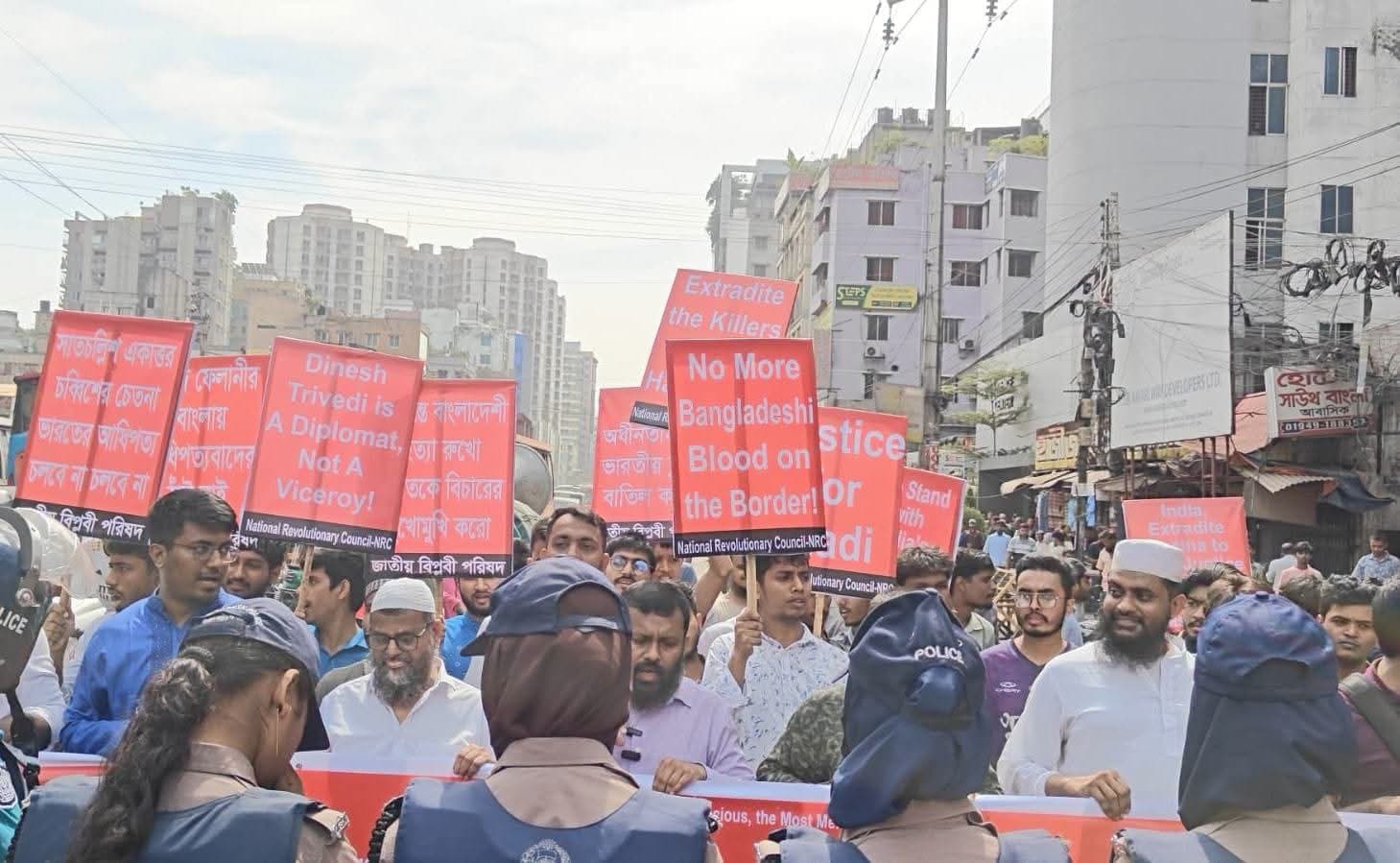
Police stopped the Jatiya Biplobi Parishad from besieging the Indian High Commission over its demand to expel High Commissioner Dinesh Trivedi. The organisation has announced an "Oust India" movement and a boycott of Indian products from December 17 if its demands are not met.
Leaders and activists of the Jatiya Biplobi Parishad (National Revolutionary Council) were stopped by police while trying to besiege the Indian High Commission in Dhaka to demand the expulsion of Indian High Commissioner Dinesh Trivedi. The organisation then gave the government an ultimatum until December 16. If its demands are not met by then, it said, it will launch a nationwide “Oust India” movement from December 17.
Police halted the organisation’s procession with barbed-wire barricades on Progoti Sarani at Bashtola in the capital’s Shahjadpur around 11:45 am on Thursday (October 29).
From the morning, the council’s leaders and activists had gathered in front of Confidence Centre next to the Shahjadpur bus stand. Around 11:30 am, they set off in a procession towards the Indian High Commission in Gulshan. When police barricaded the road at Bashtola, they took position on the main road and chanted slogans including “People, resist India’s dominance", “No place for Trivedi in Felani’s Bengal", “Trivedi must be expelled", “We will besiege the High Commission", and “Delhi or Dhaka? Dhaka, Dhaka.”
At one point, the activists tried to push past the barricade towards the road leading to the High Commission, but police stopped them from going any further. They then held a rally at the spot, leaving one side of the road open for traffic.
Addressing the rally, the council’s convener, Khomeini Ihsan, said they had come to besiege the High Commission in protest against the killing of Bangladeshis at the border, the withdrawal of water from shared rivers, including the Teesta, exploitation through unequal and subordinating agreements, and India’s refusal to extradite Sheikh Hasina for the July massacre. But police did not let them reach the High Commission, he said.
He said that within the ultimatum, High Commissioner Dinesh Trivedi must be expelled, Sheikh Hasina must be returned, border killings must stop, unequal agreements must be cancelled, and Bangladesh’s fair share of water must be ensured. Otherwise, Indian products will be boycotted across the country from December 17 as part of the “Oust India” movement.
Khomeini Ihsan alleged that, along with border killings and the withdrawal of river water, India regularly kills those who oppose its hegemony and that the country has become “a shelter for the killers of Bangladesh’s patriots.” In this context, he mentioned the presence in India of Major Mozaffar, accused in the killing of Ziaur Rahman; Bappaditya Basu, accused over the events of October 28, 2006; and those accused in the killing of Osman Hadi. He said Sheikh Hasina is also making threats from India, while bodies of July fighters are falling at home.
He claimed that the body of K M Tahsif Sauri, a former Air Force officer who had filmed Sheikh Hasina’s departure from the country on August 5, was found in the Turag River on Wednesday, and that many others are being threatened with death.
Khomeini Ihsan said everyone had hoped India’s behaviour would change after August 5. But India has still not expressed regret to the people of Bangladesh or at the graves of the July martyrs. Instead, he alleged, BJP leader Dinesh Trivedi has come as high commissioner and is behaving “like a viceroy.”
Criticising the BNP government, he said that although there were hopes that Indian hegemony would end after the July revolution, the situation has instead worsened. He alleged that the government is giving India transit through Japan by using the Matarbari deep-sea port, that metro rail costs are being doubled through JICA to give work to Indian companies, and that Japan is drawing Bangladesh, alongside India, into an anti-China struggle in the name of the BIG-B plan.
Addressing the government, he said, “Stop turning Bangladesh into India’s vassal state and a playground for great powers.” He also called on China and the Muslim world to come forward with investment and grants to protect Bangladesh’s sovereignty.
viceroy".
Also present at the programme were eye specialist Dr Farid Uddin, the council’s member secretary Dr Nabil Ahmad, assistant member secretaries Abdus Salam and Galib Ihsan, central members Sakib Samin, Saidul Islam, and Joynul Abedin, Biplobi Chhatra Parishad convener Abdul Wahed, and its assistant member secretary Ariful Islam, among others.
Your contribution keeps investigative journalism fearless, transparent, and accessible to everyone. To support us securely donate from anywhere.