The Price of a Boeing: One Year’s Labour of 123,000 Migrant Workers

Twenty-five aircraft cost Tk 75,500 crore. For a country whose fortunes now rest on money sent home by cooks, masons, and domestic workers abroad, the ledger needs to be read with its workers in mind.
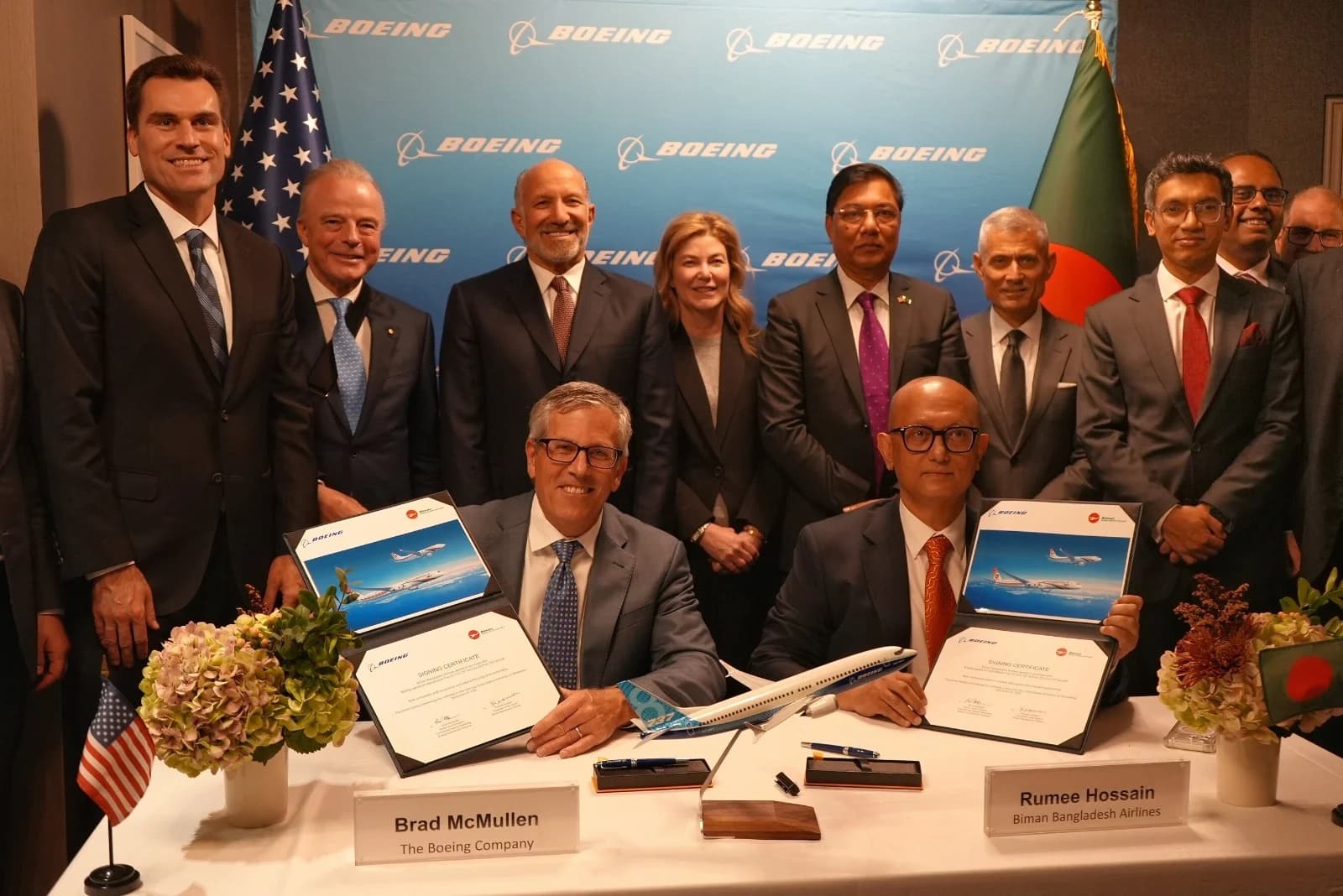
A document was signed in New York on 23 September, on the sidelines of the 81st session of the UN General Assembly. Biman Bangladesh Airlines’ chairman signed for one side, a senior Boeing official for the other. There was applause, a photograph, a statement: Biman Bangladesh is buying 11 more Boeing aircraft — five 787-10 Dreamliners and six 737-8s.
Add these to the 14 aircraft agreed in April, and the national flag carrier has now committed to 25 Boeing planes.
The April contract put the list price of those 14 aircraft at about $3.7 billion, with delivery between November 2031 and October 2035. The United States Export-Import Bank is financing the purchase. The price, financing and delivery schedule for the 11 aircraft signed for in September have not been disclosed.
At the average unit price of the April deal, those 11 would be worth roughly $2.4 billion. That puts the total list price of the 25 aircraft at about $6.1 billion — some Tk 74,700 crore at Tk 122 to the dollar. Private carrier US-Bangla has announced plans to buy 21 Boeing aircraft for $1.5 billion. A proposal to buy 10 planes from Airbus is also pending.
There are two plain reasons for buying new aircraft. The first is the state of the fleet. Biman Bangladesh’s 19 aircraft are carrying the weight of their age, and new long-haul routes need planes. Without this purchase, the fleet would slowly become unusable.
The second reason is diplomatic. Dhaka has used the Boeing order as leverage both to narrow its roughly $6 billion trade deficit with the United States and to ease the pressure of 37 percent tariffs. Seen that way, this is not simply an aircraft purchase; it is a state-level commercial bargain struck in exchange for tariff relief.
Where does the money come from? Between March and August 2026, $18.94 billion entered the country. Saudi Arabia alone sent $2.94 billion, the United Arab Emirates $1.72 billion and Malaysia $1.49 billion. The top five countries together accounted for about 60.7 percent of all remittances. Bangladeshis in those countries work mainly in construction, transport and domestic service. The bulk of the remittances buying Dreamliners for the national flag carrier comes from a worker standing on the roof of a 20- or 25-storey building in the Gulf — a man whose own home still lacks a proper roof.
The remittance ledger
In the 2025-26 fiscal year, remittances hit a record $35.56 billion, according to provisional Bangladesh Bank figures — 17.3 percent more than the $30.33 billion of the previous year. Government estimates put the number of Bangladeshis abroad at between 13 million and 15 million.
Divide the total by 13 million and each migrant sends home about $2,735 a year, or roughly $228 a month. By that average, an expatriate doctor and a mason in Saudi Arabia end up in the same bracket.
A year’s hard-earned income of 150,000 workers
Now the real arithmetic. Boeing’s latest published list prices a 787-10 Dreamliner at $338.4 million, or about Tk 4,128 crore. At $2,735 per person per year, it would take 123,712 migrant workers a full year to earn that sum. A 737-8 carries a list price of $121.6 million, which represents a full year’s income for 44,454 workers. To put it another way, Bangladesh must send 123,000 workers abroad to pay for a single Dreamliner built in Boeing’s factory.
The average itself is unkind to workers. Not everyone abroad is low-skilled; the large sums sent by engineers, doctors and businesspeople pull the average up. Strip those out, and the true burden on low-skilled workers is heavier still. In construction or domestic work in the Gulf, monthly pay runs from $300 to $500. After supporting a family and covering travel costs, a worker can seldom send home more than $150 to $200 a month. Buying one 787-10 therefore takes not 123,000 workers but, in reality, more than 150,000 — each giving a full year’s labour.
The cost of going abroad is crueller still. According to the Labour Force Survey 2024, a Bangladeshi worker spends on average about Tk 463,000 to migrate. A worker bound for Saudi Arabia needs about 19.7 months to recover that sum. The entire income of the first year and a half to two years goes to repaying the debt of getting there; only then does money start flowing home.
Add up that cost and the result is startling. Sending 123,000 workers abroad costs about Tk 5,728 crore — 39 percent more than the price of one aircraft. The workers whose remittances ultimately underwrite the plane spend more than its price simply to reach the country where they will earn the money.
The most uncomfortable comparison lies here. At an average migration cost of Tk 463,000, sending about 1.3 million workers abroad each year costs roughly Tk 60,000 crore — about 81 percent of the total aircraft purchase. A policy that allowed workers to migrate at no cost would therefore free up nearly the entire price of a new fleet.
Ending the collection of that money from migrant workers is not a humanitarian plea; it is a question of how the country accounts for its investment.
Put the question directly and the numbers sharpen. With 10,000 workers, it would take 12.4 years to earn the price of one Dreamliner. With 1,000 workers, 124 years. For all 25 aircraft — which include both the larger 787-10s and the smaller 737-8s — the total bill comes to one full year’s income for 2.238 million workers, or about 224 years if only 10,000 workers are paying.
In the 2025-26 fiscal year, 969,000 workers went abroad. If every one of them sent home their entire income without spending a taka, it would take 2.3 years to cover the cost of 25 aircraft.
Another comparison makes the point plainer. Remittances in 2025-26 totalled $35.56 billion, an average of $97.4 million a day. One 787-10 Dreamliner therefore equals not one day’s national remittance but three and a half days’ worth. Twenty-five aircraft amount to about 63 days — more than two months of the country’s entire remittance inflow. Bangladesh’s usable foreign exchange reserves stand at about $31.6 billion.
None of this is an argument for blocking the purchase. The flag carrier’s ageing planes, suspended routes and erratic schedules are real problems, and an airline run well earns dollars on its own.
Remittances are now the country’s second-largest source of foreign exchange after garment exports, contributing about 6 percent of GDP. Nor is using an aircraft order to ease tariff pressure a new tactic.
The objection lies in one place only: the ledger. How much return will this investment yield? On which routes, and for how many years, must the aircraft fly to earn back their cost? What is the annual instalment on the Export-Import Bank loan? None of this appears in any public document. Yet the aircraft will arrive between 2031 and 2035, and the burden of the instalments will fall on the children of today’s workers.
Newspapers report how many workers and how many months Boeing needs to build a plane. No press conference reports how many Bangladeshi workers, and how many years of their labour, it takes to buy one. Beneath the wing of each of the 25 aircraft that helped secure tariff relief sit the unrecorded years of hundreds of thousands of migrant workers. Accepting that hard truth is where the accounting must begin.
The author is an information technology entrepreneur and enterprise AI consultant.