Why did DW publish Masha Islam's 'mockery' of women's safety?
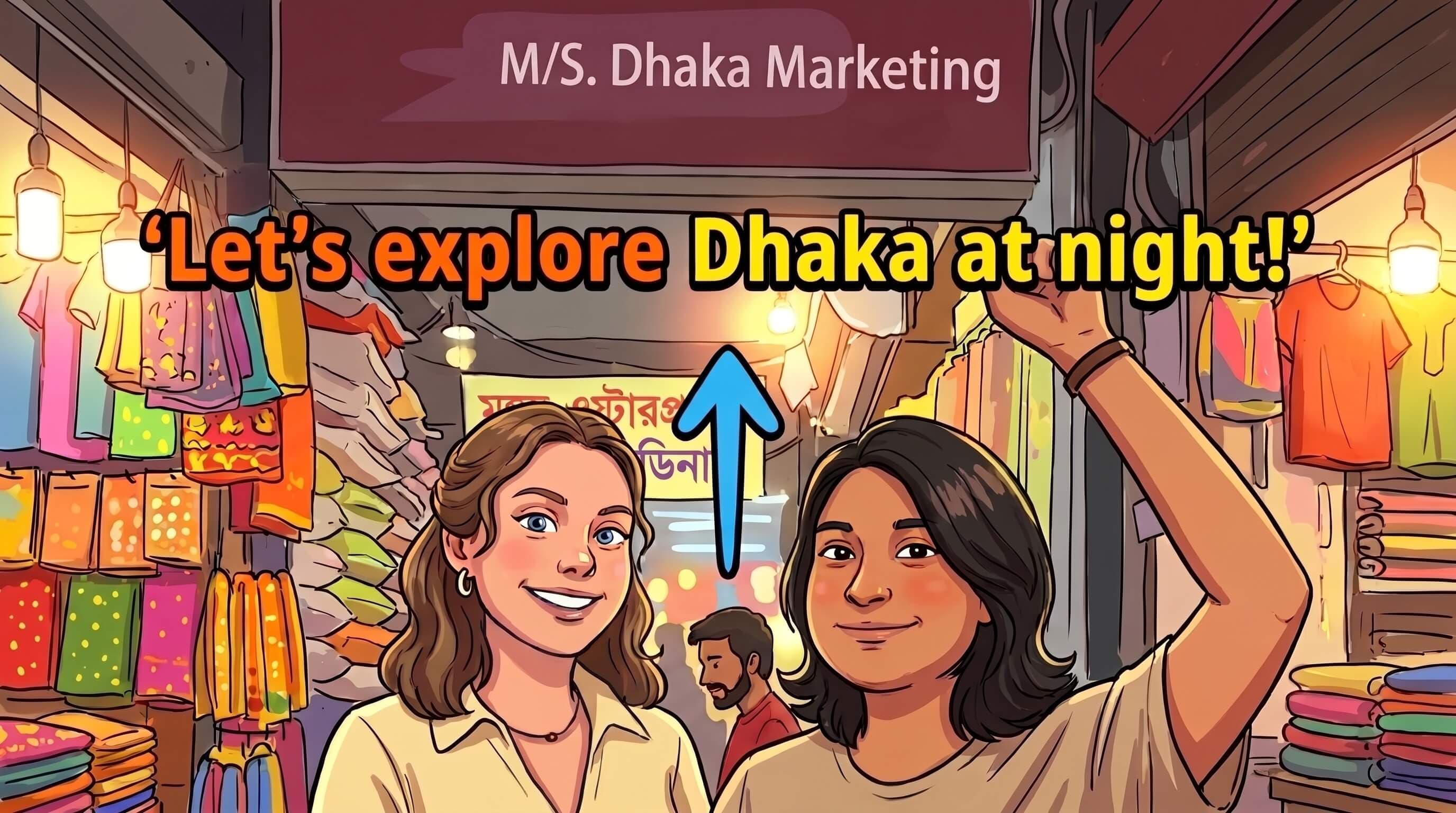
In the comments on Masha's video, many women asked where in Dhaka she had found this night market. Masha herself does not name a location. From the footage, it appears to be the New Market area of the capital. Since when did New Market become Dhaka's night market?
Since August 5, one question has kept us helpless: women's safety. With law enforcement in near collapse, women have faced harassment as a matter of routine. They have been scolded for stepping out without an orna, stopped from moving freely, and even spat on with hateful slurs. Women feel unsafe on the streets and in markets not just at night but in broad daylight. Even inside their own homes, they are not safe.
Against this reality came a bizarre, out-of-touch report by Masha Islam. Published by Deutsche Welle, it shows Masha touring nighttime Dhaka with a German woman named Emma Kramer. The musician opens her video by saying that a trip to Dhaka is wasted without seeing the night market. Her German companion then asks whether nighttime Dhaka is dangerous for women. Masha replies that everyone assumes so, but to know the truth, you have to come with her.
Masha claims nighttime Dhaka is entirely safe for women. People go out at night, she says, and stroll through open spaces and food stalls. The crowds, in her telling, are women's greatest protection. But is that really true?
Groping in Dhaka's crowds and harassment on public buses are nothing new in this country. A glance at social media or the newspapers turns up thousands of examples.
Consider the data. According to Ain o Salish Kendra (ASK), 453 women and children were victims of rape between January and August of this year. Of them, 339 were raped and 114 gang-raped. Forty-one were murdered after being raped, and two took their own lives. Another 167 faced attempted rape, and three were killed when those attempts failed.
Most alarming, although 270 rape cases and 89 gang-rape cases were filed, in many instances no information about legal action could be found. A closer look at these incidents shows that a large share of the victims were under 18, with children aged 6 to 12 at the greatest risk.
ASK's report also records that 176 people were sexually harassed by assailants between January and August. Of them, 128 were women, and 48 were men. Three took their own lives as a result of this violence, two were killed, and seven men were killed while protesting such incidents.
So much for Masha Islam's supposed "zone of safety" and the incidents that happen in crowds. Now consider domestic violence. According to ASK, 284 women and children suffered violence inside their own homes during these eight months. Twenty-two women were abused by their husbands, and five by their husbands' families. A further 108 were killed after being tortured by their husbands, and 28 died after torture by their husbands' families. Thirty-six died after torture by their own families, and another nine suffered severe abuse at their families' hands.
The data from the national emergency service 999 is grimmer still. In 2025 alone, it provided emergency services to 32,386 women who were victims of violence and sexual harassment. Over the past three and a half years, Triple Nine received 83,217 calls related to violence against women and children. In the five years after 999 was established in December 2017—that is, through October 2022—42,000 women who had been raped or abused called the service. The numbers of abuse and rape continue to rise.
These grim facts about violence against women are hardly a secret. Anyone can find them with a Google search. Masha, it seems, did not know them. Had she known, she surely would not have made such a shoddy attempt, on behalf of an international outlet, to portray nighttime Dhaka as safe for women. Perhaps she wanted to polish Bangladesh's image abroad by showing its nights as safe. Such callous reporting cannot achieve that. In the digital age, a distorted picture cannot hide the truth.
In the comments on Masha's video, many women asked where in Dhaka she had found this night market. Masha herself does not name a location. From the footage, it appears to be the New Market area of the capital. Since when did New Market become Dhaka's night market?
Masha, you are undoubtedly a privileged person. When you go out on Dhaka's streets, you travel in your own car or an Uber. So it may seem to you that Dhaka's nights are safe for women. But is that really the case? Or did you do this only to curry favor with the government or to gain some advantage? If so, you have mocked the women of this entire country.