Chile’s Other ‘9/11’: Allende’s Sacrifice and the Bloody History of the CIA

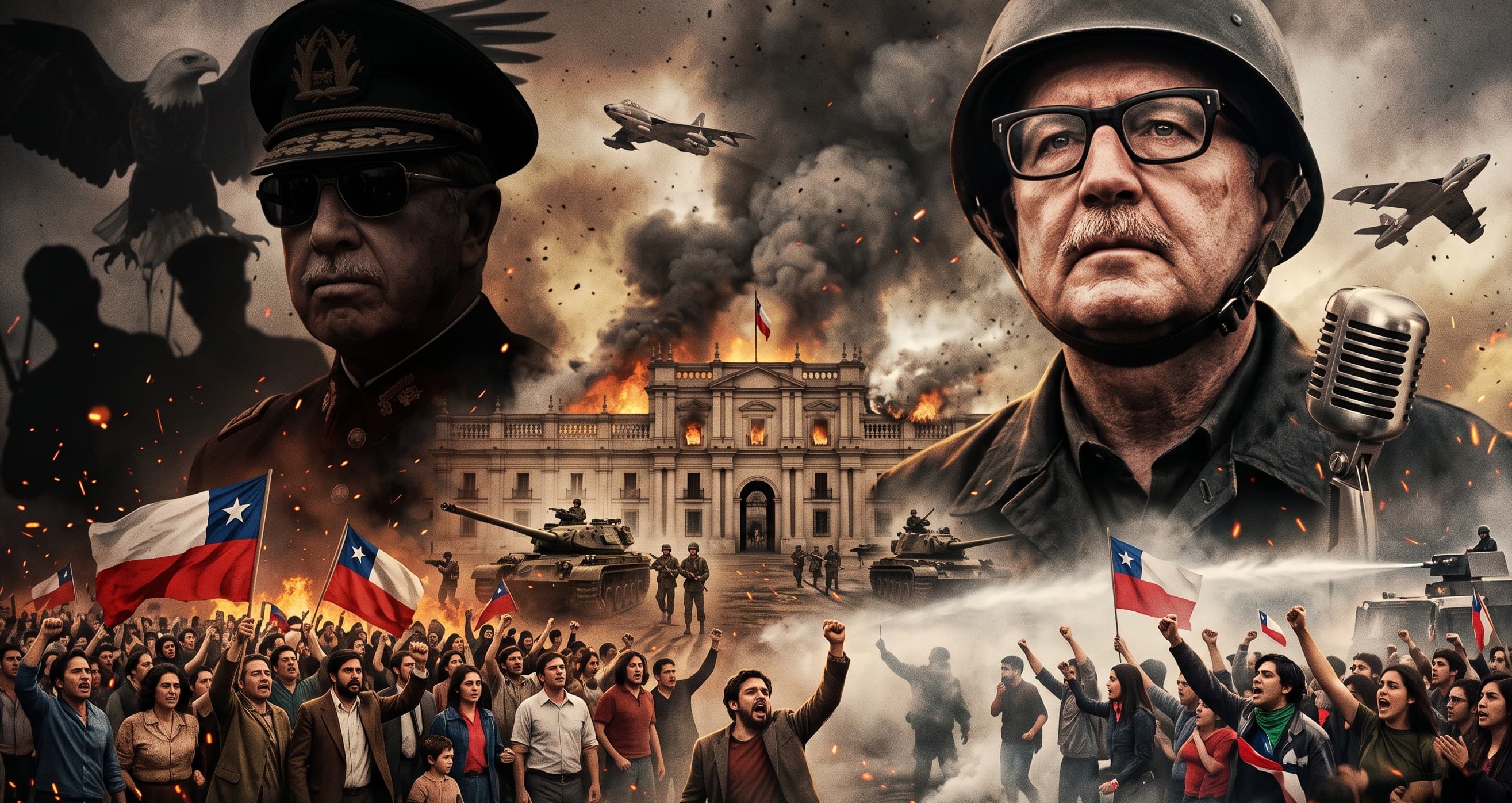
Salvador Allende defending the presidential palace during the 1973 Chilean coup
Through the sound of gunfire, the president’s voice came over the air: “My friends, this is probably my last opportunity to speak to you... There is no bitterness in my words, only disappointment. This speech will be a moral punishment for those who have betrayed their oath. I am not resigning!”
When people hear “Nine Eleven” or 9/11, they usually think of 11 September 2001, when the Twin Towers in the United States were destroyed. There is another 9/11 in history, 28 years earlier. On 11 September 1973, Chile’s democratically elected socialist president, Salvador Allende, was overthrown and killed in a military coup backed by the United States.
Every year on this day, Chileans take to the streets to remember their slain president. The 53rd anniversary was no exception. This time too, the peaceful gathering of thousands was met with state violence. The current US-friendly Chilean administration seems to have appeared with its old oppressive character. Police and security forces beat protesters—students, farmers, workers, teachers and people from various professions—and pushed them off the streets. The structure that the CIA and the US government imposed on Chile 53 years ago still has deep roots.
The Morning of 11 September 1973
It was the morning of 11 September 1973. Tank units surrounded the Chilean presidential palace, La Moneda, and military aircraft circled overhead. Gunfire could be heard everywhere. The palace was under siege. Inside, President Salvador Allende was trapped.
The military repeatedly threatened him with resignation and set deadlines. They said he would face extreme consequences otherwise. He refused to bow to military threats. He declared, “Only death will remove me from La Moneda.”
When military personnel surrounded the presidential office, he understood the situation was dire. He ordered the journalists, young people and staff inside the palace to leave through another door. In his final moments, he told them, “You young people still have much work ahead of you. You must survive to spread the word about this conspiracy against Chile and about the revolutionary ideology of Chile’s exploited people. That is why you must leave this palace.”
To save his country and its democracy, President Allende himself took up an AK-47 rifle, a gift from Fidel Castro. He stood firm, drank a little water to moisten his throat, and began his world-famous speech.
What Did Allende Say in His Final Speech?
By then, the air force had bombed and destroyed the broadcasting stations of Radio Portales and Radio Corporación. But Radio Magallanes was still broadcasting. It was on this radio that Allende spoke his last words to the workers and people of his country.
Through the sound of gunfire, the president’s voice came over the air: “My friends, this is probably my last opportunity to speak to you... There is no bitterness in my words, only disappointment. This speech will be a moral punishment for those who have betrayed their oath. I am not resigning!”
Allende understood he was standing very close to death. But there was no fear in his voice. He said, “Standing at a moment of crisis in history, I will pay for my loyalty to the people with my life. I am certain that the seed we have planted in the conscience of thousands of Chileans will not be destroyed forever. They can defeat us with force and weapons, but force and violence cannot stop a social process. History is ours... and history is made by the people.”
Expressing gratitude to the country’s farmers and workers, he warned, “Foreign capital, imperialism and reactionary forces have together created this horrible environment... You will be oppressed, but you will not be defeated.” His slogan came in the final line: “Long live Chile! Long live the people! Long live the workers! At least my sacrifice will remain a moral lesson against crime, cowardice and betrayal.”
A short while after this speech, Allende was found dead inside the palace. The military junta later announced that Allende had “committed suicide,” but this has always been surrounded by suspicion and controversy.
Why Did the Americans Kill Allende?
Salvador Allende was not a military dictator. He was the first democratically elected Marxist president in Chile, elected in 1970. After his victory, the United States could not rest. Why?
Allende’s victory was more than an election victory. It was the victory of a nation whose resources had been plundered by foreign capital for centuries, finally claiming its own wealth. Once in power, he nationalized Chile’s copper industry. For generations, major American corporations—such as Anaconda and Kennecott Copper—had controlled Chile’s mines and extracted huge profits.
Allende carried out land reform and handed control of factories to the workers. Chile’s rise was seen as a threat by the American corporate world, especially multinational telecom companies like ITT, and by the White House. They feared that if Allende succeeded, this example could spread across Latin America.
To stop Allende, the administration of then-US President Richard Nixon and the CIA secretly drew up a plan for a conspiracy. In a secret note dated 15 September 1970, CIA Director Richard Helms wrote President Nixon’s clear instruction: “Make the economy scream”—that is, destroy Chile’s economy so that it cries out in pain. Alongside this, the CIA spent millions of dollars to provoke strikes in Chile, fund opposition groups and finance terrorists, creating an artificial economic and political crisis.
The notorious US Secretary of State Henry Kissinger arrogantly commented at the time, “The irresponsible attitude of the Chilean people will lead their country down the path of Marxism, and we will just stand by and watch. That cannot be allowed.” Pressure and encouragement were then applied to Chile’s military to carry out a coup. The CIA made it clear that if they removed Allende, Washington would have no objection—in fact, it would give full support.
Betrayal and the Birth of a Dictatorship
Allende’s biggest mistake was that he placed too much trust in the institutional discipline of the army. Just one month before the coup, he appointed Augusto Pinochet as army commander, hoping he would protect the government. Within just three weeks, Pinochet committed extreme betrayal and, following the US plan, overthrew his country’s democratic president.
After Allende’s fall, Chile suffered under a long dictatorship. General Augusto Pinochet established a dictatorship that lasted 17 years, one of the bloodiest chapters in Latin American history. Directly backed by the United States and the CIA, Pinochet began a horrific genocide after seizing power. Within the first few months, more than three thousand people were killed or disappeared. Nearly 38,000 political activists were imprisoned and brutally tortured. Santiago’s vast National Stadium was turned into a concentration camp.
That day, America’s claims of “democracy” and the “free world” were exposed on Chilean soil. In 1976, in broad daylight on the streets of Washington, Chile’s former ambassador Orlando Letelier was killed by a car bomb planted by Pinochet’s spy agency DINA, with covert CIA support.
Conclusion
The filmmaker Charlie Chaplin said in the final speech of his film The Great Dictator that humanity’s future ultimately lies not in the hands of dictators, but in the hands of the people. In September 53 years ago, they were able to kill a statesman like Allende and burn La Moneda, but they could not destroy his spirit.
Even today, when millions pour onto Chile’s streets, and the current government cannot make them waver even with hundreds of beatings, Salvador Allende lives among them. Some of the young people who survived the bombed palace 53 years ago may still be in the marches today, or their successors may have taken up the cause anew. Bullets or tear gas may temporarily hurt people, and American corporate capitalists may temporarily wield the stick, but the desire for freedom and self-respect that Salvador Allende planted has survived over 53 years. The Pinochets have been thrown into the dustbin, and Allende remains a symbol in the history of oppressed people.