The Grotesque Greed of Capitalism Will Destroy the Himalayas and South Asia

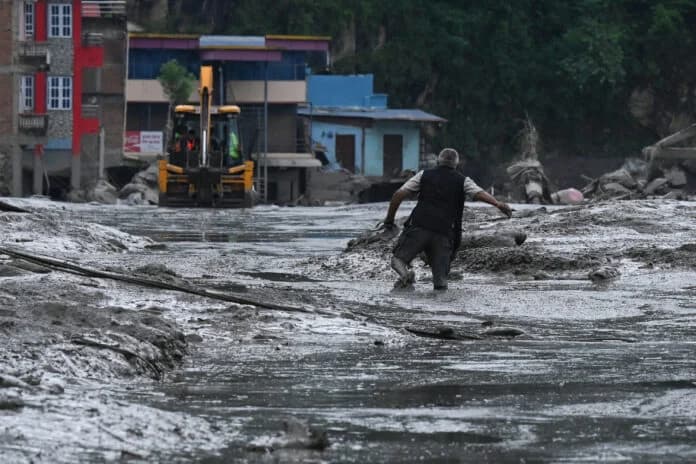
The recent deadly glacier collapse in Nepal is a stark warning. Discover how corporate greed and unchecked carbon emissions are driving the Himalayan ice melt, threatening South Asia with catastrophic floods and severe water scarcity.
At an altitude of over 5,100 metres above sea level, a centuries-old glacier in the Himalayas suddenly collapsed. Within moments, a massive slab of ice nearly 2,000 feet wide crashed downwards. Millions of tons of water, mud, and boulders came roaring down, turning into a catastrophic torrent.
On Wednesday, the destruction began in the northern border area of Rasuwa district, Bagmati Province, Nepal. The avalanche originated near the Langtang Lirung and Langtang mountain ranges in the central Himalayas, hurtling into the Lendhe and Bhote Koshi rivers. It then slammed into the settlements of the Trishuli river basin. Homes, farmlands, and lifelong dreams were swept away. Many people died. Many were left crippled.
Daniel Sugar, a geologist from the University of Calgary in Canada, analysed satellite images and confirmed that the disaster in Nepal was caused by an ice avalanche. He stated that warming temperatures and glacial instability—consistent with the effects of global warming—had made the glacier critically unstable. As a result, a huge chunk of ice broke off from the mountain flank and fell.
It is important, however, to distinguish between the immediate trigger of a disaster and the climate conditions that make such disasters more likely. Scientists have not attributed this particular glacier collapse to global warming alone.
But there is growing evidence that rising temperatures are accelerating glacier melt, weakening permafrost, altering freeze-thaw cycles, and destabilising ice and rock in the high Himalayas. Climate change is therefore not necessarily the sole trigger of every avalanche or glacial collapse; rather, it is making the mountain environment increasingly unstable and raising the likelihood and potential severity of such cascading disasters.
An Unequal War Imposed on Nature
The common people of Nepal did not start this war. Those whose homes and families were washed away by the flood had no hand in global warming. Yet they became the first victims of nature's retribution.
The capitalist world system, driven by the greed for profit, has poured greenhouse gases into the atmosphere. The innocent people at the foot of the Himalayas are paying the direct price. On one side, capitalists pile up mountains of profit and live in comfort. On the other, those who never enjoyed any of that profit, who never even had a share of it, are crushed beneath the destruction. The cruelest reality of the climate crisis is this: the people least responsible for destroying nature are forced to pay the highest price.
Yet in textbooks and corporate culture worldwide, the architects of this destruction are celebrated as successful heroes. The economic system that has pushed nature towards ruin now dreams of escaping into outer space. Meanwhile, ordinary people left behind on Earth are paying the final instalment of that profit with their lives, homes, and property. The very same capitalists who are destroying the world are venerated across countries as great achievers, celebrated as heroes of time and eternity.
NASA's Warning and the Pace of Warming
This disaster in the Himalayas is no isolated incident. Data from NASA, the US space research agency, shows that Nepal's temperature has risen consistently over the past 30 years. At altitudes above 5,000 metres, the rate of temperature increase is roughly double that of the plains. This is called "elevation-dependent warming." In the high Himalayas, temperatures are rising at 0.08 to 0.12 degrees Celsius per decade. Over the last three decades, summer temperatures in Nepal's high mountain regions have risen by up to 1.2 degrees Celsius.
NASA data also shows that the number of extreme hot summer days has increased by nearly 30 percent over the past 30 years. The freezing point, or zero-degree isotherm, has shifted upwards by about 200 metres. As a result, ice that used to remain frozen at certain altitudes is now melting rapidly.
The Carbon Responsibility- 100 Companies Account for 70% of Emissions
Research from the Climate Accountability Institute and InfluenceMap shows that just 100 fossil fuel companies are responsible for over 70 percent of the world's industrial carbon and methane emissions.
These include Saudi Arabia's Aramco, Russia's Gazprom, India's Coal India, Iran's NIOC, China's CNPC, and Western companies ExxonMobil, Shell, BP, Chevron, and TotalEnergies.
The report also shows that the wealthiest 10 percent of the global population is responsible for 50 percent of global emissions. In contrast, the poorest 50 percent are responsible for only 10 percent of carbon emissions. Despite the Paris Agreement, these large companies continue to invest heavily in coal, oil, and gas. As a result, the goal of keeping global warming within 1.5 degrees Celsius is slipping out of reach.
Forecast: Risk of Ice-Free Conditions by Century's End
The International Centre for Integrated Mountain Development and the UN's climate panel have issued extremely alarming forecasts for the Himalayas.
According to their projections, even if warming is limited to 1.5 degrees Celsius, one-third of the Himalayan glaciers will melt by 2100. If current emission trends continue, 70 to 80 percent of the glaciers will disappear forever. Between 2011 and 2020, the rate of ice melt increased by 65 percent compared to the previous decade.
Scientists say that between 2040 and 2050, the rivers of the Himalayas will reach "peak water"—the point when glacier meltwater flow is at its maximum. During this period, the risk of severe flooding will increase significantly. But after 2050, as the ice dwindles, river flows will begin to decline. By the end of the century, rivers like the Ganges and the Brahmaputra may dry up during the dry season.
Already, over 200 high-risk glacial lakes have formed in the Himalayan mountains due to melting ice. In the coming decades, the risk of glacial lake outburst floods will triple.
What Will Happen If the Himalayas Become Ice-Free?
The Himalaya-Hindukush region is called "Asia's water tower" and the Earth's "Third Pole." If this ice melts completely, a humanitarian and geographical catastrophe will engulf all of Asia. In the early years of Himalayan melting, the Indus, Ganges, Brahmaputra, and Mekong rivers will see a dramatic surge in water. Overflowing floodwaters will submerge the lowlands of Bangladesh, India, Pakistan, and China in prolonged floods.
Once the Himalayan ice is gone, the rivers will depend solely on rainwater. In the dry season, when rivers run dry, nearly 2 billion people will face drinking water shortages. Without irrigation water, fertile farmlands will turn into barren deserts. Production of staple food crops will collapse.
Melting Himalayan ice will raise sea levels, permanently submerging Bangladesh's southern coast and island nations like the Maldives. Saltwater from the sea will intrude into inland rivers, ruining land and groundwater. With river flows lost, hundreds of hydropower plants in India, Nepal, Bhutan, and China will become inoperable, leading to severe power shortages in those regions.
Hundreds of millions of people in the region will be displaced. Conflicts and wars over water and land will erupt between countries, fuelling geopolitical strife.
The Himalayan glacier collapse in Nepal is not a local accident. It is a clear warning. Nature is losing its balance. And the people who were never part of this greed are paying the heavy price for that imbalance. If we do not rein in fossil fuels now, it is not just mountains that will sink in the melting Himalayan currents—the future of human civilisation will drown as well.
---
*Author: Editor, Dhaka Papers
Email: [email protected]