The Ganges Treaty: How Important Is It for the Future?
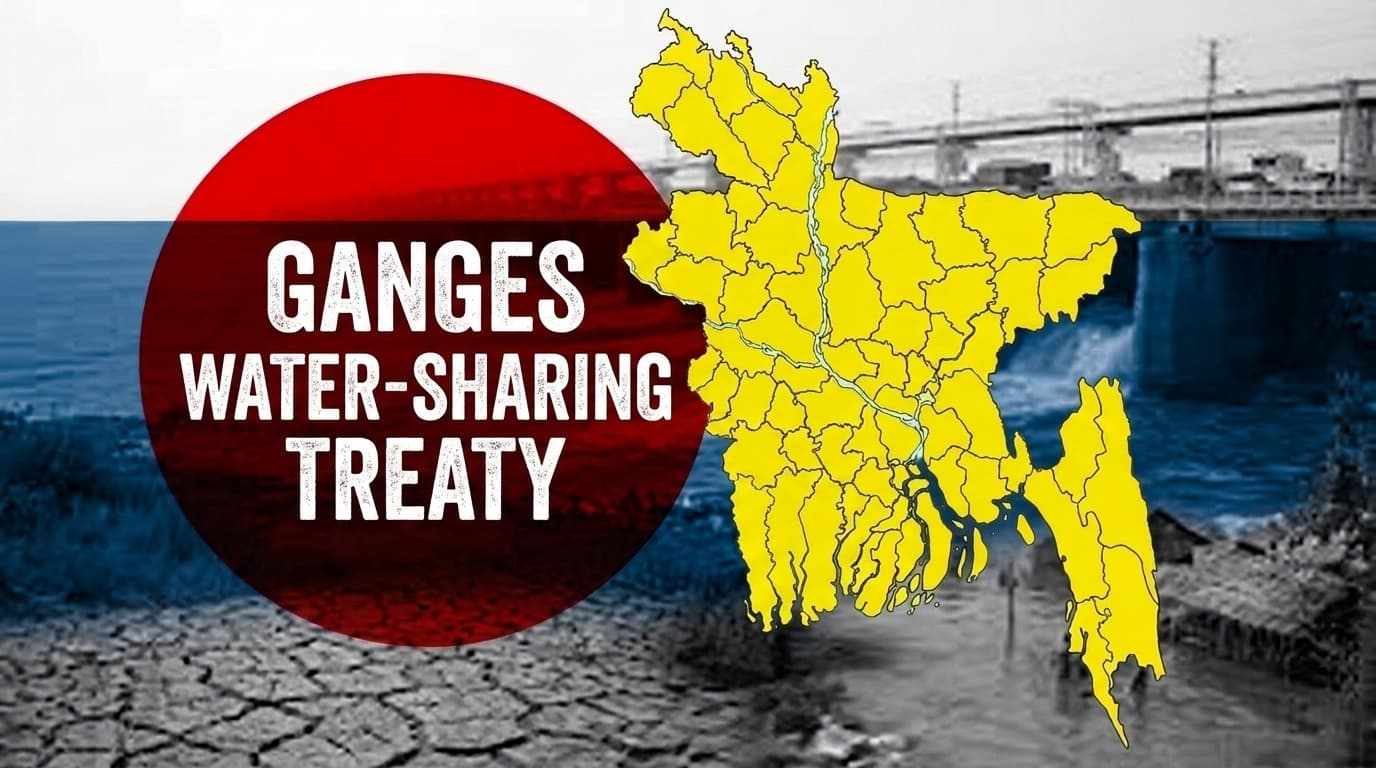
Dhaka Papers graphics
The new parliament of Bangladesh should make it a priority to sign and ratify the United Nations Convention on the Law of the Non-Navigational Uses of International Watercourses (1997). The Government of Bangladesh should also encourage India and other relevant countries to use this UN Convention as the basis for negotiations aimed at resolving all transboundary river-related disputes.
During Bangladesh’s struggle for self-determination, a popular slogan went: “Your address and mine is the Padma, the Meghna and the Jamuna!” The slogan captures the profound and inseparable relationship between Bangladesh’s existence and its rivers. Over geological timescales, the country’s geographical landmass has been formed primarily through the deposition of river-borne sediments. All the major rivers flowing through Bangladesh originate beyond its national borders. Consequently, Bangladesh has no control over the flows of the transboundary rivers that are vital to its economy, ecosystem and very survival.
Bangladesh is situated at the downstream end of the Ganges-Brahmaputra-Meghna (GBM) basin, which extends across parts of China, India, Nepal and Bhutan. Although only 8 per cent of this basin falls within Bangladesh, the country is home to 25 per cent of the basin’s total population of 600 million. Of the 54 transboundary rivers shared by the countries within the GBM basin, only the Ganges is covered by a water-sharing treaty between India and Bangladesh. The 30-year agreement was primarily designed to regulate water distribution during the dry season. The Ganges Water Sharing Treaty is set to expire at the end of 2026. Although the Ganges basin extends across India, Nepal and Bangladesh, the treaty was signed exclusively between India and Bangladesh. India and Nepal, however, have a separate agreement concerning the flows of the Gandak and Koshi rivers, both tributaries of the Ganges.
Internationally, river basins are generally regarded as single entities, even when they flow through multiple states or countries, and should be managed accordingly. All international laws, regulations and principles concerning the management and planning of transboundary rivers place emphasis on the concept of integrated water resources management at the basin level. For instance, the 1997 United Nations Convention on the Law of the Non-Navigational Uses of International Watercourses is a global treaty. It provides a framework for cooperation, management and protection of shared river basins for various purposes, including drinking water, irrigation and electricity generation. The Convention emphasises the principles of equitable and reasonable utilisation of watercourses, the obligation not to cause significant harm, and the duty to cooperate. It serves as a foundation for bilateral and multilateral agreements concerning shared freshwater resources. Another example of integrated water resources management involving all stakeholders is the European Water Framework Directive (WFD). In the context of transboundary rivers, it takes into account the interrelationships between surface water, groundwater and associated ecosystems. Successful water management arrangements in Europe developed on the basis of the WFD include the Central Commission for the Navigation of the Rhine (CCNR), the International Commission for the Protection of the Rhine (ICPR), and the Danube River Basin Monitoring Network (DRBMN).
The 1996 Ganges Water Sharing Treaty also recognised the need for basin-wide management of the Ganges and other transboundary rivers. The treaty established a useful framework for cooperation between India and Bangladesh and paved the way for long-term agreements on other transboundary rivers. However, the Ganges Water Sharing Treaty is not a comprehensive plan capable of managing water, sediment and hydropower potential across the basin while involving all stakeholders. Moreover, it is limited to water-sharing arrangements during the dry season, rather than covering the entire year.
Furthermore, the treaty contains no guarantee clause to ensure that Bangladesh receives the agreed or allocated volume of water at the Farakka Barrage. Unfortunately, the treaty has failed to ensure that Bangladesh receives the agreed volume of water at the Farakka Barrage. Several studies based on data from the Joint Rivers Commission (JRC) covering the period from 1997 to 2016 have found that Bangladesh did not receive its agreed share of water in 52 per cent of the cases. The same studies also show that Bangladesh failed to receive the agreed volume in 65 per cent of the cases during the three “assured periods” between 11 March and 10 May. Water shortages in the Ganges during the dry season disrupt navigation, lower groundwater levels in Ganges-dependent areas of southwestern Bangladesh, allow saline water to intrude upstream into freshwater rivers and agricultural lands, and cause harmful changes in the diversity of freshwater fish species.
During the monsoon, Bangladesh has no control over the flows of transboundary rivers, resulting in untimely floods and river erosion. People living in Ganges-dependent areas are losing their homes and homesteads due to river erosion and flooding. For instance, a study published in the Journal of the American Water Resources Association (JAWRA) in 2019 noted that significant hydrological changes occurred in Bangladesh’s Ganges-dependent areas between 2001 and 2014.
As freshwater flows declined, salinity levels and intensity increased at 11 of the 14 monitoring stations across Khulna, Jashore and Satkhira districts. During the study period, from 2001 to 2014, agricultural land in the area declined by 50 per cent, rural settlements by 20 per cent, and freshwater bodies by 38 per cent. The study further estimated that the direct economic losses to Bangladesh amounted to approximately US$3 billion. The Farakka Barrage has also caused significant economic damage to India. Waterlogging and recurrent flooding have affected various areas upstream of the barrage in West Bengal, Bihar, Jharkhand and Uttar Pradesh. The original objective of constructing the Farakka Barrage—to maintain navigability at the Port of Kolkata—remains unfulfilled to this day.
The decline in water flow at Farakka during the dry season is attributable to other dams and water-diversion infrastructure constructed upstream by India and Nepal. According to a 2019 report by the World Economic Forum, more than 300 dams and water-diversion structures have obstructed the Ganges, while numerous additional dams have blocked the flows of its tributaries and disrupted the river’s natural course. Since the Ganges Water Sharing Treaty is a bilateral agreement between the upstream country, India, and Bangladesh, it is India's responsibility to honour and implement the agreement.
Bangladesh’s newly elected government must formulate a new agreement on the sharing of water and sediment in all transboundary rivers, particularly the Ganges. The new treaty must include provisions guaranteeing minimum flows, as was also stipulated in the 1977 agreement. It should also establish mechanisms for managing water and sediment flows throughout the year. In addition to India and Bangladesh, efforts must be made to include Nepal, which is also part of the Ganges basin, in any future agreement.
Rather than setting a fixed term for the new treaty, it would be more appropriate to establish an agreement committing the parties to indefinite cooperation in accordance with existing international principles and conventions. However, the treaty should include a provision for review every 10 years. As Bangladesh enters new negotiations with India—and potentially other countries within the GBM basin—on the distribution and management of water and sediment in all shared rivers beyond the Ganges, the government must document and present the crises Bangladesh faces due to declining flows in the Ganges and other rivers. These include economic losses, ecosystem degradation and impacts on public health. Data on river flows should be made publicly available through the media so that citizens and researchers can participate in the decision-making process.
The water crisis should not be discussed solely in terms of its consequences for Bangladesh’s navigation, agriculture, irrigation, industry and fisheries. It must also be viewed through the lens of global health, or “planetary health”, which encompasses the impacts of climate change on ecosystems, the environment and public health.
In negotiations to renew the Ganges Treaty, Bangladesh should take a firm position in favour of a basin-wide integrated water and sediment management agreement, or “compact”, involving India and Nepal. Similarly, Bangladesh must work with China, India, Bhutan and Nepal to reach a long-term agreement or understanding on the management of the Brahmaputra basin.
A “compact” is an agreement among all stakeholders in a river basin that establishes a comprehensive, multipurpose plan for the conservation, use, development and regulation of water and related resources. Its objective is to ensure maximum benefits and efficient services for all parties concerned. Compared with a conventional water-sharing treaty, a “compact”, or integrated agreement, offers a far more forward-looking approach to managing transboundary water flows. Such an agreement can benefit stakeholders in both upstream and downstream regions.
Under this arrangement, it would be possible to assess the potential for multiple uses of water resources across the GBM basin. These could include the construction of reservoirs in upstream areas for electricity generation, recreation and tourism, as well as for increasing water flows downstream during the dry season. It is also essential to reach an agreement among the countries concerned on how the costs of such initiatives will be shared.
Bangladesh’s new government should approach the management of transboundary water resources with an open mind. In dealing with China on the management of the Brahmaputra basin, Bangladesh should work jointly with India. The new Parliament of Bangladesh should make it a priority to sign and ratify the “1997 United Nations Convention on the Law of the Non-Navigational Uses of International Watercourses”. The government should encourage India and other relevant countries to use this UN Convention as the basis for negotiations aimed at resolving all transboundary river-related disputes. If necessary, Bangladesh could propose an international conference on transboundary rivers, involving the World Bank, the International Monetary Fund (IMF), the European Union (EU), JICA, DFID, USAID and other relevant development partners.
Bangladesh must place “hydro-diplomacy” at the centre of its diplomatic relations with all countries within the GBM basin. In simple terms, when making decisions concerning other treaties, agreements or commercial transactions with China, India, Nepal and Bhutan, Bangladesh should take transboundary river issues into account. For instance, Bangladesh could reopen discussions with India on transit and transshipment arrangements, with the aim of achieving a lasting solution to transboundary river-related problems based on fairness and cooperation.
The people of the countries sharing the GBM region are connected by a long history and a shared heritage. Therefore, instead of viewing the natural flow of rivers as a source of conflict, we should regard them as bridges that connect us.
________________
Author: Geologist, environmental scientist, water resources and coastal ocean scientist, and Global Coordinator of BEN.
Your contribution keeps investigative journalism fearless, transparent, and accessible to everyone. To support us securely donate from anywhere.