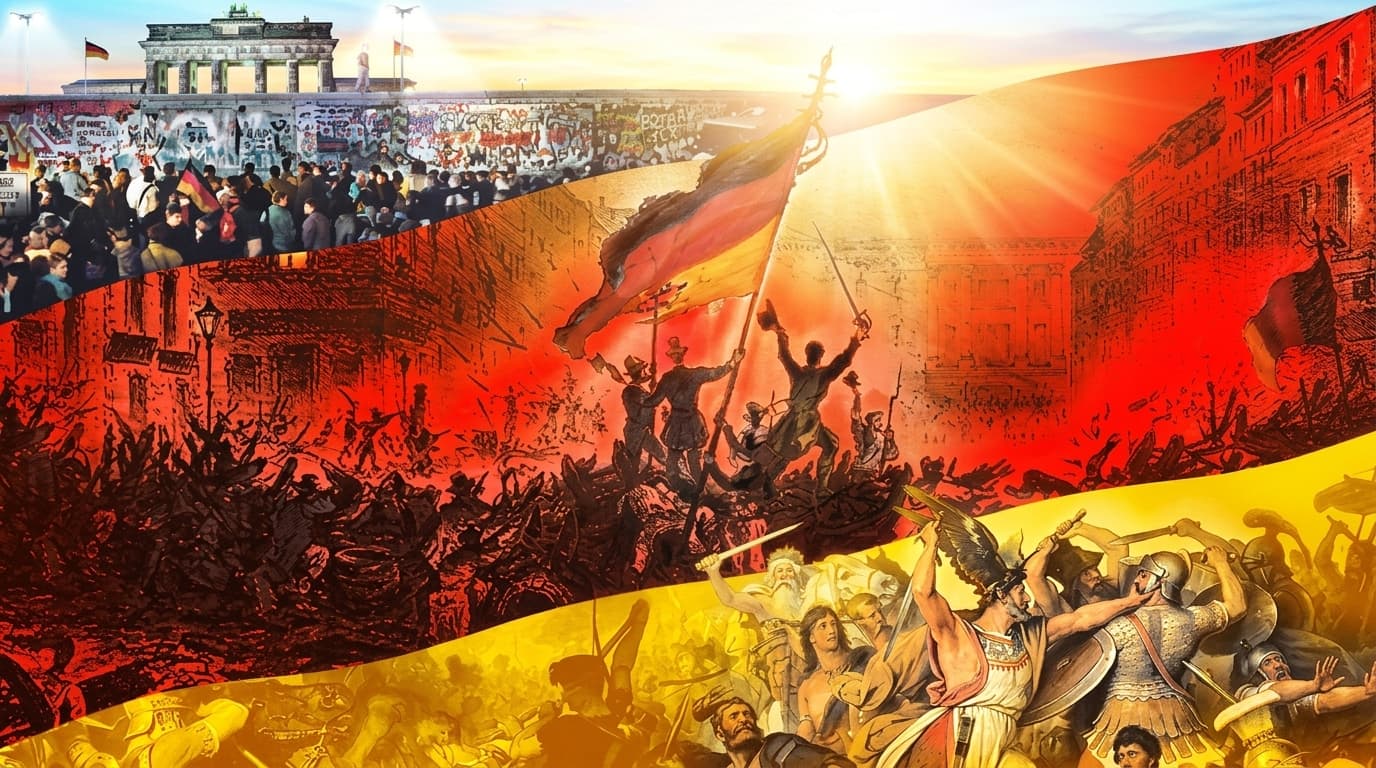
November Revolution and the Birth of the German Republic

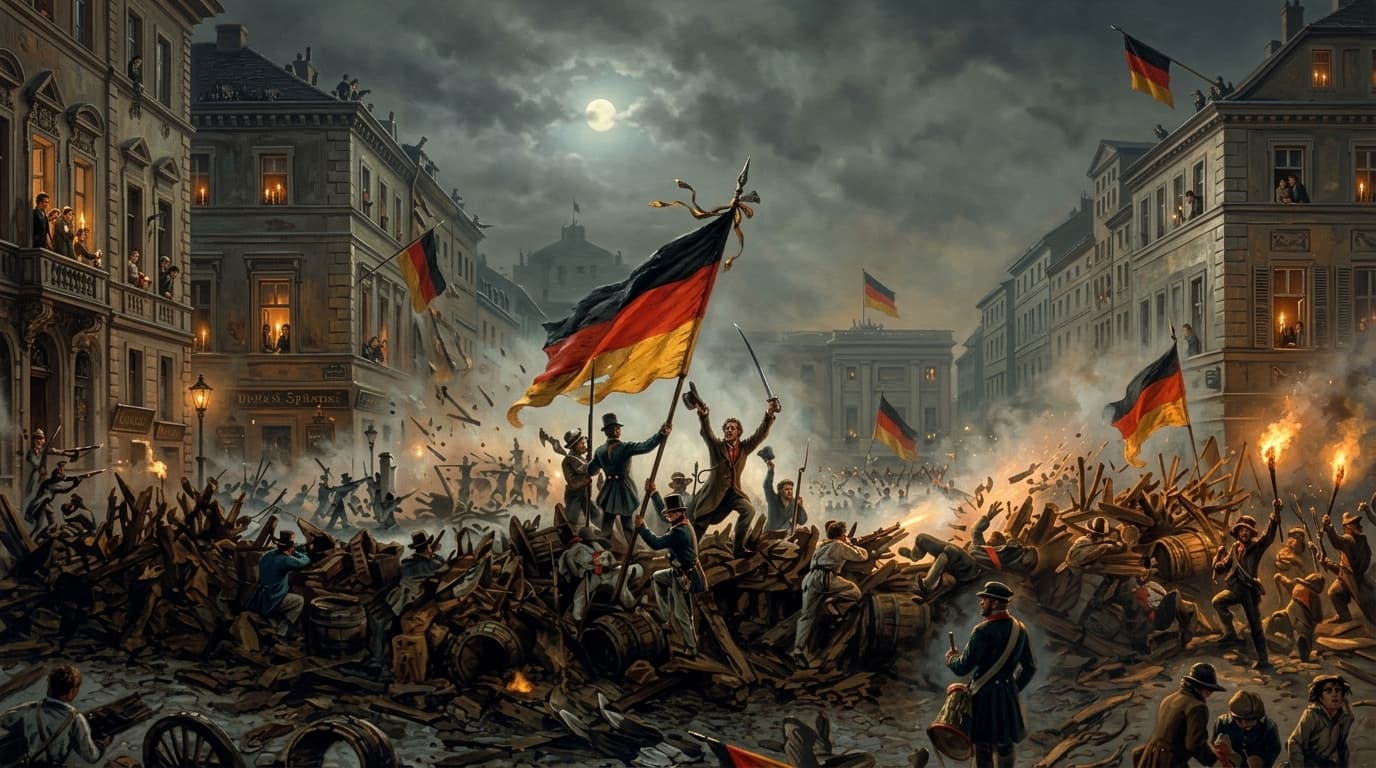
Birth of the German Republic
The November Revolution had birthed the republic with little bloodshed. Yet, the two conflicting visions of Germany proclaimed by Scheidemann and Liebknecht would ultimately lead to a bloodbath in the days to come.
As the First World War was coming to an end, in a global fever of rebellion, kings and monarchs were toppling left and right. Then-Prime Minister of the UK, David Lloyd George, remarked to French Premier Clemenceau that “The whole of Europe is filled with the spirit of revolution.” Among them, the most significant and most talked about is the Russian Revolution. Yet, around the same time as the Russian Revolution, another revolution shook up Europe: the German Revolution, which remains largely ignored in popular discourse, often dubbed the ‘forgotten revolution’. Yet, the history of the 20th century cannot be written without understanding the victories of the German Revolution as well as its failures. It succeeded in ending the First World War, overthrew the German monarchy, and established a parliamentary republic, but the eventual failure of the revolution shattered the dream of a global socialist chain reaction and sowed the seeds of the rise of Hitler in 1933.
I. Ferment
Much of the history of the German Revolution revolves around the Social Democratic Party of Germany (SPD). The German Revolution is quite peculiar in the sense that the leaders of the revolution and the counter-revolution both stemmed from the same party, the SPD. It was formed in 1875 under the name Socialist Workers' Party of Germany. Although the party was outlawed in 1878 under Otto von Bismarck’s Anti-Socialist Laws, it continued operating underground using covert organizing networks. After the ban was lifted in 1890, it officially adopted the name Social Democratic Party of Germany (SPD). In 1891, the party adopted the Erfurt Program at its party congress. The program was explicitly Marxist in nature and called for the abolition of capitalist private property and its transformation into social ownership, which can only be achieved through class struggle alone.
By 1912, the SPD had become the largest party in Germany with a million members, 4 million voters, 3 million members in affiliated unions, a number of newspapers, and the largest faction in the Reichstag with 110 seats. Yet, as the SPD’s parliamentary success grew, the party leadership became less and less radical in their objectives. They still spoke of revolution but less as an immediate possibility and more as a utopian vision of an indefinite future. Its principal theorist, Eduard Bernstein, argued that socialism could be achieved incrementally through legislative reform. This was fiercely contested by the party’s left-wing, led by Rosa Luxemburg and Karl Liebknecht, who insisted that the bourgeois state apparatus could not be reformed from within but had to be dismantled through revolution. Yet despite these disagreements, both factions prioritized party unity foremost.
With the onset of the First World War, this treasured unity was to be permanently shattered. On August 4, 1914, reversing decades of internationalist and anti-militarist resolutions, the SPD parliamentary faction, led by Friedrich Ebert, voted unanimously in favor of war credits to finance the Imperial war effort, known in the anti-war left as the ‘Great Betrayal’. The leaders of both the SPD and the major trade unions entered into a truce with the government, agreeing to refrain from criticizing the government, speaking out against the war, and calling any worker strikes.
In December of 1914, Liebknecht became the first SPD deputy in the Reichstag to vote against further war credits. Luxemburg, Liebknecht, and a few other anti-war radicals started publishing an illegal underground journal called the Spartacus Letters. Its task was to popularize revolutionary and anti-war views among the masses; the journal’s popularity gave them the name Spartacus Group or the Spartacists. Simultaneously, Richard Müller, a lathe operator of the German Metal Workers’ Union, formed the Revolutionary Shop Stewards, a network of mid-level union organizers in the factories of Berlin, who coordinated anti-war strikes independently of parties. In March of 1915, Liebknecht was joined by Otto Rühle in voting against war credits, and by early 1916, the opposition in the Reichstag grew to 20 deputies, for which they would be expelled from the SPD.
In April of 1917, the expelled members formed the Independent Social Democratic Party of Germany (USPD), which was joined by the Spartacus Group and the Revolutionary Shop Stewards. The USPD was united under the opposition to the war, but it contained a wide range of political tendencies, from reformists and moderates like Eduard Bernstein and Karl Kautsky to the far-left: the Spartacists and the Stewards.
As the war dragged on, Germany was facing severe losses, both militarily and on the domestic front. The Allied naval blockade choked off vital agricultural and raw material imports, culminating in the ‘Turnip Winter’ of 1916/17, causing mass starvation, in which thousands of German civilians died. Domestic distress was further exacerbated by the December 1916 Auxiliary Service Law, which subjected the working class to compulsory labor allocations, forced them into armaments factories, and restricted their movement. Widespread civilian distress culminated in the Bread Strike of April 1917 and then the Great January Strike of 1918, organized by the Revolutionary Stewards, which saw over 400,000 workers mobilize across the empire to demand immediate peace without annexations, the end of militarism, and democratic reforms.
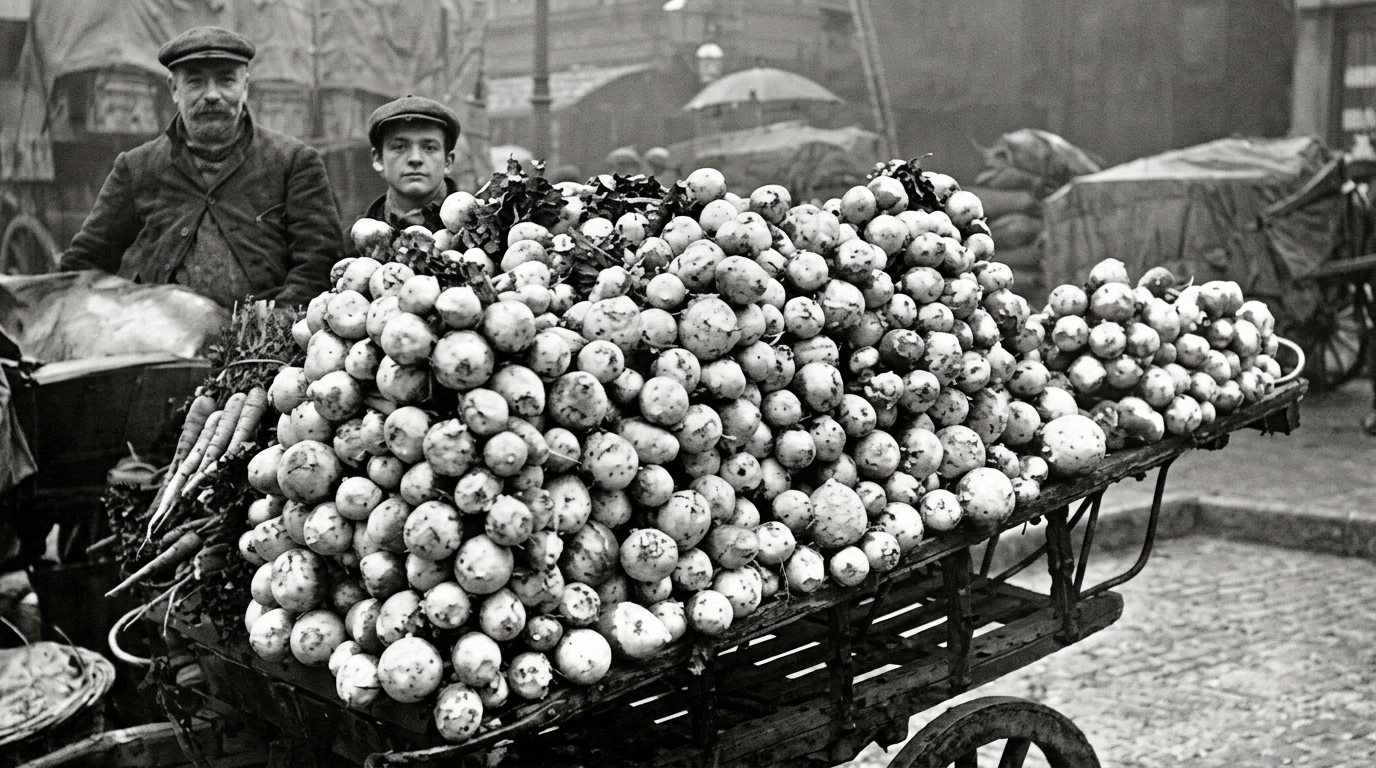
A handcart piled with turnips. Typically reserved as livestock feed, turnips became the primary substitute for potatoes amid severe famine.
These strikes developed political consciousness among the workers, made the Stewards organizationally apt, and demonstrated that the urban proletariat had the ability to paralyze the entire state infrastructure, which, according to historian Arthur Rosenberg, served as a ‘dress rehearsal’ for revolution. As the workers of Berlin became increasingly class-conscious and emboldened by the news of a revolution in Russia, they decided that revolution was the only way forward. The Spartacists, the Stewards, and a few left-wing members of the USPD formed an executive committee in late October of 1918. They set a date for the revolution: 11 November 1918. While they patiently waited for the revolution, the revolution did not wait for them.
II. The Spark: Mutiny at Kiel
By late September 1918, the German Western Front was collapsing. General Erich Ludendorff informed Kaiser Wilhelm II that military defeat was imminent. To avoid responsibility for the capitulation, Ludendorff demanded the immediate formation of a civilian government to negotiate an armistice. On October 3, 1918, the Kaiser appointed Prince Max von Baden as Imperial Chancellor and created a cabinet consisting of SPD figures like Philipp Scheidemann and union leader Gustav Bauer. This maneuver gave birth to the infamous ‘stab-in-the-back’ myth, which asserted that the Imperial Army remained undefeated in the field but had been betrayed by leftists and Jews.
On October 27, 1918, as the newly appointed civilian government was negotiating an armistice, Imperial Naval Command officers in Wilhelmshaven made a covert, unauthorized decision. They planned to attack the British Royal Navy in a final, honor-bound "suicide mission" to preserve the prestige of the officer corps. On the night of October 30, recognizing that the operation would cause the needless sacrifice of tens of thousands of lives, sailors aboard the battleships Thüringen and Helgoland, anchored off Wilhelmshaven, mutinied. In response, the naval command had to abort the operation and arrested over 1,000 mutineers and transferred ships to the coastal city of Kiel for court-martial.
On November 3, thousands of sailors, soldiers, and industrial dock workers demonstrated in Kiel, demanding the release of the arrested mutineers, and marched toward the military prison. Military patrols fired on the demonstrators, killing seven people and wounding 29. This killing sparked the revolutionary fire that quickly swept across Germany. By the morning of November 4, the revolt had engulfed Kiel's barracks and ships; they disarmed officers, seized weapons, released imprisoned mutineers, and hoisted red flags over the fleet. On the evening of November 4, the sailors elected Germany’s first Workers' and Sailors' Council aboard a torpedo boat, representing 20,000 personnel. They weren't asking for better rations or higher wages; instead, they demanded the immediate abdication of the monarchy, an end to the war and imperialist militarism, the release of all political and military prisoners, and universal, equal suffrage for all men and women.
Between November 4 and November 8, armed sailors, soldiers, and industrial workers all over Germany seized municipal infrastructure, freed political prisoners, disarmed garrisons, and established workers' and soldiers' councils. On the night of November 7, Kurt Eisner of the USPD led a mass demonstration in Munich, ousted the old Wittelsbach dynasty, and proclaimed the People's State of Bavaria, while on November 8, Spartacist organizer August Merges led an insurrection in Brunswick and declared the Socialist Republic of Brunswick. Hamburg, Bremen, Lübeck, Cologne, Essen, and Leipzig also fell under council control within days.
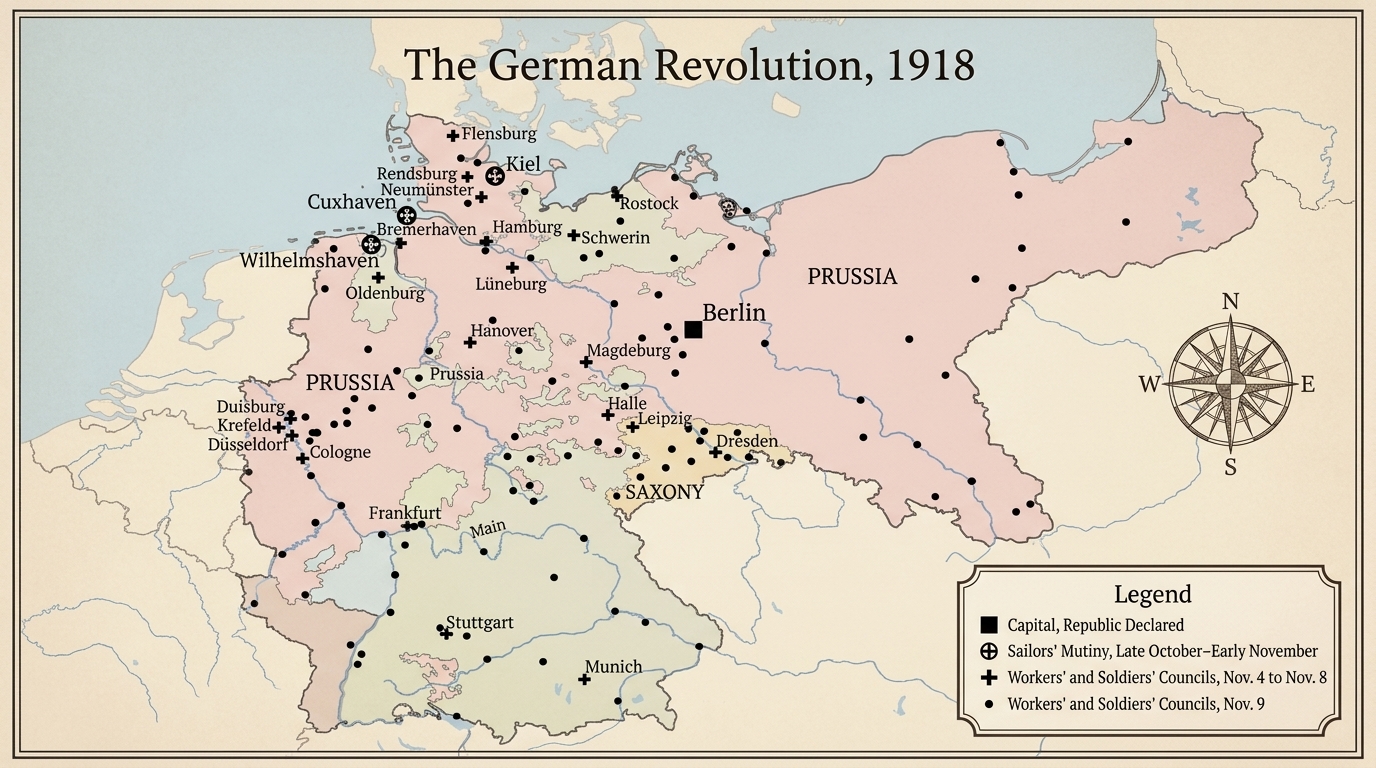
Map detailing the rapid spread of the revolution across Germany
It wasn't just limited to workers' and soldiers' councils; artistic and cultural councils, peasant councils, and citizens' councils were also being organized. Such was the prestige of the councils at that time that even a staunch political liberal like Max Weber joined the Workers' and Soldiers' Council of Heidelberg. The councils varied in political alignment as well; SPD-led councils were content not doing much other than following the government's instructions, whereas councils where Spartacists and left-wing members of the USPD held the majority enacted radical changes. For example, the council in Bremen prohibited any attempts to re-establish the old senate or a national assembly, Neukölln abolished the police force, the Hanau council banned worker dismissals and enforced an 8-hour workday, while the Müllheim council raised wages by up to 80%.
This uprising was remarkably peaceful, orderly, and celebratory, perfectly mirroring the poetic observation made by the anarchist philosopher Gustav Landauer: “In revolution, everything happens incredibly quickly, just like in dreams in which people seem to be freed from gravity.” However, in this revolutionary optimism, imperial civil servants, police officials, and municipal judges were left largely undisturbed in their administrative positions, allowing counter-revolutionary elements to survive within the state apparatus.
Terrified by the collapse of state authority, Chancellor Prince Max von Baden dispatched SPD deputy Gustav Noske to Kiel on November 6 to pacify the movement. Utilizing his prestige as a Social Democrat, Noske gained the trust of the sailors, got himself elected governor of Kiel, neutralized the radical elements, reinstated naval hierarchy, and restored military command. Noske’s mission established the SPD leadership's operational template: end the revolution in the name of revolution.
III. Proclamation of the Republic(s)
On the morning of Saturday, November 9, 1918, the revolutionary wave had reached its final destination: Berlin. Organized by the Revolutionary Shop Stewards, hundreds of thousands of industrial workers marched from the factories toward the city center, bearing banners that read "Brothers, don't shoot!" Müller feared a massacre, believing that the infantry would drown the revolution in blood. However, his fears proved entirely unfounded, as none of the troops were willing to shoot at the workers. Instead, the soldiers of the imperial garrisons stationed in Berlin joined the crowds, surrendering their barracks and weapons without firing a shot. The Kaiser still had hopes of suppressing the revolution by force at this point but no longer had enough troops at his disposal. General Wilhelm Groener informed the emperor that the troops were no longer following his command.
The emperor hoped to remain the king of Prussia. However, at noon on November 9, Prince Max von Baden, without the emperor's consent, unilaterally announced that the emperor had decided to abdicate the throne. He then resigned and unconstitutionally handed over the Reich Chancellery to Friedrich Ebert. Ebert, in turn, asked von Baden to act as imperial regent until a successor to the Kaiser had been appointed, continuing to assume that monarchy could still be saved by transforming Germany into a parliamentary monarchy.
At 2 p.m. on November 9, the SPD leadership was dining at the Reichstag with a huge crowd gathering outside the building. Upon hearing rumors that Liebknecht was leading a rally towards Berlin Palace, where he could proclaim a Soviet-style council republic, SPD leader Philipp Scheidemann, acting without the authorization of party chief Ebert, stepped up towards the balcony window of the Reichstag and shouted towards the crowd, “The old and rotten has collapsed! Long live the new! Long live the German Republic!”
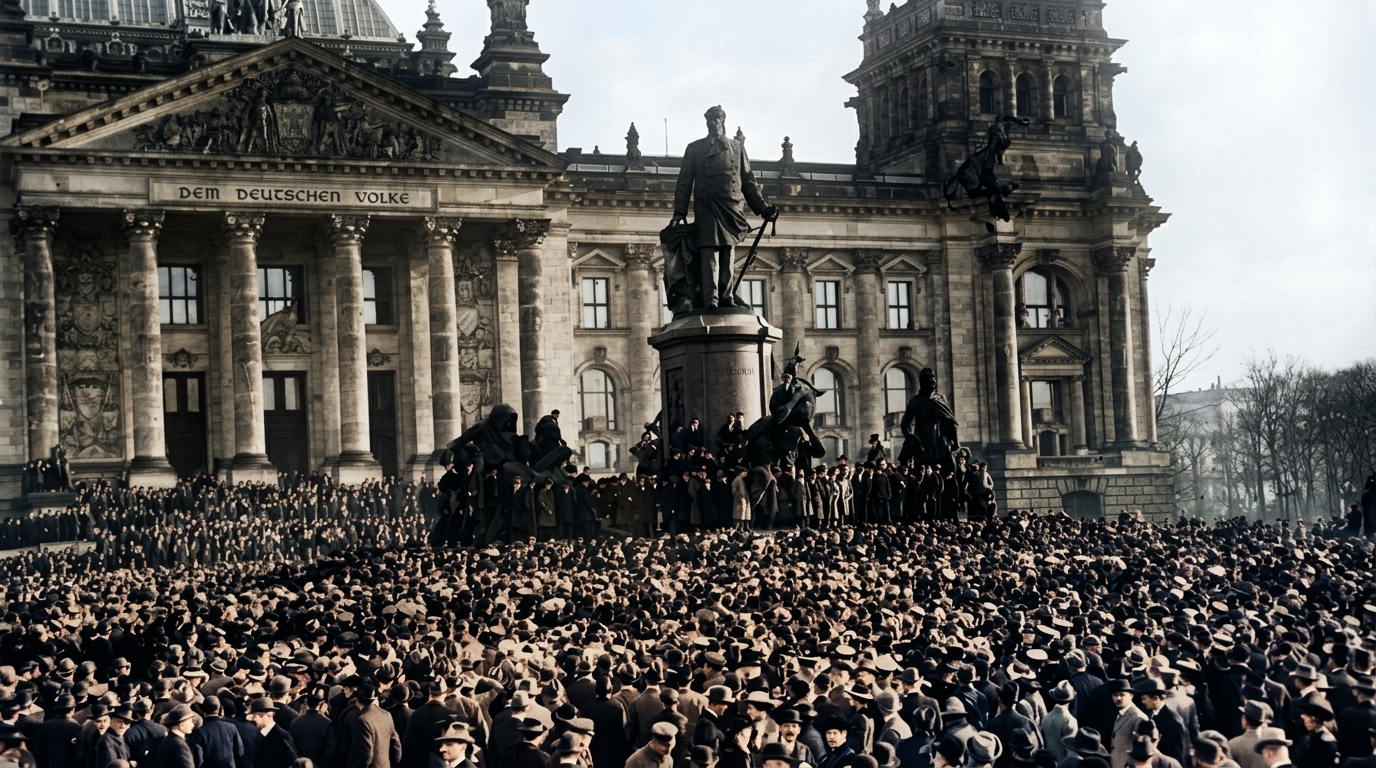
Philipp Scheidemann proclaims the German Republic in front of the Reichstag on 9 November 1918
When Scheidemann sat back down, Ebert was furious at him, insisting that Scheidemann had no right to proclaim a republic, as such a constitutional decision belonged strictly to a future elected national assembly. In truth, Ebert would have greatly preferred a constitutional monarchy with one of the Kaiser's sons assuming the throne. In fact, during negotiations with Max von Baden, he told him that he hated the revolution “like sin.”
Two miles away, in front of the Berlin Palace at 4 p.m., Karl Liebknecht announced a radically different vision of Germany. Standing on the central balcony of the Imperial Palace, Karl Liebknecht unfurled a red flag and announced, “The old is no more. The rule of the Hohenzollerns, who for centuries lived in this palace, is over. In this hour we proclaim the Free Socialist Republic of Germany,” and called for all executive, legislative, and judicial authority to be transferred to workers' and soldiers' councils.
At the end of his speech, he said, “Those among you who want to see the free Socialist Republic of Germany and World Revolution come to pass, raise your hands and swear,” and a sea of hands arose. Yet Liebknecht’s declaration was like a phantom victory. Unlike Scheidemann, who had the administrative muscle of the SPD behind him, Liebknecht possessed no massive party machinery or organized administrative network. The Spartacus Group in Berlin numbered fewer than fifty active members at that moment. It was a proclamation of a republic that would never come to be.
The next day, confronted with the collapse of the empire, Kaiser Wilhelm II boarded the train and fled into exile to the Netherlands. The November Revolution had birthed the republic with little bloodshed. Yet, the two conflicting visions of Germany proclaimed by Scheidemann and Liebknecht would ultimately lead to a bloodbath in the days to come.
[This is the first part of a two-part series on the German Revolution of 1918.]
____________________
Author: Writer and Translator
[email protected].
Your contribution keeps investigative journalism fearless, transparent, and accessible to everyone. To support us securely donate from anywhere.