The Violent End of the German Revolution
Dhaka Papers graphics
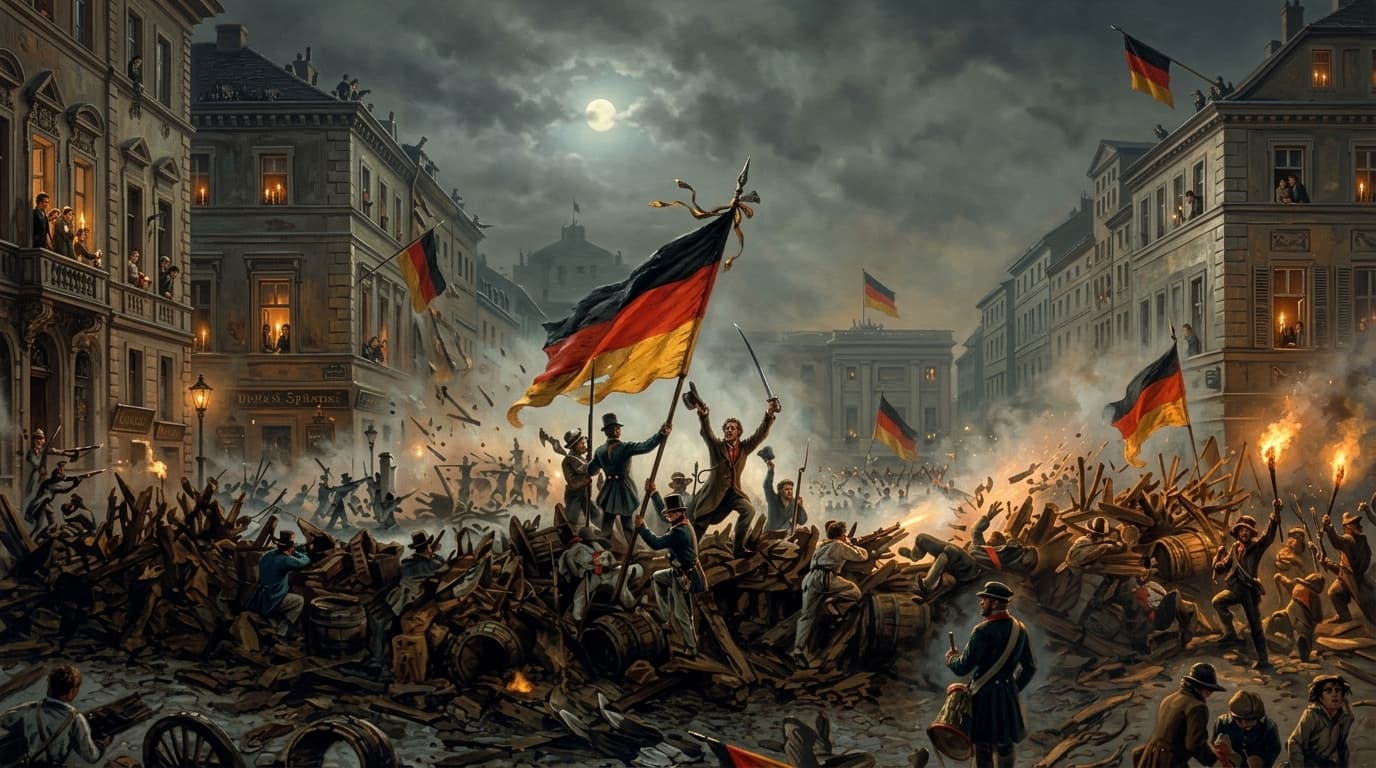
With the armed uprising broken, white terror descended upon Berlin. Freikorps patrols roamed working-class districts, executing suspected insurgents without trial. Despite the extreme danger, Luxemburg and Liebknecht stubbornly refused to flee the city, moving between temporary safe houses in the Wilmersdorf district.
The story of the German Revolution is, in many ways, the story of world revolution. According to Karl Marx, a communist revolution is preconditioned by a highly developed industry and a highly organised and politically conscious proletariat (industrial workers). Germany possessed both of these; thus, Germany was the leading candidate for a communist revolution. Many Marxists of the day believed that, with the aid of a socialist Germany, the rest of the world would follow suit in a global chain reaction. When the Bolsheviks came to power in 1917, they fully believed that their success depended on a successful German revolution, as Russia was still, for the most part, unindustrialised. The leader of the Bolsheviks, Vladimir Lenin, remarked, “It is an absolute truth that without a German Revolution we are doomed.”
In November 1918, that anticipated revolution had come; sparked by a sailors’ mutiny in Kiel on November 3, revolutionary fire had engulfed Germany within days. On November 9, the revolution reached Berlin and, without any blood being spilled, toppled the centuries-old monarchy. Yet, in the ensuing power vacuum, Germany’s future hung in the balance. On one side were the Social Democrats (SPD and the right wing of the USPD), who wanted a liberal parliamentary republic, and on the other side were the communists (Spartacists, Stewards and the left wing of the USPD), who wanted a Council Republic.
I. Dual Power in Berlin
On the afternoon of November 9, the Revolutionary Stewards entered the Reichstag and issued a revolutionary declaration by majority vote. This declaration urged all Berlin workers and soldiers to choose representatives, one for every 1,000 workers and one per military battalion. These delegates were to gather at Circus Busch at 5 PM the next day to choose a provisional government called the Council of the People's Deputies. While the Revolutionary Stewards were planning to establish a government of councils, in another room of the Reichstag, certain members of the SPD and the USPD were discussing a government of parties.
On November 10, delegates assembled at Circus Busch. Through organised mobilisation and the distribution of thousands of leaflets, the SPD secured a majority among the delegates. The assembly ratified the creation of a six-member Council of the People's Deputies, with three SPD members and three USPD members, headed by Friedrich Ebert. Germany entered a state of ‘dual power’, a term coined by Lenin. During the Russian Revolution, dual power was split between two opposing camps, the Petrograd Soviet and the provisional government. Yet in Germany, Friedrich Ebert achieved the remarkable feat of being both the Chancellor of the old Reich government and, within 24 hours, the co-chair of the Council of the People's Deputies. He was simultaneously both the leader of the revolution and the counter-revolution.
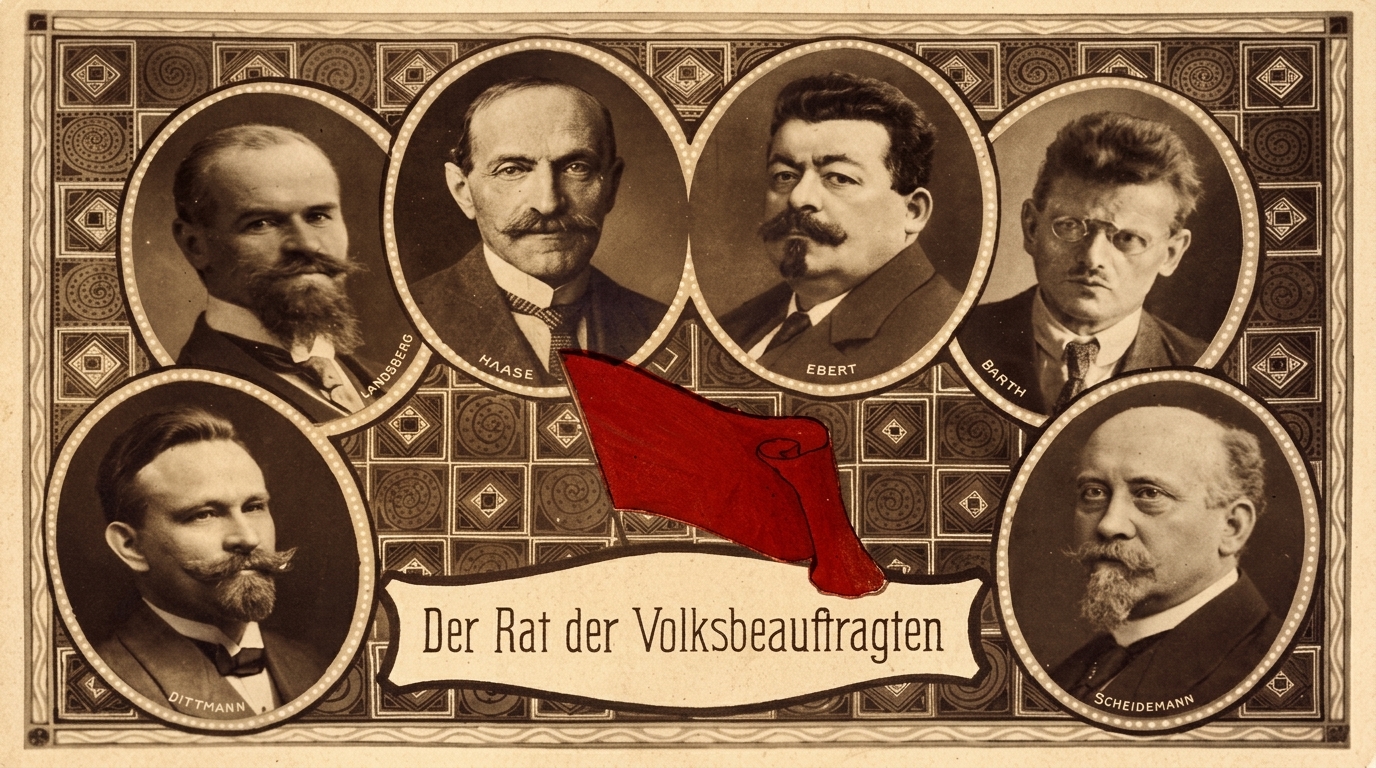
To oversee this provisional government, the assembly elected a 14-member Executive Council of Workers’ and Soldiers’ Councils, consisting of seven SPD members and seven USPD members, chaired by Richard Müller. In theory, the Executive Council was the supreme organ of the revolutionary republic, possessing the legal authority to monitor and even dismiss the People's Deputies. Ebert was the head of the government, but Müller was the head of the state. In practice, however, Ebert and his colleagues systematically bypassed and undermined Müller's council. The Executive Council was also mired in constant internal disagreements and indecisiveness, prompting its critics to mockingly call it a debating society.
On the night of his election, Ebert received a direct telephone line connecting his office to the Imperial Army Command in Kassel. On the other end of the line was General Wilhelm Groener, Quartermaster General of the German Army. Groener offered military loyalty to the new Ebert government, and in return, Ebert pledged to insulate the military from democratic oversight and preserve the traditional authority of the aristocratic officer corps. This preserved the officer corps as an autonomous, self-governing ‘state within a state’. This arrangement became known as the Ebert-Groener Pact.
On December 16, the first National Congress of Workers’ and Soldiers’ Councils was held in Berlin. The congress secured some partial victories, such as the socialisation of key industries and resolutions to advance women's equality. Another important agenda item at the congress was the question of whether Germany would be ruled by a national assembly or by workers’ and soldiers’ councils. For the Spartacists and the Stewards, a vote for a national assembly meant the road towards bourgeois rule and a vote for the counter-revolution, while some members of the USPD believed that both a national assembly and the council system could coexist. On this question, the leftists suffered a devastating defeat, with the majority of the congress voting for a national assembly and, therefore, the eventual dissolution of the councils.
II. Bloody Christmas of 1918
As Christmas arrived, the soldiers in Berlin were looking forward to celebrating after four years of war, yet what followed would become known as ‘Bloody Christmas’. One of the main military forces of the revolution was the People's Naval Division, made up of 2,000 revolutionary sailors stationed at the Berlin Palace. The newly appointed military commander, Otto Wels, demanded that they evacuate the palace, reduce their numbers and eventually dissolve into the Republican Guard. The sailors refused to evacuate the palace until they received their back pay and new staff quarters. Thus, they went to the Reich Chancellery to express their demands; however, Ebert refused to meet them. The sailors then took Otto Wels hostage and blockaded the Chancellery.
Although the sailors let Wels go without any injuries, Ebert had already invoked the Ebert-Groener Pact. At 2 AM on Christmas Day, he ordered General Arnold Lequis and Major Waldemar Pabst to attack the Berlin Palace with army assault troops and heavy artillery and to round up the People's Naval Division. Government troops opened fire, and a gunfight broke out. Workers from the surrounding areas heard the gunshots, came to see what was happening and began cheering on the sailors. This demoralised some of the government troops, causing them to defect. The troops were forced to withdraw, suffering a humiliating defeat, but 67 men had already been killed in the battle.
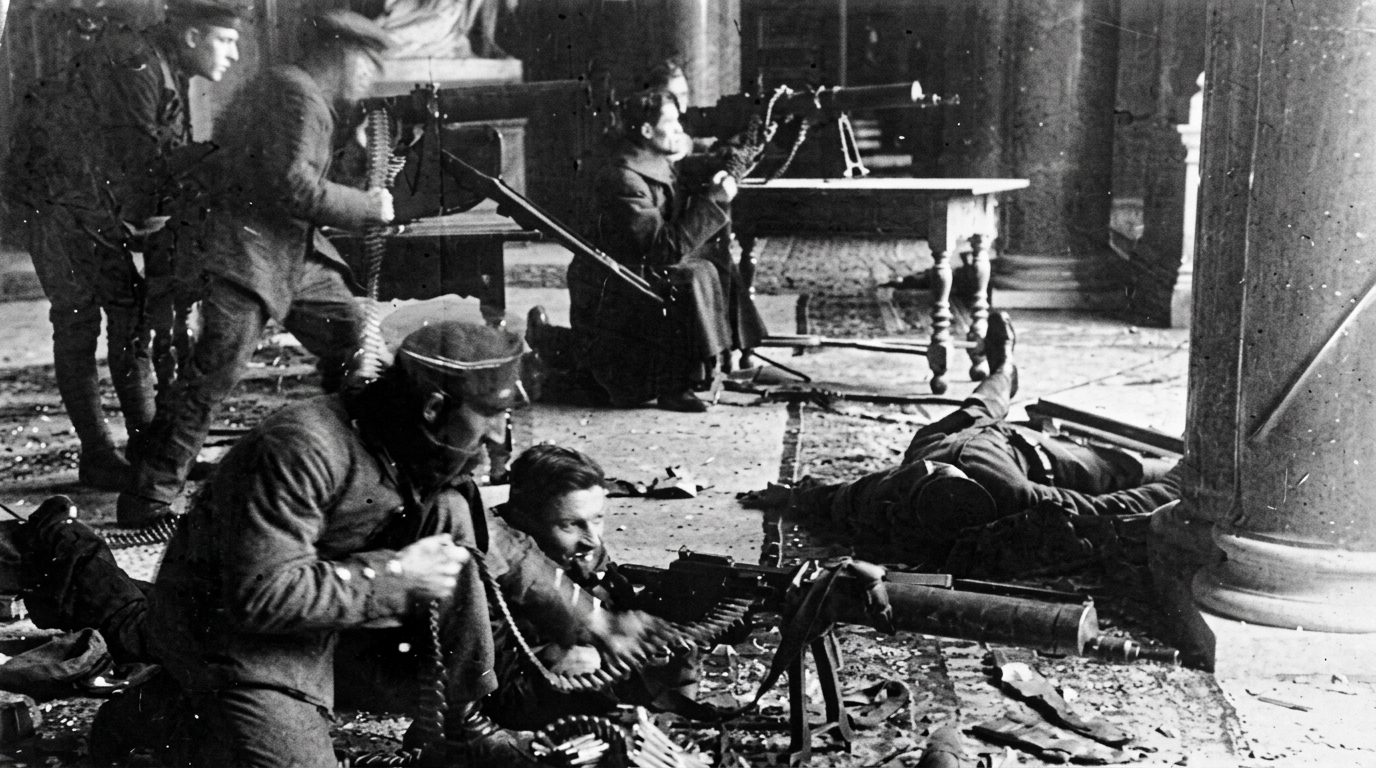
Following the events of Bloody Christmas, all three USPD members resigned from the Council of People's Deputies in protest on December 29. The fragile coalition of socialist parties was dead. Ebert and General Groener were happy that the USPD had left; the military command had wanted them to leave all along so they would stop interfering in its proceedings. Now the government was run entirely by the SPD. Ebert replaced the departing ministers with hardline SPD loyalists, most notably Gustav Noske, who took charge of the War Ministry. The cabinet dropped the name Council of the People's Deputies and rebranded itself as the Reich Government. Embracing his new role, Noske famously declared, “Someone has to be the bloodhound. I won't shirk the responsibility.”
Noske immediately set about organising a new mercenary military force: the Freikorps (Free Corps). Formed out of volunteer officers, veterans and radicalised nationalist youths, these paramilitary units were characterised by virulent anti-Semitism, misogyny and a fanatical hatred of socialism. They were marked by an almost absurd tendency towards arbitrary brutality, which prefigured the atrocities that would later be committed by the Nazis. They were dressed in imperial uniforms and frequently sported chalk-drawn swastikas on their helmets. Many officers of the Freikorps would become high-ranking Nazi officials, such as Heinrich Himmler, Ernst Röhm and Rudolf Höss, the future commandant of Auschwitz.
Increasingly alienated and antagonised by the SPD government and fearing the collapse of the revolution, the radical left, namely the Spartacists and the International Communists of Germany (IKD), gathered in Berlin on December 30, 1918, to found the Communist Party of Germany (KPD), led by Rosa Luxemburg. The Revolutionary Stewards were also eager to merge with the KPD but demanded equal representation on the executive committee. The negotiations failed, and the young KPD was left organisationally weak and severed from the Berlin proletariat. This was compounded by Luxemburg’s critique of Bolshevik-style centralism. She believed that revolution could not be directed by a central committee; rather, the proletariat would rise spontaneously and carry it out. This meant that, unlike the Bolsheviks, who had been preparing for an insurrection since 1903, the KPD had neither the preparation nor the organisational capacity for one. This would become abundantly clear in the event that came to be known as the Spartacist Uprising.
III. The Spartacist Uprising
On January 4, 1919, Chancellor Ebert and War Minister Noske formally dismissed Emil Eichhorn, Berlin’s police chief. Eichhorn, a left-wing USPD member, was regarded by the working class as a vital safeguard against unilateral SPD control over the security apparatus. Recognising that Eichhorn’s removal was a calculated attempt to strip the left of its last remaining armed outpost in the capital, the USPD, the Revolutionary Shop Stewards and the KPD issued a joint call for a mass protest demonstration on January 5. The strike turnout was larger than anyone expected, with over 100,000 workers pouring into the streets.
During the strike, rebellious workers independently poured into Berlin’s newspaper district and occupied the office of the SPD mouthpiece Vorwärts, renaming it Rote Vorwärts (Red Vorwärts). Inspired by the massive turnout at the strike and the seizure of Vorwärts, Liebknecht believed that the overthrow of the Ebert government was now possible. Although the KPD had explicitly decided that it would not attempt to carry out any hasty coup attempts, Liebknecht was overcome with intense revolutionary optimism and called for the overthrow of the Ebert government. A 53-member Revolutionary Committee was hastily formed at the police headquarters.
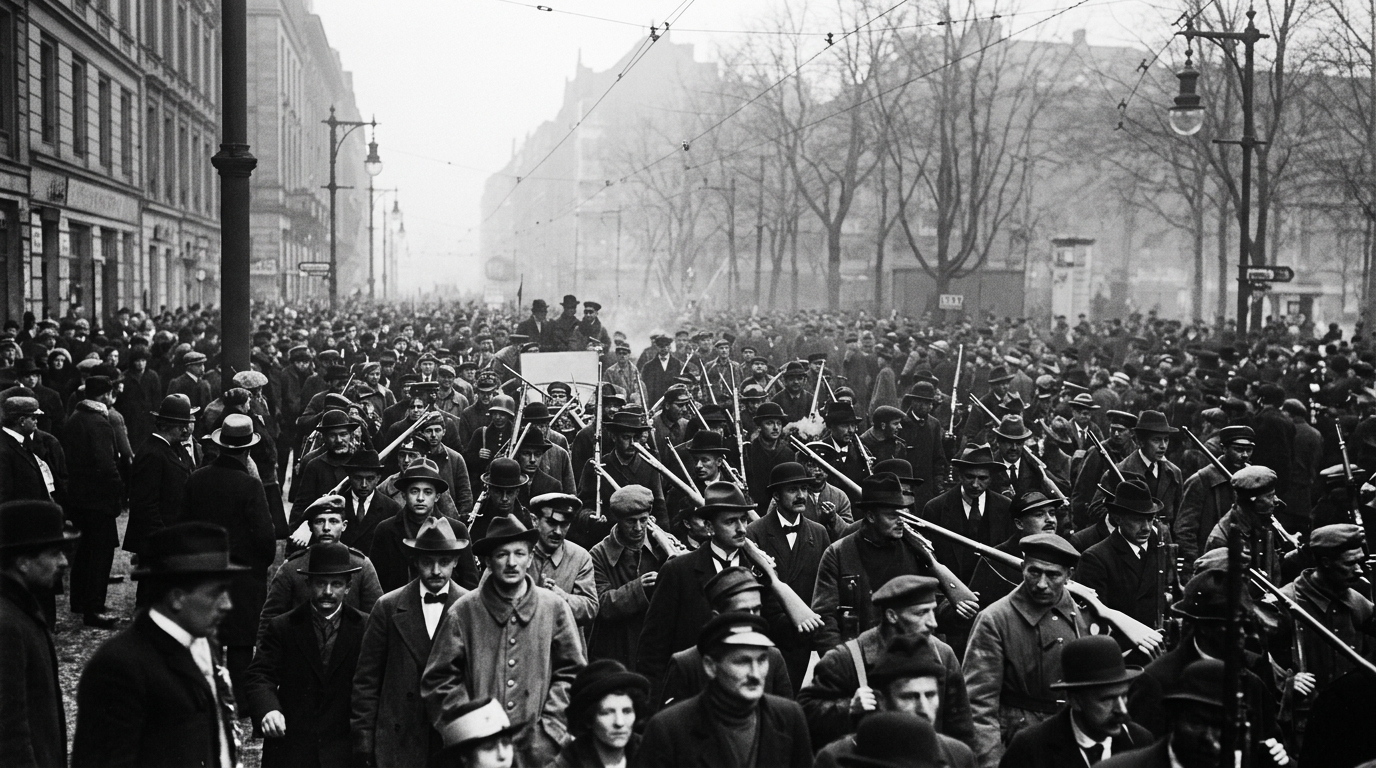
Although the uprising is most commonly known as the Spartacus Uprising, the only Spartacists on the committee were Liebknecht and Wilhelm Pieck; the rest were mostly Stewards and left-wing USPD members. Luxemburg had little faith in the uprising and never joined the committee. She recognised that the vast majority of the workers on the streets were there to defend Eichhorn and the gains of the November Revolution, not to overthrow the government.
Over the next two days, the committee proved entirely incapable of leadership, indulging in endless debates while the workers on the streets waited for orders or strategic directives. By the evening of January 6, the strike had already begun to retreat, and Eichhorn's dismissal was finalised. As the committee stalled, Gustav Noske assembled several fully armed Freikorps brigades on the outskirts of Berlin on January 8, 1919. The revolutionary committee recognised that the uprising had failed and wanted to negotiate with the government. However, Ebert dismissed the call for negotiations, demanded unconditional surrender and issued a proclamation declaring that “the hour of reckoning is approaching.” Although Luxemburg initially opposed the uprising, it was at this point that she expressed her support for it, believing that since the workers were already fighting in the streets, it would be wrong to disavow them now.
On January 10, Freikorps units armed with heavy artillery, mortar batteries, tanks and flamethrowers swept through the city, crushing centres of revolution one by one and executing captured prisoners mercilessly. They attacked Spandau, killing the chairman of the workers’ council as well as the chairman of the soldiers’ council. The following day, Freikorps troops attacked the Vorwärts building, where 300 workers had taken cover. As artillery smashed through the façade, the workers hoisted a white flag and sent seven envoys to negotiate a surrender. The Freikorps troops executed them on the spot, lined up the remaining occupants against walls and shot them. By January 12, the police headquarters had been retaken, and the January Uprising was crushed, leaving over 150 insurgents dead.
IV. White Terror Descends
With the armed uprising broken, white terror descended upon Berlin. Freikorps patrols roamed working-class districts, executing suspected insurgents without trial. Despite the extreme danger, Luxemburg and Liebknecht stubbornly refused to flee the city, moving between temporary safe houses in the Wilmersdorf district.
On the evening of January 15, 1919, both Luxemburg and Liebknecht were arrested and taken directly to the Eden Hotel, headquarters of the Freikorps Garde-Kavallerie-Schützen-Division. After interrogation and beatings at the Eden Hotel, Liebknecht was driven to Tiergarten Park and shot in the chest. His body was delivered to a nearby police station as an unidentified corpse. Luxemburg was escorted out of the hotel, struck down with a rifle butt, shot in the head and thrown into the Landwehr Canal.
To cover up the assassinations, the military issued fabricated reports claiming that Liebknecht had been “shot while attempting to escape”, while Luxemburg had been “lynched by an angry mob”. No one was ever meaningfully punished for the executions. It was in this environment that Max Weber gave a lecture in Munich, where he famously defined the state as the holder of “a monopoly on violence”.
In February, Freikorps columns marched into northern Germany to smash the Bremen Council Republic. In March, when Berlin workers launched a general strike demanding socialisation and the release of political prisoners, Noske issued a shoot-on-sight order. In the ensuing “March Massacres”, between 1,200 and 3,000 workers were slaughtered.
Twenty-nine unarmed members of the People's Naval Division were lured into an administrative office under the pretext of receiving back pay and executed. In May, Freikorps units invaded Munich, crushing the Bavarian Council Republic. Hundreds were executed, including the communist leader Eugen Leviné and the anarchist philosopher Gustav Landauer, who was beaten and trampled to death in a prison yard.
On August 11, 1919, the new constitution was ratified, which officially renamed Germany as the German Reich (Deutsches Reich) and dissolved the Executive Council of Workers’ and Soldiers’ Councils, marking the end of the revolution. The constitution preserved the structural architecture of the old Imperial Reich. The SPD left the imperial judiciary, civil service bureaucracy and military officer corps entirely intact. Furthermore, the constitution included the fatal Article 48, an emergency provision that granted the Reich President dictatorial powers to suspend civil rights, rule by decree and deploy military force against internal political dissent—a constitutional loophole that Adolf Hitler would exploit in 1933 to dismantle the republic from within.
____________________
Author: Writer and Translator
[email protected]
Your contribution keeps investigative journalism fearless, transparent, and accessible to everyone. To support us securely donate from anywhere.