Silent Sentinel: Why Is a US Military-Gerade Underwater Drone in Bangladesh’s Bay?

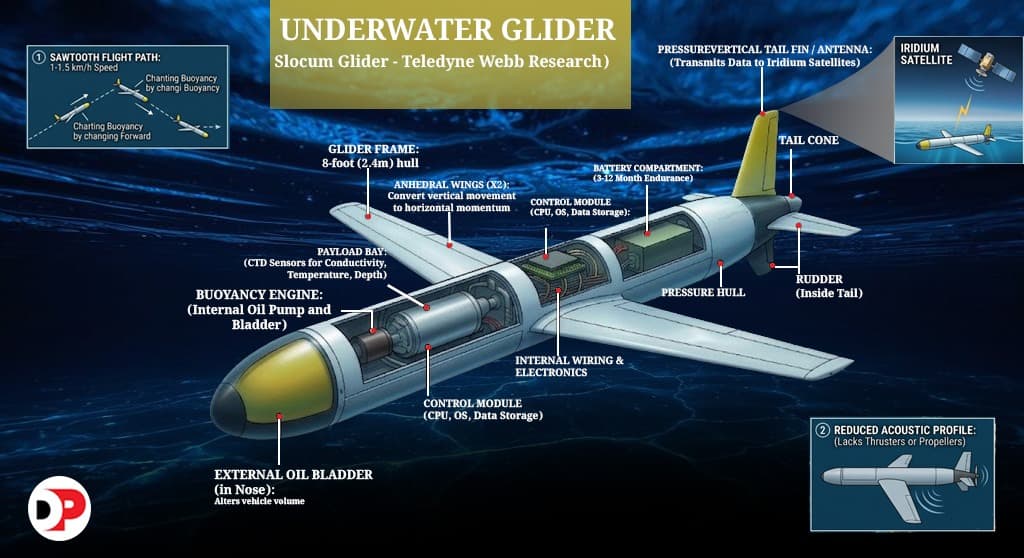
Sketch: AI
The American-built vehicle, capable of silent surveillance and anti-submarine warfare, raises stark questions about foreign intelligence operations in waters Bangladesh considers its own. With the manufacturer silent and mission data locked away, one thing is clear: someone was mapping Bangladesh's Bay without asking permission.
On the afternoon of 31 May 2026, fishermen from Patharghata, a coastal upazila in Bangladesh's Barguna district, hauled an unexpected catch from the Bay of Bengal: an 8-foot-long torpedo-shaped unidentified underwater vehicle from their nets.
The vehicle contains internal wiring and various electronic devices and the purpose of those gedets and actual capability of these are not clear. Examination of the available photos and videos shows that the device was manufactured by Teledyne Webb Research, a US-based company specializing in autonomous underwater vehicles. It is an unmanned underwater glider designed to navigate extreme deep-sea environments and transmit precise data.
Publicly available defense records indicate that the US Navy has procured over 210 such gliders from Teledyne over the past decade. It is still unknown what this glider was doing in Bangladeshi waters or who deployed it. The specialized vehicle is currently in government custody.
An email was sent to the US company Teledyne Webb Research, mentioning the batch number found on the glider recovered in Patharghata. The email inquired about the specific organization to which this glider was supplied. However, Teledyne did not respond to the email.
According to initial visual inspection, the vehicle contains electronic modules, battery units, CTD sensors, control systems, and an antenna-like communication device. Investigators reportedly identified manufacturer markings and a serial number, S/N: *****, on the control module. Dhaka Papers, which first reported the serial number, notes that such identifiers could help trace the glider's original purchaser. However, Bangladesh authorities have not yet officially confirmed the exact origin or ownership of the device. Open-source tracking suggests this serial number could help identify the organization or entity to which the glider was originally sold or transferred. The barcode and manufacturer markings confirm it is a product of Teledyne.
Through direct examination of the control module recovered from the glider, Dhaka Papers identified the device's serial number as S/N: ****. The module, which functions as the vehicle's central processing unit, hosts its operating system and data-storage components. It also archives incoming sensor data. Open-source tracking suggests this serial number could help identify the organization or entity to which the glider was originally sold or transferred. The barcode and manufacturer markings confirm it is a product of Teledyne.
Teledyne and the US Navy
In the late 1980s, renowned oceanographer Douglas Webb designed an underwater vehicle. It could travel miles beneath the ocean without a traditional engine or propeller. Recognizing the strategic value of this concept, the US Navy’s research wing funded the project in 1986. This wing was the Office of Naval Research, then known as the Office of Naval Technology. The technology was developed between 1986 and 1991 under a US Navy budget and direct contracts.
Following testing, the project completed its first successful underwater dives in 1991. These took place at Wakulla Springs, Florida, and Seneca Lake, New York. In 1994, Douglas Webb secured the official US patent for this technology. The project was originally developed with support from the US Navy and attracted significant naval interest.
After 2000, military applications of the Slocum Glider expanded significantly. Open-source defense documentation suggests variants were later adapted for military applications. This included the LBS-G (Littoral Battlespace Sensing Glider) program.
According to official defense records, Teledyne Webb Research has supplied over 210 of these gliders to the US Navy. Formal procurement began with the first commercial contract signed in 2009. Continuing this military procurement program, the US Navy signed a new contract with Teledyne in July 2021. Under this agreement, the US Navy’s Naval Oceanographic Office continues to procure these gliders. It also secures advanced software maintenance services.
The glider recovered in Patharghata is not a conventional civilian buoy. It is a sophisticated underwater glider manufactured in the United States. Open-source records indicate its capabilities can support both scientific and military missions.
Capabilities and Military Applications
While the exterior of the glider recovered in Patharghata looks harmless, its internal capabilities are highly advanced. Operating deep beneath the surface, it gathers critical data. According to naval experts, this data can support modern naval operations.
The glider is equipped with highly sensitive CTD sensors. These sensors measure water conductivity, temperature, and depth. These three elements are used to calculate salinity variations across different underwater layers. While this may seem like basic environmental data, defense analysts note it can actively support naval operations.
The speed of sound underwater depends directly on changes in water temperature and salinity. By diving to various depths, the glider creates a highly accurate digital profile of this underwater speed of sound.
Standard radar and light cannot penetrate deep water. Therefore, submarines and warships rely entirely on sound waves via sonar systems. Variations in water temperature and salinity create underwater boundaries known as 'thermocline layers'. These layers can refract, scatter, or partially reflect sonar energy. Submarines often hide beneath these thermocline layers to prevent opposing warships from detecting them.
One of the principal applications of such gliders is the collection of environmental data relevant to underwater acoustic operations. Such data may contribute to submarine detection and tracking. However, it is only one component of broader anti-submarine warfare capabilities.
Open-source analyses suggest such data may help naval operators optimize sonar performance. It also improves the detection of underwater targets under certain conditions. These activities fall within the broader framework of Anti-Submarine Warfare (ASW), which includes the detection, tracking, and monitoring of underwater threats.
Certain Slocum Glider configurations can be equipped with acoustic instruments capable of contributing to bathymetric surveys. Such systems may generate detailed maps of underwater terrain, including trenches, ridges, and seabed topography. However, it could not be independently confirmed whether the recovered glider carried such payloads.
It can be used for surveillance and data collection in sensitive maritime environments. This provides operators with valuable situational awareness. Because of its low acoustic signature, the device can conduct surveillance with a reduced likelihood of detection. This feature strongly supports naval capabilities.
Technical Mechanics and Stealth
The most intriguing aspect of the recovered underwater glider is its external design. Unlike conventional vessels or submarines, it lacks propellers or thrusters. It travels miles through the ocean without the roar of a traditional engine. This silent propulsion relies on a clever application of physics.
The glider moves by altering its buoyancy. Its nose contains a specialized oil bladder and a small electric pump. To dive, the pump draws oil from the external bladder into the hull. This slightly reduces the vehicle's volume, making it heavier than water and causing it to sink. To ascend, the pump pushes the oil back into the external bladder. This makes the vehicle lighter than water, causing it to float upward.
Two small fixed wings on its sides convert this vertical movement into forward, horizontal momentum. As a result, the device glides forward at an angle. This specific flight path is called a "sawtooth pattern." Because it lacks a large engine, it travels slowly. It covers about 1 to 1.5 kilometers per hour. However, its battery can operate continuously for 3 to 12 months.
Acoustic Characteristics and Detection Limitations
Open-source defense literature frequently notes that gliders of this type present a reduced acoustic profile, potentially complicating detection and tracking efforts. The primary method for detecting underwater vessels is listening for the sound of engine vibrations or propeller rotations. This Slocum Glider has neither. Even its internal oil pump generates relatively little acoustic noise.
Consequently, such gliders may be more difficult to detect than conventional propeller-driven underwater vehicles. This silent operation is why the device is considered an asset for intelligence gathering.
Iridium Satellite: The Hidden Information Highway
The glider's main objective is to gather massive amounts of oceanographic data, such as temperature, salinity, and depth. It then transmits this data to the control room. Data transmission occurs through Iridium's satellite communications infrastructure using mission-specific communication protocols configured by the operator.
Iridium is an American communications firm with a constellation of 66 satellites encircling the globe. It is one of the few satellite networks capable of providing near-global coverage, including polar regions.
When the glider completes a leg of its mission, it surfaces. Its vertical tail fin acts as an antenna. It connects to an Iridium satellite and transmits collected data to designated ground stations. Once the data transfer is complete, the glider downloads fresh commands or new GPS coordinates. It then dives back into the ocean.
US Navy Deployments and Strategic Presence
The United States maintains a significant strategic presence in the Bay of Bengal and the wider Indian Ocean region. A review of recent events shows that in September 2024, the USS Blue Ridge was present at Chittagong Port and its outer anchorage. This ship is one of the flagship command vessels of the US Seventh Fleet. This command and control ship coordinates maritime security and intelligence-gathering operations.
Furthermore, US Navy oceanographic survey vessels regularly conduct maneuvers and surveys in the Bay of Bengal to map the deep sea. These survey ships are typically the platforms used to deploy underwater gliders into the deep ocean. No evidence has emerged linking the recovered glider to the USS Blue Ridge or to any specific US naval deployment in the region.
Mathematical Correlation of Speed and Distance
A geographical comparison can be made between where the glider was recovered in Patharghata and the position of Chittagong Port. The direct nautical distance from the Chittagong Port outer anchorage to the coastal area of Patharghata in Barguna is approximately 150 to 170 kilometers, averaging 160 kilometers.
At its typical operating speed of approximately 1 to 1.5 kilometers per hour, a Slocum Glider could theoretically cover a distance of 160 kilometers within roughly 4.5 to 6.6 days under self-propelled conditions.
If the vehicle had instead become disabled and drifted passively, its movement would have depended primarily on local ocean currents rather than its designed cruising speed. The self-propelled estimate suggests that, if operational, the glider could have reached the recovery area within several days. Any drift-based estimate, however, would require separate analysis of regional ocean currents. Determining its exact route and point of origin would therefore require additional evidence.
Who May Have Deployed the Glider?
International powers are highly active in the Bay of Bengal. Bangladesh resolved its maritime boundary disputes with its neighbors, India and Myanmar, over a decade ago. Despite this, both nations maintain a deep interest in the Bay of Bengal. However, no publicly available information indicates that India or Myanmar has acquired this type of Teledyne glider.
Beyond them, China and the United States hold major interests in the region. No publicly available information was found indicating that Teledyne has supplied this type of glider to China. In contrast, Teledyne's glider program was entirely initiated through US Navy funding. The United States has purchased at least 210 such units from the company.
The available evidence strongly indicates that the recovered device was manufactured by Teledyne Webb Research. Yet the central questions remain unresolved: who operated it, for what purpose it was deployed, and how it ultimately reached Bangladeshi waters. Resolving those questions would likely require cooperation from the manufacturer, access to the vehicle's stored mission data, and further investigation by the relevant authorities.
_________
*Author: Editor, Dhaka Papers
Email: [email protected]