Coffin-Bound Remittances, the Business of Religion, and an Eighty-Two-Sikka Slap
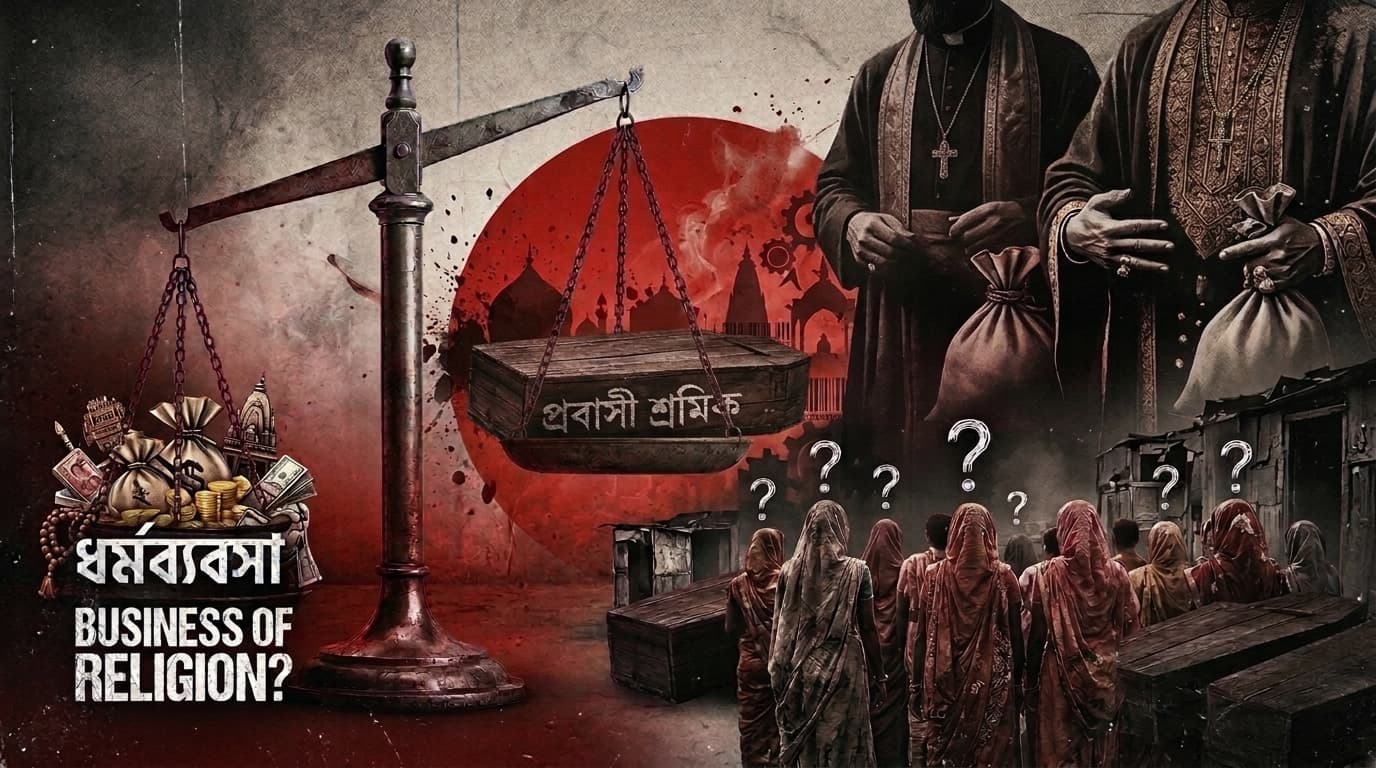
Dhaka Papers graphics
Across the subcontinent, 2.1 million people work in the Gulf countries; during the Covid-19 pandemic, a great deal was written about the inhumane treatment they had to endure. But in mainstream politics, they still cannot even be a footnote. Some have become foot soldiers. They have become carriers of various shades of fundamentalism.
Two young people—a man and a woman—have come home to Bangladesh in coffins, accused of kissing in the Holy Mosque. The Saudi government has still not told the Bangladesh government exactly what they were accused of, where the alleged offence took place, or how they were tried. The young man's father says his son's death was the result of a personal feud with a Pakistani colleague. Leaving aside this tale of family intrigue in South Asia, let us take a quick look inside Bangladesh's economic storehouse.
International remittances amount to about 7% of Bangladesh's GDP. They come from poor Muslims like these two—one a mason, the other a domestic worker—who, in the land of the Sheikhs, sweat blood, sleep twenty in a cramped room, eat sparingly, save their money and send it home through bKash. Taken together, Bangladesh's migrant workers send home $35.59 billion, or roughly 3.37 trillion Indian rupees. Saudi Arabia has the largest number of migrant workers, so the largest share of remittances comes from there too. From 2021 to June 2026, the bodies of 250 Bangladeshi women have returned from Saudi Arabia alone. All of them were domestic workers. 250. Their deaths were not tied to religious sentiment, so they hardly made the news. 250. Saudi Arabia also has the highest suicide rate among women domestic workers. In a Netra News report, Noor, who returned from Saudi, said she used to believe that the people of Mecca and Medina could not be bad; now, with broken ribs and bruises, she warns others not to go to Saudi. She tells stories of how many girls have come back to Bangladesh pregnant.
That money, smeared with blood and tears, builds brick houses, pays for sisters' weddings, and puts a migrant's name on a plaque for generous donations to the neighbourhood mosque. On one side are garment workers, on the other migrants: they are the coal, dung cakes, and dry leaves of Bangladesh's economy, burning in the stove, and the smell of hot rice fills village after village in Noakhali, Brahmanbaria, and Feni. To save money, a son stays abroad year after year; the kafeel seizes his passport and abuses him, and the migrant has no way of getting it back. He bought the neighbouring plot last year, with debt on his head; he borrowed money to buy a ticket to Dubai, and that loan has not been repaid either. He cannot return home; he cannot return defeated. Coming home dead is acceptable; coming home defeated is not. He cannot return defeated. In Saudi Arabia alone, an average of 2,500 Bangladeshi workers die every year, according to Wage Earners' Welfare Board data. In most of their cases, the cause is recorded as "natural death". Falling from a roof is natural; dying in the heat is natural; even a tin roof collapsing on someone's head is natural.
Two people have come back dead in coffins. The government has done nothing. The elders, the jalsa organisers, the clerics, and the Tawhidi crowd have instead applauded. Blasphemy? What courage. They did well to kill them—that, apparently, is the correct religion. Wrongdoing on the Saudi side goes unnoticed; even when it is noticed, no one speaks of it. Poor Muslims' lives are cheap; their money can build stages for mehfils, but their killing does not make the pious blink so much.
Today I saw that the father of an abused child gave an eighty-two-sikka slap to a cleric who had sexually harassed the child. Unless such a stinging slap lands, society does not wake up. Asifa's killers get the tricolour; Ankita's killers become governors. If only we could deliver such a stinging slap! There is no shortage of complaints about the harassment of children, boys and girls, in schools and places of worship. Across South Asia, religion is used as a shield to cultivate unrighteousness. Poor people fight over temples and mosques, while the government quietly hands over water, forests, land, and ports to rich traders. The hard-working people of South Asia, battered by hunger and poverty, then head abroad in search of work. He begs a cousin for help; he falls into the trap of a fake agency and loses everything; he dies in a jungle while trying to go to America by the donkey route; he is caught by police while trying to enter Europe from Romania—but he does not give up. In jail, in a refugee camp, whenever he remembers his mother, he remembers the face of his unmarried sister. He does not give up. South Asia's labouring body recites the kalma, sings gurugita, reads the Hanuman Chalisa, or does none of it; perhaps it seeks courage and comfort from the sky and river of its childhood, from the red ribbon in the hair, from the newly grown moustache, from all the safe memories of its own life. Sitting in Arabia's hot desert or in Canada's snowstorm, he dreams of returning home one day after earning a lot of money. He does not understand that his homeland is being stolen, that his youth, labour and dreams have been sold at a high price.
Across the subcontinent, 2.1 million people work in the Gulf countries; during the Covid-19 pandemic, a great deal was written about the inhumane treatment they had to endure. But in mainstream politics, they still cannot even be a footnote. Some have become foot soldiers. They have become carriers of various shades of fundamentalism. But I do not see protests in any country demanding tougher international labour laws! I only count the bodies that come to my notice and record them on the computer as data.
Yesterday a gentleman wrote that the people of Bangladesh have understood the difference between religion and the business of religion. And they do not dance to the clerics' words. In our country too, people will understand the difference between religion and the business of religion. But the Bengalis on this side of the border—in West Bengal—are still in a daze; for now, they are licking Gujarati dhokla and thekua from Bihar and UP, thinking these are prasad. Let them lick; our riverine country takes time to heat up. They too have a slap coming to them. The country of Subhas Bose, Masterda, Ila Mitra and Rokeya will not go completely to the dogs! What do you say?
*Author: Leader, Communist Party of India (Marxist)
West Bengal, India
Your contribution keeps investigative journalism fearless, transparent, and accessible to everyone. To support us securely donate from anywhere.