The Doctor Who Is Challenging the Democratic Establishment in Michigan

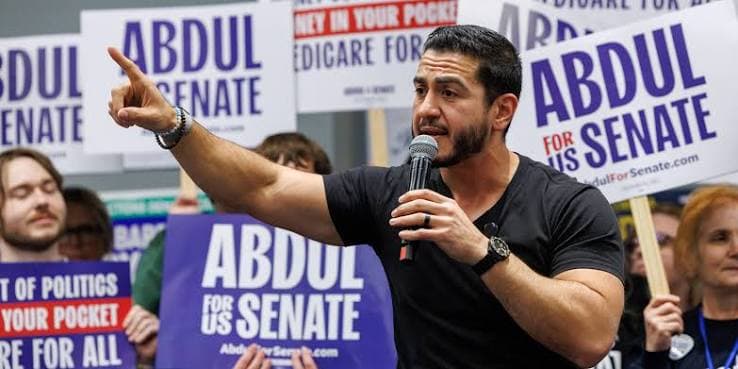
Abdul El-Sayed's Senate campaign has become a test of whether the Democratic Party still has room for a politics centered on universal healthcare, working-class power, and opposition to war.
On August 4[1], Michigan voters will decide far more than their next Democratic nominee for the U.S. Senate. They will vote on what it actually means to be a Democrat in the post-industrial Midwest. On one side stands Representative Haley Stevens[2], a candidate favored by party leadership and propelled by a tidal wave of super PAC cash[3][4]. On the other is Dr. Abdul El-Sayed[1], an epidemiologist and former county health director[5][6], who is attempting to weld universal healthcare, working-class debt relief, and an anti-war platform into a formidable electoral coalition.
For decades, the political establishment has approached healthcare largely as a spreadsheet puzzle—figuring out how to tinker with subsidies just enough to pacify voters while protecting the profit margins of private insurers like Blue Cross or Cigna. El-Sayed brings a fundamentally different diagnosis to the campaign trail. Early in his public health career, he repeatedly observed an ugly paradox: you cannot genuinely heal a child’s asthma if that child is sent immediately back to a neighborhood smothered by unregulated industrial emissions[7]. Through this lens, sickness in the Rust Belt is not a personal failure, but the predictable consequence of a fractured political economy that places corporate interests over human lives.
That conviction defined his tenure after he was brought in to rebuild Detroit's health department in the wake of municipal bankruptcy[6], and later, his leadership of Wayne County’s health department[6]. It was there that El-Sayed broke past traditional administrative limits to enact an aggressive intervention. Partnering with a national nonprofit, his department initiated an innovative program utilizing public relief funds to buy and erase up to $700 million in local medical debt[6][8]. The strategy is remarkably efficient—buying distressed obligations for pennies on the dollar from local hospital networks[9] to rescue struggling families near the poverty line.
This wasn’t just administrative charity; it was a material transfer of power back to workers. "Medical debt is a financial anchor on too many families," he explained while unveiling the program[8], echoing a common theme from his stump speeches that no family should face bankruptcy over illness[10]. Relieving that debt returns direct bargaining leverage to a heavily strained working class. Predictably, it’s also the primary reason organized labor has aligned behind his Senate bid.
But proposing the obsolescence of medical debt, combined with pushing aggressively for Medicare for All[6], naturally triggers an immune response from the Democratic donor class. Consultants frequently discourage structural reforms by pointing to "electability." The enduring centrist narrative insists that alienating corporate donors in a swing state risks giving ground to Donald Trump’s MAGA loyalists. The harsh truth is much simpler: challenging the lucrative monopolies of the American medical system terrifies industry lobbyists, and they will pay handsomely to neutralize anyone who tries it.
The financial counterassault in Michigan has been historic. Entering the final stretch of the primary, AdImpact data showed super PACs burying the airwaves to favor Stevens with a monstrous 12-to-1 spending advantage[4]. Central to this bombardment is the United Democracy Project, a PAC affiliated with the American Israel Public Affairs Committee (AIPAC), which has directed upward of $15 million in the race specifically to block El-Sayed’s ascent[3].
Why does a pro-Israel political action committee care about a doctor running on Medicare for All in the Midwest? Because the establishment clearly recognizes the danger of a populist who seamlessly links foreign military spending with domestic decay. In a state reeling from the Biden administration's unconditional military support for Israel’s devastation of Gaza, an energized coalition of young voters, Arab Americans, and Jewish anti-war organizers is refusing to sit down quietly. El-Sayed taps directly into this frustration, pointing out that billions funneled into weapons contractors abroad are dollars siphoned straight from lead-remediation efforts[6][7] and deteriorating water grids in Wayne County. For powerful lobbies, a politician willing to brawl with the military-industrial complex is inevitably a politician who will pick a fight with pharmaceutical companies next.
The conventional playbook in Washington insists that offering caution is the best safeguard against a right-wing threat. Run quietly, cater to suburban swing voters, and avoid economic disruption at all costs. Yet it was exactly this brand of timidity—ignoring working-class distress and abandoning ambitious labor reform—that disillusioned enough voters to breach the Midwestern Blue Wall in the first place.
Whether the primary breaks toward El-Sayed or the deep war chests backing Stevens, one outcome is already written. A growing movement within Michigan has signaled they are finished with table-scrap concessions. They aren't looking to tinker with a healthcare system designed to exploit them—they intend to write a completely new contract.
_______
1) ballotpedia.org
2) time.com
3) bridgemi.com
4) axios.com
_________
Author: Editor, Dhaka Papers
Email: [email protected]