A Tk 30,000 Minimum Wage for Garment Workers: Why Is It Urgent?
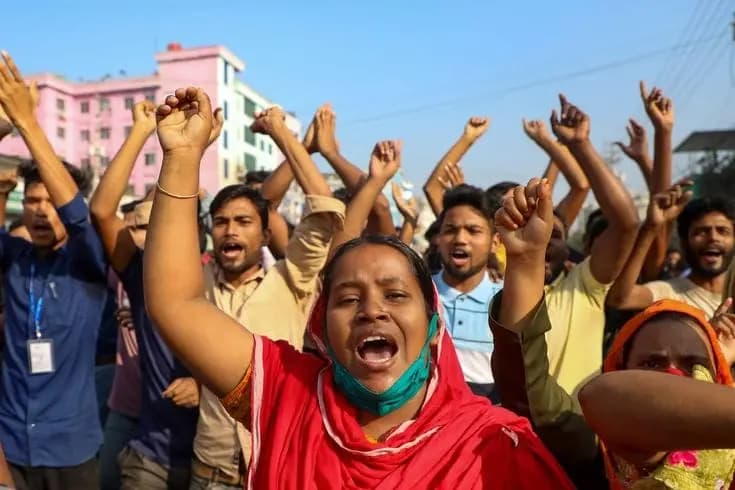
Photo: Collected
All told, about Tk 26,000 a month is now needed just to keep breathing and barely stay alive. As a result, earning only Tk 12,500 or 13,000, workers are getting caught in a web of debt every month.
Every day at dawn, hundreds of thousands of garment workers wake up and hurry in groups toward the factories. It is their back-breaking labor and sweat that keep the biggest wheel of the country’s economy turning. Yet the wages they receive at the end of the month make it impossible to survive in today’s market. On paper, the minimum wage for an ordinary worker is currently Tk 12,500, which has been in effect since December 2023. Before that, under the 2018 wage board, this wage was only Tk 8,000.
Because the labor law has been amended in line with international law, there is now a legal obligation to form a new wage board every three years instead of every five. Accordingly, a new pay structure for workers is due to be announced again by November of this year, 2026, and the government has already made a decision in principle on it.
Under the law, garment workers’ basic pay rises by 5 percent every year. At first glance, it may seem that workers’ income is going up every year anyway, so why is a new pay structure needed every three years? The answer lies in the market’s frightening game of inflation, of the taka losing its value.
A product that cost Tk 100 in late 2023 now costs about Tk 136 at the end of 2026. In other words, over the past three years, overall inflation has risen by a total of 30.4 percent. And at the end of this year, when the new pay structure is announced, this inflation will have reached close to 40 percent. Put simply, what Tk 12,500 could buy in 2023 now costs Tk 16,000 to 16,500 at the end of 2026.
With pay rising 5 percent a year, after three years a worker’s minimum wage comes to Tk 14,470. But the real market figures tell a different story. Under the heavy pressure of inflation, the taka has lost so much value that, compared with three years ago, a garment worker’s minimum wage has in fact fallen by an average of Tk 2,000. The International Labour Organization (ILO) Convention No. 131, on the one hand, speaks of a worker’s minimum right to live a decent social life with their family, and on the other hand, it also takes the employers’ interests into account.
But the real picture of how a garment worker in our country runs a small household of four is extremely harsh. Even to eat coarse rice with at least one egg each or a medium-sized fish a day, a family of four spends Tk 10,000 to 12,000 a month on food alone. The rent for a small, cramped, damp and unhealthy room in the factory belts of Dhaka, Gazipur or Ashulia, plus gas and electricity bills, sends another Tk 6,000 to 8,000 into the landlord’s hands. On top of that, add family members’ illnesses and medical care, and the bare minimum for a child’s school notebooks, pens, and studies, and at least Tk 4,000 more is needed. All told, about Tk 26,000 a month is now needed just to keep breathing and barely stay alive. As a result, earning only Tk 12,500 or 13,000, workers are getting caught in a web of debt every month.
Because of these inadequate wages, women workers in particular are getting trapped in the dark nets laid by NGOs or high-interest moneylenders. The extreme mental pressure of paying interest every month is taking away their right to make family and social decisions. To escape this situation, the right and reasonable price for garments must be secured from foreign buyers through collective action. Because a healthy, well-fed worker shows more skill at work and can work happily, which in the end benefits the owner’s business. So, to let workers live with dignity through a balance of rights, it is now the need of the hour to set aside the old wage calculations and fix the minimum wage at Tk 30,000 in the new 2026 structure.
Workers in Ashulia, Uttara and Gazipur have already taken to the streets with this demand. Police attacks on their movement bring back the same old picture of state repression used to crush democratic movements under the fascist regime. Yet it was out of the desire to change this very picture that workers threw themselves bravely into the July uprising. They had hoped that in the post-uprising state, they would no longer have to face police attacks, repression, or the force of the state to win their demands. But the return of that same old repressive behavior against the workers’ movement tells us that this fight still has a long road ahead.
Your contribution keeps investigative journalism fearless, transparent, and accessible to everyone. To support us securely donate from anywhere.