The Mysterious Transformation of Mawlana Jalal al-Din Rumi

It is through this man's teaching that we came to understand the truth of Moses and of Jesus, the truth of all the prophets. The perfect prophets we read of in our scriptures: their ways we have seen in this man. If you call him the Muhammad of this age, we call him the Moses of this age, the Jesus of this age.
The Mysterious Transformation of Mawlana Jalal al-Din Rumi
I am the dust on the path of Muhammad, the Chosen One;
I am a servant of the Qur'an.
Should anyone draw from my words
anything beyond this,
I am quit of him,
and his words offend me.
Hear these lines, and you would assume they came from a cleric of the Qawmi madrasas. Now hear two lines from another poem:
If the idol is your face,
better to be an idolater;
if the wine is from the cup of your love,
better to be drunk.
Hear that, and anyone might take it for the work of some reckless poet drunk in a tavern. Yet different as they sound, both poems belong to the same man. He is the immortal poet of Persia, Mawlana Jalal al-Din Rumi.
Rumi wrote of meeting an idol in the lane of the winehouse, one whose two curling locks gave off such a fragrance that he cut off the hand of his greed for this world and the next. Everyone knows that love can bring a person to ruin in this world and the hereafter alike. But this poet describes that ruin not as a catastrophe but as something he cherishes. That he has lost even his longing for paradise is not his regret. It is his joy, as though this were exactly how things ought to be.
Consider this. The pious renounce their appetite for this world, but this poet says that, intoxicated by love, he has renounced his appetite for the paradise of the next one too. The man who calls himself a servant of the Qur'an and the dust beneath the Prophet's feet is the same man who declares that he will worship the idol of his beloved's face and that such worship is the better way. In a faith that forbids wine, he sings a hymn to drunkenness in that faith's own name. In a faith whose mullahs forever dangle the lure of paradise, he stays inside the fold and still gives up his longing for heaven.
So who is he: a believer, or an infidel? That is not a judgment we human beings may take into our own hands, for in this life we hold no authority to judge anyone, human or beast. Yesterday was September 30. On that day, 819 years ago, this enigmatic poet of Persia was born. The world knows him as Rumi. He is Mawlana Jalal al-Din Rumi.
In his early life, Rumi was a mullah through and through. He was a formidable scholar of the Hanafi-Maturidi tradition. He issued fatwas, delivered the khutbah from the pulpits of the mosques of Konya, in what is now Turkey, and taught his lessons in the madrasa. When he rode through the bazaar on the back of a mule, a column of madrasa students followed behind him. The headship of the madrasa rested on his shoulders. He was thirty-seven years old. Honor, renown, a secure life, and the reverence owed a learned man all lay in the palm of his hand. Seen from outside, no life could have been more orderly.
Then, in the middle of all this, on a cold afternoon in November, a wandering dervish came and stood in the bazaar of Konya. The year was 1244. The dervish was nearly sixty and wrapped in a coarse black cloak. He drifted from town to town, selling baskets and belts. His name was Shams al-Din, and he was a man of Tabriz. History knows him as Shams-i Tabrizi.
It was on that winter afternoon that Rumi, the formidable maulvi, first met Shams, the dervish.
What followed that meeting, no one in Konya could have imagined. Rumi forgot his madrasa, his family, and his worldly obligations. Day after day, month after month, he withdrew into seclusion with Shams. The lessons stopped. The book of fatwas was closed. The pulpit stood empty. Students waited at his door, and the Mawlana did not come out.
The students grew resentful, then burned with jealousy. Whispers spread through the city that the Mawlana had lost his mind and that some vagabond sorcerer had bewitched him. Under that pressure, Shams one day left for Damascus. Rumi was shattered. And out of that separation, for the first time in his life, poetry poured from his lips. World literature had received the legendary Jalal al-Din Rumi.
Rumi sent his son, Sultan Walad, to Damascus. Legend has it that the son found Shams playing chess with a Christian boy. Shams returned to his disciple in 1247, but not for long. On a winter night in 1248, he vanished forever. Some say jealous disciples murdered him. Others say he simply went away, somewhere far off.
Whether Shams disappeared or was killed is something we can no longer know.
This time it was Rumi who rushed to Damascus. He searched every street and alley for his master. His clothes were in tatters, he rolled in the dust, and he gave no thought to washing, eating, or sleeping. But the one he sought, that disheveled dervish Shams of Tabriz, was nowhere. Nowhere at all. Frantic, Rumi combed the whole of Damascus and did not find him.
It is said that at the end of that search, Rumi came to an astonishing truth. Stunned, he asked himself whom he was looking for. The one he sought was within him. Shams was inside him, and Shams and Rumi were no longer two. Rumi discovered, in wonder, that in finding his murshid within himself he had found the entire universe within himself as well. It was as if he were a single drop of water, and within that drop lay the whole foaming ocean of the world.
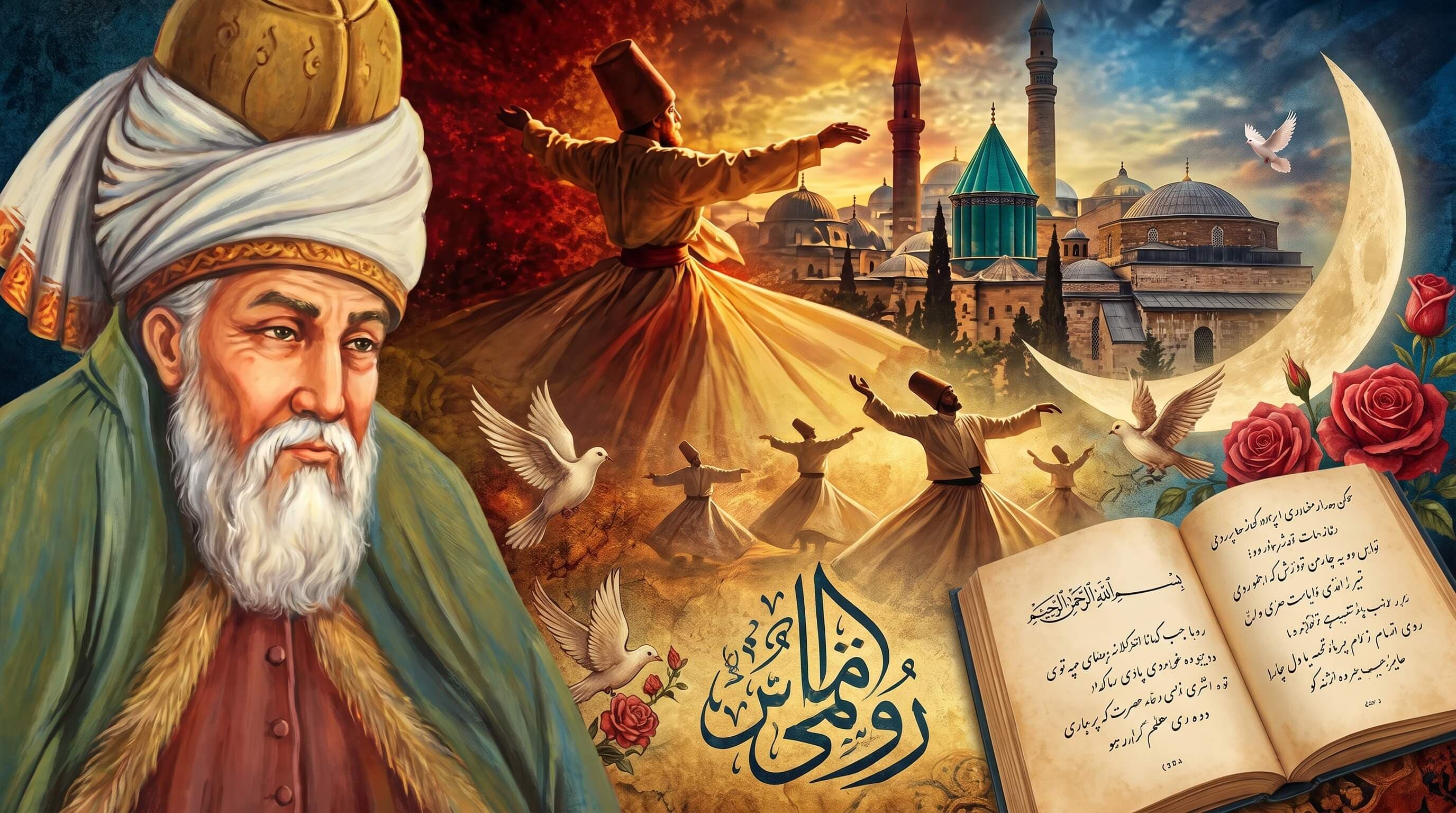
After that realization, Rumi was changed forever. The man who once stood at the minbar issuing fatwas, who taught the strict ordinances of the sharia in the madrasa, now turns. He turns and keeps on turning. The drums beat, the music of the sama rises, and Rumi turns. As he whirls, everything around him falls into a trance. People begin to turn around him, and as they turn, they forget their households, forget empire, forget law, forget religion, and forget scripture. And as he turns, poetry falls from his mouth. Like wondrous flowers dropping from his lips, carrying scents both familiar and strange, it intoxicated all who were near.
By then, this mad dervish, this vagabond Mawlana, had gathered countless disciples. Forgetting to wash or eat, they whirled at his side. They waited for the moment a couplet would escape his lips so that they could write those astonishing words down. In this way, the lines that came from Rumi's mouth grew into thousands of poems and ghazals.
And here is the remarkable thing. At the close of many of those ghazals, Rumi signed not his own name but the name of Shams.
That is why the collection is called the Divan-i Shams-i Tabrizi. Rumi wrote it, but it bears the name of Shams. Rumi was, after all, Shams's divana, the one driven mad by love, and where else would his murshid dwell but in the Kaaba of Rumi's heart? So Rumi and Shams were no longer separate. Shams's words came forth from Rumi's mouth, a kind of gurudakshina, the offering a disciple lays before his master. The master vanished, yet he lives on in his disciple's poems, in his words and in his ghazals. In that poetry, which has passed from person to person for centuries, Rumi lives on, and Shams of Tabriz is still awake.
Next, Rumi's poetry took the side of a man whose very name sends a veritable earthquake through the foundations of clerical establishments the world over. He was Mansur al-Hallaj, another formidable Sufi mystic and poet of Persia. Rumi wrote that the words that came from Hallaj's mouth were not Hallaj's own. Through Hallaj's mouth, God the Merciful Himself had spoken: Ana al-Haqq, "I am the Truth!"
Let us now look at Mawlana Rumi, just once, through the eyes of Konya's ulama. The Rumi who once issued fatwas according to Hanafi fiqh now dances to the rhythm of music. The man who once preached the khutbah from the minbar is now madly in love with a wandering dervish. The man who once stood guard over the sharia now writes songs of wine and idols. And Mansur al-Hallaj was stoned to death as a heretic, yet Rumi now proclaims his very words to be the voice of God!
The question arose, as it was bound to. Has Rumi not turned against the sharia? Is this Rumi still a believer? Or is he an infidel? The question is a hard one. But Rumi himself left behind the answer.
He wrote:
Beyond unbelief and Islam there lies a desert plain.
The knower who reaches it lays his head down in prostration,
for there is neither Islam there, nor unbelief,
and whoever arrives there does not ask
where he now stands.
The man who wrote this spent the last twelve years of his life after Shams composing the Masnavi. On page after page of that great work of nearly twenty-six thousand verses, there are verses of the Qur'an. Few mystical poets writing in Persian quoted the Qur'an as often as he did. And it is this same Rumi who speaks of a realm beyond unbelief and faith.
The question, then, is whether that realm belongs to Muslims alone. Rumi, the poet burned in the fire of love, says:
Unbelief and Islam arrived only yesterday,
but love has been here since the beginning.
Whoever has been slain by love,
do not count that infidel among the infidels.
Rumi, in other words, is declaring that the door to truth is not confined to any one community and that the key to its lock is love.
Rumi never bid death farewell. No Sufi received death as sorrow; they embraced it as union with a loving Creator. So it was with Rumi, who used to say that the day of his death would be his wedding day. That night came on December 17, 1273. On a Sunday, as the sun was setting, Mawlana Jalal al-Din Rumi closed his eyes. He was sixty-six years old.
Is sixty-six a long time in the life of this world? Perhaps not. Rumi called it Shab-e Arus, the wedding night, the night on which the lover is at last united with the beloved. The next day, the streets of Konya were flooded with people. The crowd was so vast that by the time the coffin reached the burial ground, evening had fallen. That crowd held more than Muslims. There were Christians and Jews, and there were Greeks, Arabs, and Turks.
The Christians recited the Injil, the Gospel. The Jews recited the Torah and the Zabur, the Psalms of David. Everyone wept, each in the language of his own scripture. Some Muslims were angered by this and tried to drive the non-Muslims away. What business, they demanded, did they have at the funeral of a Muslim scholar? The Christians and Jews replied:
"It is through this man's teaching that we came to understand the truth of Moses and of Jesus, the truth of all the prophets. The perfect prophets we read of in our scriptures: their ways we have seen in this man. If you call him the Muhammad of this age, we call him the Moses of this age, the Jesus of this age."
Rumi was buried by Islamic rites. The ritual washing, the shroud, the funeral prayer and the burial were all performed as for a Muslim. But those weeping behind his coffin did not belong to a single faith. And Rumi's shrine today stands open to all of humanity, without distinction of religion or nation.
It is said that Rumi spoke these words about his own tomb and khanqah:
Come back, come back,
whoever you are, come back.
Though you be an infidel, a fire-worshipper, an idolater,
come back.
This dargah of ours is no threshold of despair.
Though you have broken your repentance a hundred times,
come back all the same.
Whether Rumi himself said this, or whether it came to circulate in his name only later, cannot be established historically. But this much can be said with certainty: even if he never spoke these words, words so magnanimous could have attached themselves to no name but his.