Liberal Media in the Crosshairs of ‘The Dissent’s’ Framing: A Structural Rebuttal


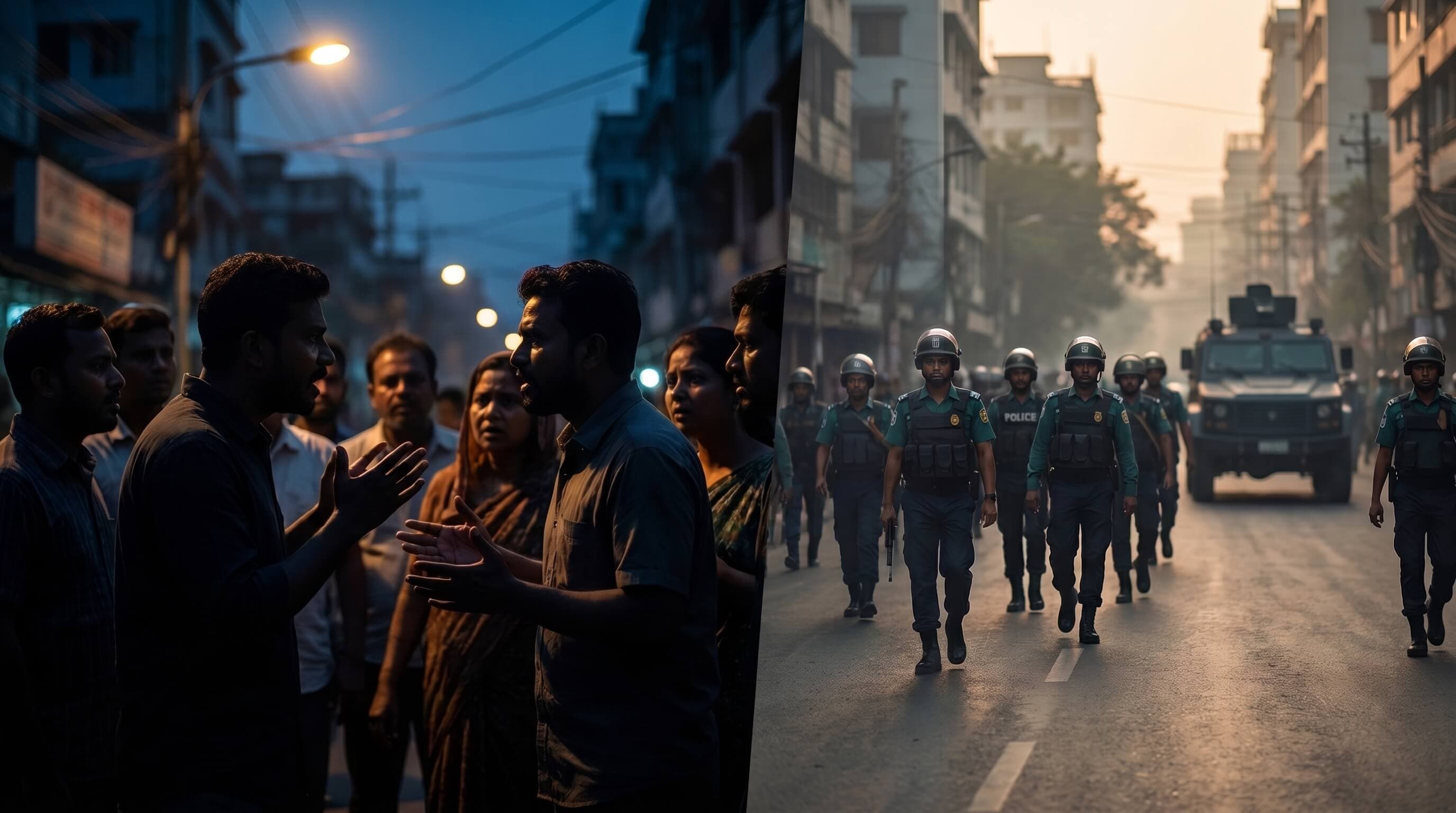
Photo: From Facebook page
The central question, then, is not whether framing exists. Framing is an unavoidable feature of journalism. The more relevant question is whether such framing consistently reflects partisan intent or whether it emerges from the structural logic of commercial news production.
On June 13, an article titled “Is Prothom Alo Facilitating the Awami League Through Headline Framing?” by Rabi Hossain appeared on the fact-checking platform The Dissent. The piece argues that mainstream media outlets—particularly Prothom Alo—intentionally use journalistic framing to construct what it calls a “soft frame”: a generalized, protective, and often sanitised identity around the Awami League (AL) and its affiliated organizations. In contrast, it claims, the same media consistently revisits the past actions of anti-discrimination student movement activists, especially those associated with the July movement, to cast them in negative or derogatory frames.
At first glance, the argument may appear coherent to an average reader. The narrative is structured, confident in tone, and supported by selective examples. But once placed against the analytical frameworks of Media and Communication Studies, comparative models of journalism, and a broader set of contemporary news data, the argument begins to look less like a structural critique and more like a selective reading of newsroom practice. The core methodological issue here lies in highly selective sampling (‘Selection Bias’) and a problematic flattening of contextual differences (‘False Equivalence’).
What emerges, when these claims are examined against established theories of journalism and actual reporting patterns, is a far more complex—and less conspiratorial—logic of news production.
The Attention Economy at Play
One of The Dissent’s central examples revolves around Mahdi, a local movement coordinator who was described in headlines through his own viral remark: “I burnt down the police station.” The article argues that when this individual was later attacked while seeking refuge in a police station, the media deliberately highlighted the paradox between his earlier statement and his present situation. According to The Dissent, this framing was used to produce ironic humour, and the fact that around 12 outlets carried similar headlines is presented as evidence of coordinated institutional intent.
This interpretation, however, overlooks how commercial journalism structurally operates.
Across most modern media systems, news is not simply a neutral reflection of events; it is shaped by attention dynamics. In comparative media theory—most notably in Comparing Media Systems (Hallin and Mancini, 2004)—journalistic cultures are shown to differ significantly. Two dominant models are often highlighted: the Social Democratic or Nordic model, and the Liberal Commercial model found in the United States and Canada.
In the Nordic tradition, press ethics place strong emphasis on individual privacy and restraint in labeling. Even when an unknown individual goes viral for a controversial statement, the press tends to avoid permanently attaching identity-defining tags to that person. A typical report might simply read: “A 32-year-old youth sought refuge in a police station.”
Bangladesh, however, operates far closer to the liberal commercial model, where attention is the primary currency. In this environment, editorial decisions are heavily shaped by “news value” principles, classically outlined by Galtung and Ruge (1965), where negativity, contradiction, and unexpectedness function as high-impact triggers for readership engagement. The phrase “burnt the police station” is therefore not an editorial invention designed to manufacture political meaning; it is a naturally selected attention hook within an already attention-driven system.
The United States offers numerous parallel examples. A teenager who once said “Cash me outside” on television continues to be referenced in major media using that phrase. A woman involved in a racially charged false police call became widely known as “Central Park Karen.” A Canadian incident involving a viral chair-throwing video led to the enduring label “Chair girl.” Even corporate scandals, such as the Korean Air “nut rage” episode, continue to follow individuals in media memory through shorthand labels.
In that sense, identifying Mahdi through a viral statement is not an anomaly or a coordinated narrative strategy. It is part of a broader structural logic of modern news economies where recognition is often built through condensed identifiers.
The Economy of Recognisability and False Equivalence
The Dissent then raises a comparative question: if Mahdi’s past actions are highlighted in coverage, why are similar descriptors not consistently attached to high-profile political figures such as Obaidul Quader or Shamim Osman during reports of attacks on their properties?
This is where the argument shifts into what can be described as an apples-to-oranges comparison. It treats two fundamentally different categories of subjects—unknown local actors and nationally embedded political figures—as though they operate under identical conditions of visibility.
This overlooks what media sociology describes as the economy of recognisability. As Howard Becker (1963) noted in Outsiders: Studies in the Sociology of Deviance, the way labels are applied depends heavily on whether a subject is socially known or structurally anonymous within public discourse.
For nationally recognized figures like Quader or Osman, audiences are already familiar with their political identities, controversies, and roles. Repeating such contextual information in every headline is not only redundant but often constrained by the practical economics of space in print and digital journalism.
Having worked in national newspapers such as Kaler Kantho, Prothom Alo, and Desh Rupantor, one editorial principle repeatedly becomes evident: “news value” is not abstract theory—it is daily newsroom arithmetic. Every word competes for limited space, which itself carries direct commercial value. At high advertisement rates per column inch, repetition of already-known political context is not always editorially justified. Omitting a label, in such cases, does not indicate protection; it reflects prioritization.
For lesser-known individuals, the situation is different. Indexical identification becomes necessary simply to orient the reader. When Donald Trump appears in court coverage, headlines often read straightforwardly: “Donald Trump arrives at court.” His identity already contains the narrative weight. But in the case of lesser-known individuals involved in the January 6 Capitol riot, media outlets frequently rely on descriptive labels tied to their viral actions to establish recognizability.
Seen in this light, the differential treatment is not evidence of bias but a reflection of asymmetrical public familiarity.
Salience and Selective Evidence
The Dissent further argues that when individuals associated with the Awami League face violence or legal action, their political identities are often replaced with softer descriptors such as “Professor” or “Freedom Fighter,” thereby allegedly masking their political identity.
This interpretation confuses framing with concealment.
In journalistic practice, salience refers not to what is hidden, but to what is made prominent. As Robert Entman (1993) explains, framing involves selecting certain aspects of reality and making them more noticeable in order to shape audience attention. In practical newsroom terms, an assault on an unknown political worker may not attract broad readership. However, if the same individual is framed as a “Dhaka University Professor” or an elderly “Freedom Fighter,” the story immediately gains emotional and cognitive weight.
This is not ideological shielding. It is narrative prioritisation driven by audience engagement dynamics.
The broader claim advanced by The Dissent is based on a limited set of examples. A handful of selectively chosen cases are used to generalize a systemic pattern. Yet when a wider set of approximately 50 reports from major Bangladeshi outlets since August 2024 is examined, the pattern becomes far less one-sided than suggested.
Across AL-related reporting, descriptors such as “Fugitive,” “Banned Organization,” and “Murder accused” appear frequently and prominently. Headlines routinely foreground legal and punitive framing when applicable. Conversely, individuals identified through protest or coordination roles are often described through behavioral incidents—such as coercion, violence, or misconduct—rather than institutional identity alone.
The overall picture is not one of selective leniency, but of consistent reliance on high-salience descriptors across different political contexts.
Newsroom Reality in Practice
Two specific case studies further illustrate how this logic operates in practice.
In December 2024, Cox’s Bazar AL leader Naznin Sarwar Kaberi was arrested while hiding inside a rooftop water tank. If the intention had been to soften or protect her image, headlines could have simply referred to her as a “former political leader.” Instead, almost all major outlets foregrounded the unusual nature of the arrest location. Headlines such as “Even hiding in a water tank couldn’t save the AL leader” became widespread across national media. The emphasis was not on political identity but on narrative impact.
A similar pattern appears in coverage of the banned Chhatra League. Following its official designation as a banned organization, a flash march in Kuril led to multiple arrests in June 2026. Across major outlets, there was no attempt to soften institutional identity. Reports consistently used explicit legal framing such as “14 arrested during the banned Chhatra League’s march.”
Taken together, these cases suggest that liberal commercial journalism in Bangladesh operates less through ideological alignment and more through a consistent logic of visibility, legality, and audience engagement.
Modern journalism, as Shanto Iyengar (1991) observed, often transforms political events into episodic narratives designed for immediacy rather than structural explanation. Bangladesh is no exception. Whether it is a fugitive arrested at the border or a viral political statement resurfacing in headlines, both are processed through the same editorial mechanism: what will be read, shared, and remembered.
Conclusion: Framing as Structure, Not Conspiracy
The central question, then, is not whether framing exists. Framing is an unavoidable feature of journalism. The more relevant question is whether such framing consistently reflects partisan intent or whether it emerges from the structural logic of commercial news production.
While concerns about media objectivity and institutional accountability remain valid and necessary, interpreting these editorial patterns solely as evidence of ideological sympathy risks oversimplifying how modern journalism actually functions. Newsrooms do not operate as neutral mirrors, nor as coordinated political actors. They operate within constraints of attention, space, recognizability, and audience expectation.
Understanding that structure is essential before assigning intent.
---
*Author: Editor, Dhaka Papers
Email: [email protected]