Not Tokenism, But Structural Reform: Is the ‘Pink Bus’ Shrinking Women’s Space?

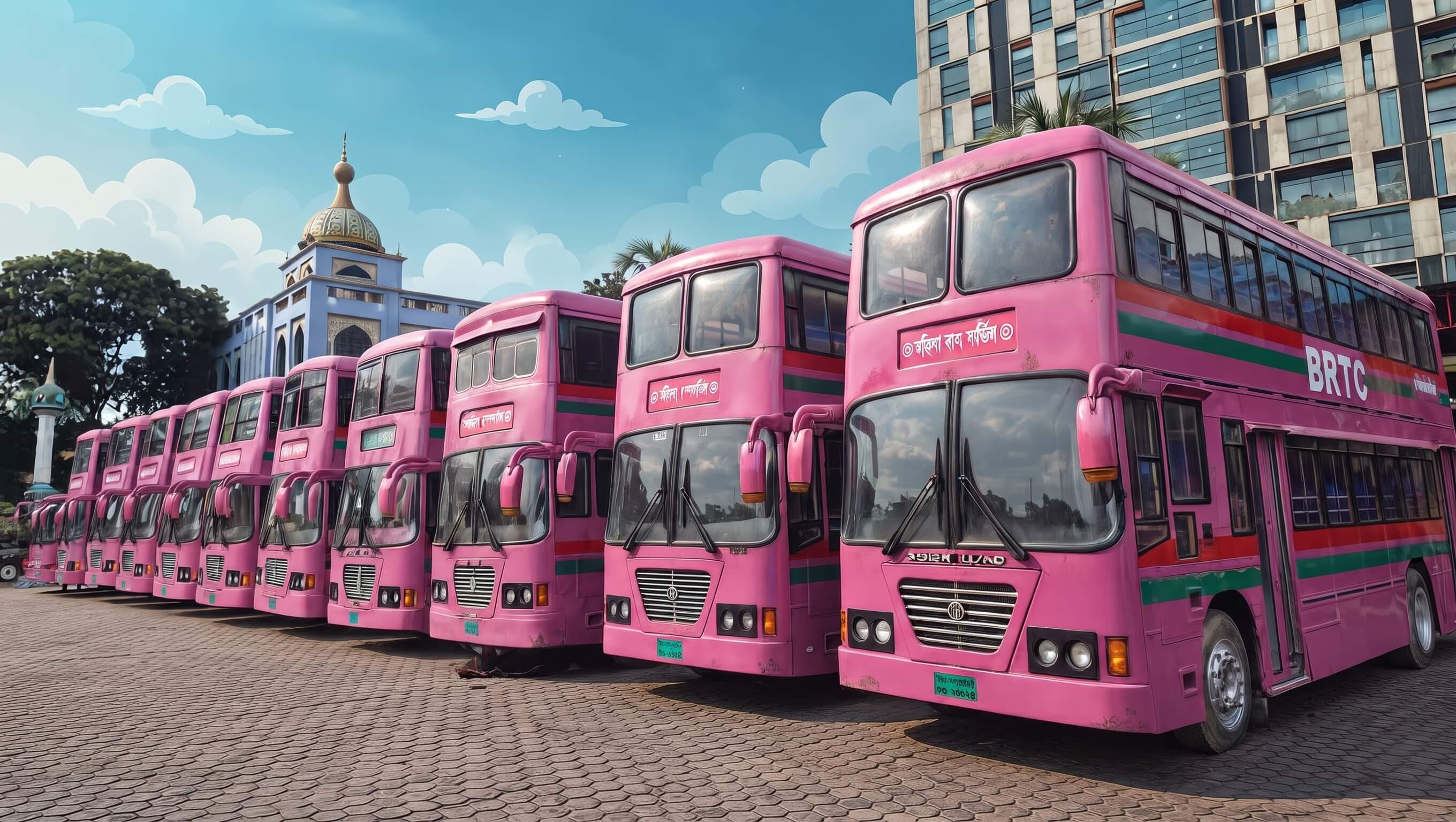
Are Pink Buses and segregated spaces empowering women or pushing them to the margins?
The debate surrounding gender-segregated public transport is a crucial one. Following the recent introduction of a screened-off area for women at Dhaka University’s TSC—a place associated with free intellectual and social exchange—the issue has become highly polarized. Supporters say separate buses can improve women’s safety, while critics argue that such measures reinforce gender segregation rather than address its causes.
The more important question is whether these initiatives actually integrate women into the mainstream or push them to the margins. Public life is a shared space for men and women. Women must be able to study, work, shop, and live alongside men. Therefore, public transport policies should be judged by whether they expand women’s ability to participate in public life or inadvertently exclude them.
Globally, women-only transport initiatives have produced mixed results. In Bihar, India, Pink Buses have been operating since 2025, with women driving them by 2026. While this provides immediate relief, it risks becoming a symbolic gesture rather than a systemic change. The employment of women as drivers is a positive development in itself. It represents an empowering form of structural inclusion.
However, any initiative that confines women to separate transport spaces, even if driven by women, risks reinforcing gender segregation. Similar initiatives exist in Kathmandu, Nepal, which has also introduced a separate bus service for women. In South Asia, these services are often portrayed as progressive, but they do not challenge the structural issues that make public transport unsafe in the first place.
From a global perspective, the outcomes are equally complex. According to a study in Rio de Janeiro's public transport, the introduction of women-only carriages reduced the likelihood of physical harassment by nearly 50 percent.
In Mexico City, studies found that after women-only metro carriages were introduced, sexual harassment declined by 2.9 percentage points. However, these findings show that women-only measures can reduce harassment in the short term, but they do not address its root causes. Tokenism refers to symbolic measures that appear progressive but do little to change the underlying structure.
Instead of holding offenders accountable through apprehension and punishment, it shifts the burden onto women by restricting their presence in public spaces. This approach treats safety as a female responsibility, not a public one.
However, women-only buses should not be rejected outright. In the short term, they can serve as a temporary safety measure. For example, a 2022 BRAC study found that approximately 94 percent of women have experienced some form of sexual harassment on public transport in Bangladesh. This staggering prevalence highlights the urgent need for immediate relief, but such relief must not become a substitute for a permanent solution.
One positive aspect of the Pink Bus initiative is the employment of women as drivers, conductors, and transport workers. This demonstrates that women are capable not only of driving women-only buses, but of serving the entire public, regardless of gender. These services can provide a crucial transitional space while broader reforms are implemented.
But there are clear downsides to this approach.
Segregation does little to address the behaviour of male perpetrators. Rather than restricting women’s presence in public spaces, the state’s primary duty should be to hold offenders accountable. Relying on segregation inadvertently normalizes the idea that women's presence in public spaces is inherently unsafe.
This shifts the burden of adaptation from perpetrators to women. Furthermore, separate arrangements do not fix the deeply embedded structural shortcomings of public transport; they merely bypass them.
The state must move beyond tokenism, adopt concrete policies and action plans, and ensure their effective implementation. A zero-tolerance policy against sexual harassment must be enforced across public spaces, public transport, and institutions. To ensure long-term safety, offenders must be swiftly identified, arrested, and subjected to exemplary punishment.
The High Court directive regarding effective harassment cells must be implemented, and public transport must be made safe through adequate CCTV surveillance, proper lighting, and real-time tracking systems. Furthermore, comprehensive gender-sensitivity training programmes for law enforcement, transport workers, and the general public must be implemented, alongside a clear and comprehensive master plan covering urban design, transport infrastructure, and public awareness.
A broad-based effort involving the state, society, and families is necessary. The ultimate goal of equality is not gender segregation, but equal rights, dignity, and safety for all. The Pink Bus or screened-off spaces can offer immediate comfort for some women. However, they do not change the underlying structure of the public sphere.
Our goal should be to make every public space, transport system, and institution safe and inclusive for women. That means making ordinary public transport and public spaces safe rather than relying on segregation. What is needed is not segregation, but a collective social transformation where the safety of women is considered a shared responsibility. Separate buses and screens are not the solution. The goal should be a society in which women can move, work, and participate freely and safely alongside everyone else.
Your contribution keeps investigative journalism fearless, transparent, and accessible to everyone. To support us securely donate from anywhere.