How true is the prevailing assumption about Qawmi madrasas, poverty and militancy?
Dhaka Papers graphics
To understand the social base of militancy in Bangladesh, we need to look at three separate periods. The first stage involves Harkat-ul-Jihad, or HUJI-B, formally announced in 1992. Built by fighters returning from the Afghan war, this organisation had Deobandi or Qawmi ideological roots.
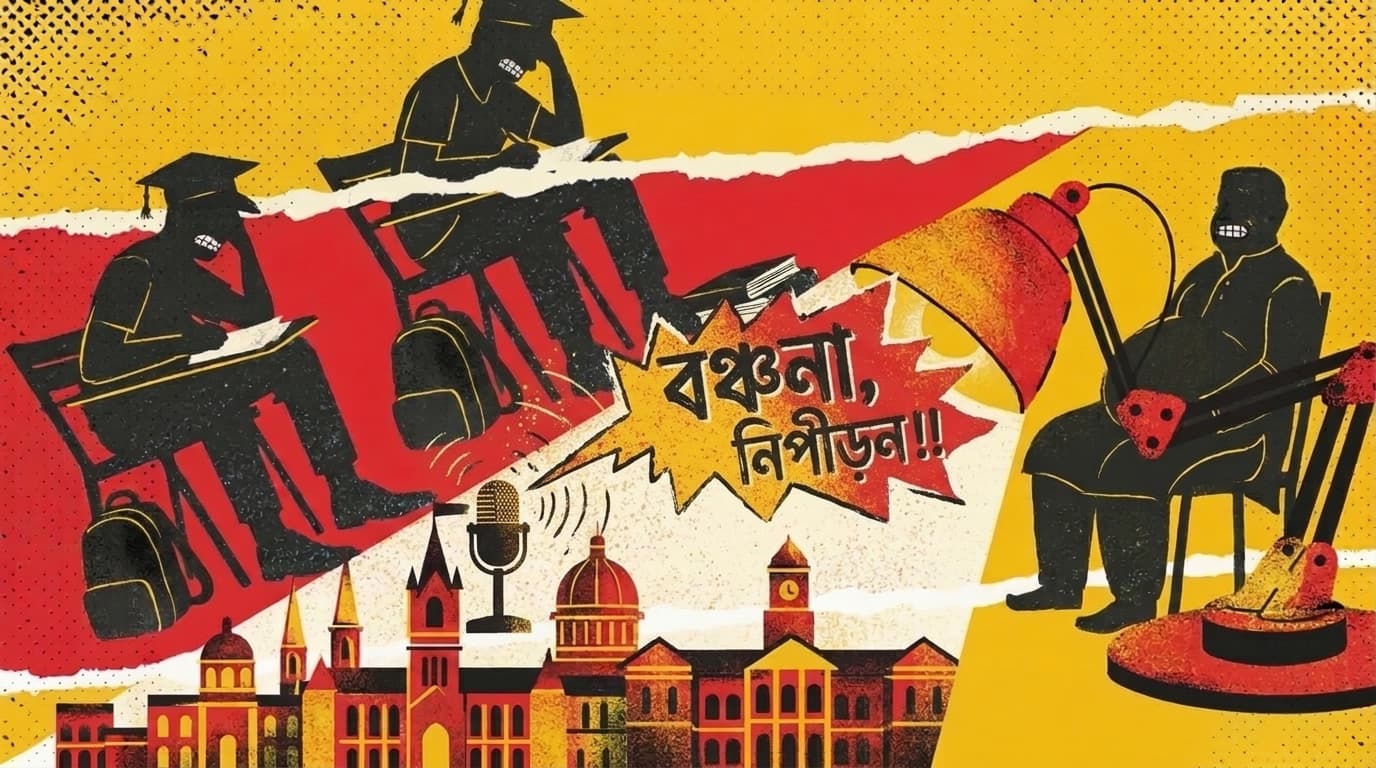
For years, a common assumption in Bangladesh has been that a child from a poor family attends a Qawmi madrasa, graduates, struggles to find work, feels rejected by society and eventually turns to militancy out of resentment. But available data and police statistics do not support this idea. Qawmi madrasa graduates do face limited employment opportunities and low pay. Yet poverty or madrasa education is not the main cause of militancy. Where any connection exists, it is weak and indirect.
A 2021 study by the Anti-Terrorism Unit (ATU) of Bangladesh Police examined 1,217 people accused in militancy cases between 2001 and 2020. It found that 80 percent of the accused had mainstream education. The other 20 percent came from madrasas. Within that 20 percent were people educated in Alia, Qawmi and Ahl-e-Hadith madrasas. The young men behind the 2016 Holey Artisan attack had attended English-medium schools and private universities, and came from well-off families.
Political scientist Ali Riaz found a similar picture. Analyzing information on militants arrested in Bangladesh in 2014 and 2015, he showed that 61 percent of them were children of middle-class or upper-middle-class families. Among 65 whose profession was known, 9 were engineers, and only 25 were laborers or madrasa students.
Economists Alan Krueger and Jitka Maleckova examined data on 129 killed Hezbollah fighters in Lebanon and found that only 28 percent came from poor families. At that time, 33 percent of Lebanon's population was poor. They concluded that the link between poverty or limited education and terrorism is very weak and indirect.
Another researcher, Marc Sageman, analyzed the social background of 306 al-Qaeda members and found that about 73 percent came from upper-class or middle-class families. Peter Bergen and Swati Pandey examined the backgrounds of 79 attackers involved in five major terrorist attacks worldwide and found that only 11 percent had studied at madrasas. By contrast, 54 percent had attended college or university. They argued that madrasa education typically does not impart the skills needed for large-scale attacks. It is therefore a mistake to single out madrasas in security policy.
Recognition of certificates and the reality of the job market
The Qawmi education system is divided into six levels, from Ibtedayi to Dawra-e-Hadith. Without government supervision and financial support, these madrasas mainly run on community donations. According to researcher Masuda Bano's analysis, Alia madrasa students are prepared for general schools and modern professions, while Qawmi students are mainly prepared for religious posts in mosques and madrasas.
There is no reliable government count of the actual number of Qawmi madrasas and students in the country. In 2017, quoting BANBEIS data, The Daily Star reported that there were about 14,000 Qawmi madrasas and 1.4 million students. In the same year, a Hefazat-e-Islam leader claimed that there were 48,000 madrasas and 8.5 million students. In July 2026, the education minister stated in a speech that about 7 million students were studying in nearly 25,000 madrasas in the country. Given the wide discrepancies in estimates of the number of madrasas and students, it is impossible to determine accurately how many Qawmi graduates enter the job market each year. But it is certain that every year, the number of graduates exceeds the number of new posts created in the religious sector.
In April 2017, the government declared the certificate of Dawra-e-Hadith, the highest level of Qawmi madrasa, equivalent to a master's degree in Islamic Studies and Arabic. In 2018, a law was passed on this matter. The recognition was intended to allow Dawra graduates to apply for jobs requiring a master's qualification. But education experts told Prothom Alo at that time that because the quality of education was not on par with the mainstream system, this recognition would only create confusion.
A 2025 study by Ehsan and Khanam found that even after recognition, Qawmi graduates struggle to secure and retain jobs because of gaps in English, ICT and technical skills. Another barrier is the lack of government recognition for lower-level certificates of the Qawmi board (Befaq). A review in the Bangladesh Agricultural University journal noted that most madrasa graduates work as imams or teachers for very low pay. Very few hold formal-sector jobs in government or the private sector. In a BIGD survey in Cox's Bazar, most of the 782 former madrasa students surveyed believed that their education was of little use in securing non-religious jobs.
Control over jobs for Qawmi graduates lies in the hands of local committees. There are about 350,000 mosques in the country. All but six are run by local committees. In November 2025, the religious affairs adviser told Dhaka Tribune that the salaries of imams and khatibs are very low. He asked the committees to pay salaries according to the national pay scale. The main employer of Qawmi graduates is therefore not the state but local mosque committees, and their bargaining power is limited. Local committees determine salaries, and the social standing attached to these posts may also depend on their decisions.
But it should be kept in mind that unemployment is not only a problem of Qawmi madrasas. According to 2024 figures, the unemployment rate among highly educated graduates in the country was 13.5 percent. Besides, about 30 percent of young people in the country were outside education, employment or training.
Does deprivation really produce militancy?
Sociologists have studied the relationship between economic deprivation, unemployment and violence in various ways. Political scientist Ted Gurr showed in his 1970 book that people do not rebel only because of extreme deprivation. People become angry when a large gap opens between what they believe they deserve and what they actually receive. In 2017, the government recognised the Dawra-e-Hadith certificate as equivalent to a master's degree, but the job market did not offer graduates opportunities commensurate with that qualification. The recognition raised graduates' expectations, but suitable jobs remained scarce.
Again, researchers Diego Gambetta and Steffen Hertog examined the educational backgrounds of more than 800 violent Islamists in the Muslim world and found that the share of engineering and science graduates was unusually high. Compared with the general population, the share of engineers among militants was about 17 times as high. The frustration of holding a recognised degree without access to the expected opportunities may contribute to extremism.
But anger or frustration alone does not make a young man a militant. Researchers like Marc Sageman and Charles Tilly have shown that turning anger into violence requires an organization, money and networks. In many cases, researchers have found that young people encounter militant groups through friends or family members as they become drawn to extremist ideology. That network draws frustrated young people into militant groups. Unemployment alone does not explain militancy. Recruitment networks also matter.
Three stages of militancy in Bangladesh and the position of madrasas
To understand the social base of militancy in Bangladesh, we need to look at three separate periods. The first stage involves Harkat-ul-Jihad, or HUJI-B, formally announced in 1992. Built by fighters returning from the Afghan war, this organisation had Deobandi or Qawmi ideological roots. Many Qawmi teachers and students had gone to the Afghan war. The connection between Qawmi madrasas and militancy in Bangladesh is clearest during this period.
In the second stage, Jama'atul Mujahideen Bangladesh, or JMB, was formed in 1998. According to a Prothom Alo analysis, it was mainly formed by people educated in madrasas of the Ahl-e-Hadith tradition and in board-affiliated madrasas. ATU data shows that 38 percent of accused militants were members of JMB, and 81 percent had homes in the economically backward Rajshahi and Rangpur divisions. But there were two levels within the same organization. In 2016, the police detective branch said that 100 to 150 madrasa students were working for JMB in 16 districts, but they were directed by a team of 16 highly educated individuals. The students served mainly as rank-and-file members.
In the third stage, from 2015, Neo-JMB emerged. This group was behind the Holey Artisan and Sholakia attacks. Most of its members were urban and well-off, with backgrounds in science and information technology. Qawmi institutions, students and teachers appear to have had a limited role in Neo-JMB at this stage.
In the ATU study, among 1,217 accused over two decades, only about 240 were found to be madrasa-educated. On the other hand, estimates of the number of Qawmi students in the country range from 1.4 million to 7 million. The overwhelming majority of Qawmi graduates, including those who are unemployed or low-income, have not turned to violence. The idea that a Qawmi unemployed person is necessarily a militant does not match the data at all.
Hefazat's movement and militancy are not the same thing
If organised armed militancy and a mass religious movement like Hefazat-e-Islam are treated as the same phenomenon, important differences between them are obscured. Hefazat is not a militant organisation on the police's anti-terrorism unit list. In 2013, Qawmi teachers and students organised on the streets under this banner.
According to anthropologist Samia Haque's observation, Hefazat's followers are not limited to madrasas. The movement also draws substantial support from working people, including garment workers, drivers and security guards. Class matters here too. On the other hand, political platforms like the Ghatak-Dalal Nirmul Committee (Committee to Eliminate the Killers and Collaborators of 1971) claimed that many students had come to that rally because of the lure of stipends and pressure from teachers. Whatever the truth of these claims, armed militancy cannot be explained by poverty or unemployment. But the link between the deprivation of marginalised people and a mass movement like Hefazat is much stronger.
Class struggle or reactionary behaviour?
Many people call this social resentment among Qawmi graduates class struggle, while others dismiss it as reactionary behaviour. Neither label is entirely accurate.
There is no doubt that the source of their resentment is economic and class-based. This resentment stems from a narrow job market, the monopoly control of mosque committees, and the frustration of being excluded from the mainstream despite holding a master's-equivalent qualification. But the language and goals of their movement are not primarily economic. In class struggle, the opponents are usually factory owners, landlords or the state's economic policy. Yet the target of Qawmi young people's resentment is mainly religious and cultural. Their resentment is expressed in ideological battles over which behavior in society is Islamic and who is anti-Islamic. One notable exception was the demand for recognition of certificates in 2017. At that time, Qawmi leaders described it as a long-neglected right and as recognition of the country's largest social force. There was bargaining for group interests, but it did not take the shape of class struggle.
Again, dismissing them simply as reactionary is also harmful for analysis. In sociology, reactionary generally refers to a stance in favor of restoring a past social or political order. But French researcher Olivier Roy has shown that today's religious extremism is not merely a repetition of the past; it is a product of modern globalization and identity crisis. Besides, if someone is labelled reactionary, the real economic deprivation behind their resentment may be overlooked.
How the media and policymakers should see it
The media, writers and policymakers should avoid generalizations that treat the entire Muslim population as a single group, whether by invoking Muslim anger or madrasa extremism. Three distinct phenomena need to be kept apart: the structure of low income and employment barriers faced by Qawmi graduates despite formal recognition of their qualifications, mass religious organizations like Hefazat, and armed militant networks. If these three are treated as one phenomenon, people will assume that the first leads directly to the third, which is completely contrary to the data.
Instead of blaming or belittling an unemployed maulvi personally, it is important to highlight the gaps in the system. It is necessary to talk about the control exercised by local mosque committees, low pay, and the reality of job applications being rejected even with a master's-equivalent qualification. At the same time, it should be kept in mind that explaining the cause of deprivation does not mean supporting violence. No one earns the right to bomb just because they are deprived. And those who channel resentment into violence deserve to be exposed: the online propagandists and the organizers of militant networks who recruit through them. The ATU study found that the second main path of militant recruitment is online.
Even if there is no direct connection with militancy, the question of reforming Qawmi education does not go away. Sending millions of young people into the job market without basic skills in English, mathematics and technology poses a serious challenge for the country's workforce. This is not a question of militancy; it is a question of education policy. But one question remains. Society recognized a qualification as equivalent to a master's degree but failed to create enough jobs for those who held it. Who, then, would channel that young man's frustration?
---
*Author: Editor, Dhaka Papers
Email: [email protected]
Your contribution keeps investigative journalism fearless, transparent, and accessible to everyone. To support us securely donate from anywhere.