Women of Bengal, Durga: Women’s Rights and Durga Puja in Bangladesh
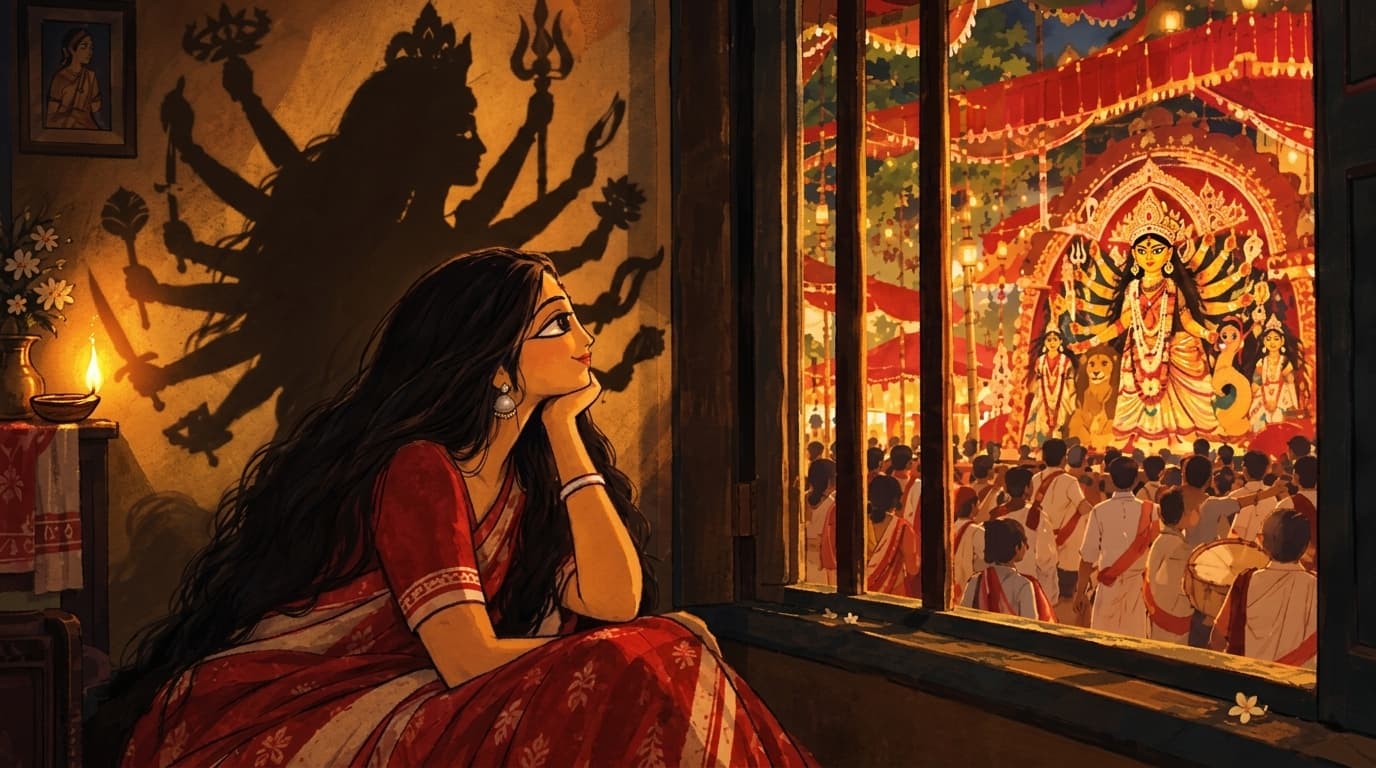
Cartoon: AI generated
When an entire nation, Hindu and Muslim together, walks from pandal to pandal to stand before a ten-armed woman on a lion, something shifts in how we see women. Not overnight, but it shifts. Women are the force that outnumbers anyone who believes they can be pushed down. This year, on the streets, they made that point without saying a word. I understand that calling a woman a goddess does not make a society feminist. You can garland a goddess in the morning and silence a woman by evening.
For ten days this autumn, the women of Bangladesh took the road. They came in red and white and in saffron and gold. They walked in groups from mandap to mandap long after midnight. They danced to the dhak, laughed into the crowd, and held the street as if it had always belonged to them. Because it had. I watched them and felt something I had almost forgotten. It felt like an answer. Durga is not a guest in this country. She is one of its oldest residents. Tradition holds that she was first worshipped in the hills of Chattogram, at the hermitage of the sage Medhas. This is where the Devi Mahatmya opens, with a defeated king, Suratha, arriving in exile and looking for somewhere to rest. Long before there was Bangladesh, this soil knew her name. And remember how her story goes. The demon Mahishasura had been promised that no god and no man could kill him. The gods tried and failed. So they poured their fire together, and out of that blaze stepped a woman.
Mahishasura never feared her. It simply never occurred to him that a woman could be strong enough. That was his mistake, and it cost him his head. We call it Asur Bodh, the slaying of the demon. But it is more than a scene sculpted in clay. It is a reminder that Shakti, the power, was hers all along. So why does this matter now? Look at what Bangladeshi women have lived through in the past few years. Murder. Rape. Abuse at home and on the street, and Indigenous women have not been spared. Child marriage, which we fought so hard to push back, is quietly returning. Some preachers now speak openly in favour of taking several wives. Online, a bitter resentment of women is spreading among angry young men. And an imported, rigid ideology keeps repeating the same lesson: women are weak, and their place is behind a wall. That lesson has never fit Bengal.
Here, Durga Puja arrives with colour, music and dance. It belongs to everyone. Your faith is yours; the festival is ours. When an entire nation, Hindu and Muslim together, walks from pandal to pandal to stand before a ten-armed woman on a lion, something shifts in how we see women. Not overnight, but it shifts. Women are the force that outnumbers anyone who believes they can be pushed down. This year, on the streets, they made that point without saying a word. I understand that calling a woman a goddess does not make a society feminist. You can garland a goddess in the morning and silence a woman by evening.
Scholars have argued over this for decades. In “Is the Goddess a Feminist? In "The Politics of South Asian Goddesses (2000)”, edited by Alf Hiltebeitel and Kathleen Erndl, some writers argue that Hindu goddesses fail the strict test of Western feminism. Others refuse to leave it there. They argue that the Goddess is not a museum symbol but a living presence and that she turns hard questions back on the very people who worship her. In one essay, by Usha Menon and Richard Shweder, Durga seems to ask, 'What kind of gods are these?' In another, through Draupadi, the question becomes: what kind of men are these? One contributor offers the idea I keep coming back to. A goddess like Durga can give ordinary women a sense of their own worth, even women who have never heard the word "feminist". Over time, those women may find their own kind of feminism, rooted in their own faith and culture, not copied from the West. And if any goddess is ready for that role, it is Durga or Kali, not the gentle Sita or Lakshmi. There is an older reading too, from Samkhya philosophy. When the male ego, ahamkara, swells into something monstrous, the gentle goddess becomes a warrior. Her sword is discernment, and it takes off the swollen head. Anyone who claims a god’s authority for himself had better watch out for the lion-rider’s blade. I can’t think of a better description of what this country needs to remember. Durga was not born a feminist icon. She became one by fighting. That does not mean women must always be at war. But at this moment, in this country, we need some of her Shakti (strength) in us. Some call her Ma (mother). Some call her Devi (goddess). Some call her Doshobhuja, the one with ten arms. In every form, she is worshipped by people willing to see a woman as divine. Yes, there are contradictions in that, and we should not pretend otherwise. But think of a girl who grows up looking at a woman who is armed, unafraid, and worshipped on a lion. She learns something no lecture could teach her. And Durga does not come alone. She comes with the harvest.
On Saptami, a banana plant dressed as a bride stands beside her. She belongs to our rivers, our fields and our autumn sky. So let us celebrate her as fully as we can. She will help protect our women, our nature, and the harmony between our faiths that has always made Bengal what it is. But let us not stop at worship! Our women are worshipped but not paid, denied fair wages at work and a fair share of their father’s and husband’s property, and Hindu women in Bangladesh most of all; it is time our Durgas received what is rightfully theirs.
Ashche Bochor Abar hobe! (We shall celebrate again next year!)
---
*Author: Syeda Nilima Dola
Filmmaker, Poet
Your contribution keeps investigative journalism fearless, transparent, and accessible to everyone. To support us securely donate from anywhere.