The World Cup and the Triumph of Crony Capitalism

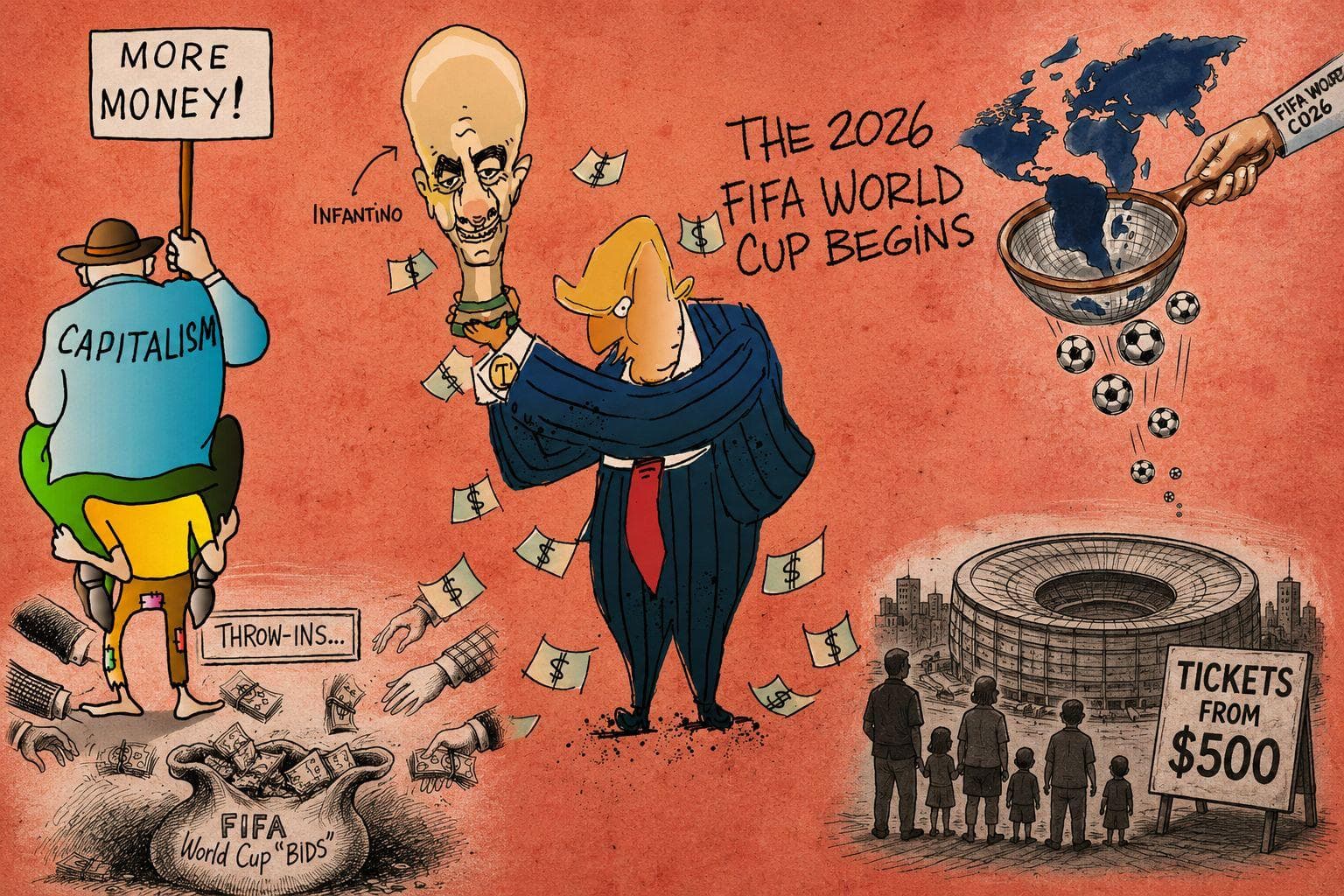
Sketch: AI
Red Flag, in its essay "Cannibal Capitalism Eats the World Cup", offers a blunt answer. The publication argues that public resources are increasingly mobilised to support private profit. Cities invest heavily in infrastructure, transport and security. Governments devote personnel and administrative resources.
A day before [writing this article], I called a cousin who lives in Philadelphia to ask about the mood surrounding the World Cup in the United States. Instead of excitement, I got a three-minute tirade. "This World Cup reeks of crony capitalism," he said.
He had hoped to take his four nephews and nieces to a match while travelling in California. The fixture he had in mind was hardly one of the tournament's glamour ties: Jordan versus Algeria. Yet when he checked the ticket prices, he was stunned.
"The cheapest ticket I could find was around $500," he said. "Five hundred dollars for Jordan against Algeria! Outside those two countries, most people probably wouldn't even notice the match. And yet we are expected to pay that much just to get through the gate."
His complaint may have sounded exaggerated, but it captured a growing unease surrounding the 2026 FIFA World Cup. Football's biggest tournament has always been a commercial enterprise wrapped in the language of global unity.
Yet this edition, spread across the United States, Canada and Mexico, has made the tension harder to ignore. The thing that was once marketed as the world's most democratic sporting festival increasingly resembles a showcase for the interests of corporations and wealthy consumers.
The World Cup has never existed outside the market. Football became a global phenomenon in part because it adapted successfully to television ad sponsorship and of course mass consumption. Thus the issue is not that capitalism has entered the game….it is whether the game has become subordinate to commercial and political interests.
The evidence is mounting.
The tournament is unfolding amid stories about visa restrictions, border controls, soaring accommodation costs, hospitality packages worth thousands of dollars and FIFA's increasingly close relationship with political power.
The spectacle on the pitch is competing with a broader story about who gets access, who profits and who is left out.
Politicization of innocence
In a recent New York Times article, Jon Guida argued that the World Cup has become “deeply entangled with Donald Trump's political project.” Instead of a celebration of internationalism, he suggested, the world cup has increasingly served as a stage for the projection of national power.
FIFA, which routinely invokes political neutrality when convenient, appears remarkably comfortable aligning itself with governments and leaders when doing so advances its institutional interests.
That assessment reflects a broader transformation within football's governing body. As The New Yorker recently observed, Gianni Infantino's FIFA has evolved into a vast revenue-generating enterprise, increasingly centralised around the ambitions of its president.
The expansion of the World Cup from 32 to 48 teams was marketed as a triumph of inclusion. It has also produced 104 matches, expanded broadcasting inventories and created unprecedented opportunities for sponsorship sales.
In business terms, the logic is obvious. More teams mean more games. More games mean more advertising slots. More advertising slots mean more revenue. Inclusion may be part of the story. Commercial expansion is undoubtedly another.
Several critics argue that the consequences are becoming increasingly visible. Culture in Sports, in an article titled "How the World Cup Became a Playground for the Wealthy", contends that attendance at major tournaments is steadily becoming a luxury experience.
Ticket prices, hospitality packages, premium seating and accommodation costs have transformed what was once a mass spectator event into a premium product.
The exclusion is subtle. No one is formally barred from attending. Instead, attendance is priced beyond the reach of many ordinary supporters. Access remains theoretically universal while becoming practically restricted to those with sufficient disposable income.
That irony should not be lost on football's administrators. The sport's popularity was built by migrants and urban communities. Yet many of those same communities increasingly experience the World Cup as television consumers rather than participants.
Marxist.com pushes the critique further, describing the tournament as a case study in the commodification of sport. Its ideological conclusions may be disputed, but its central observation is difficult to dismiss.
Nearly every major reform promoted as expanding football's reach has also expanded FIFA's commercial opportunities. Growth and inclusion are not mutually exclusive objectives. But it is often unclear which objective comes first.
But what distinguishes the 2026 tournament is the very degree to which commercial interests have become intertwined with state power.
The price of inclusion
Reuters recently reported concerns from human-rights organisations about what they described as a "climate of fear" surrounding parts of the tournament, citing immigration enforcement and travel restrictions in the United States.
Controversies involving Iran and other politically sensitive countries have further exposed the contradictions of staging a supposedly global celebration within increasingly restrictive border regimes.
These developments reinforce an argument advanced by Eurasia Review. The publication noted that the World Cup exposes the gap between the rhetoric of globalisation and the realities of power.
Capital crosses borders with ease. Sponsors cross borders with ease. Corporate executives cross borders with ease. Fans and visitors from certain countries often face a more complicated reality.
This is where the concept of crony capitalism becomes relevant.
Crony capitalism is not simply a market economy. It is a system in which economic success is closely tied to political connections and institutional access. Influence becomes as important as competition. Proximity to power becomes a valuable asset.
FIFA's modern operating model increasingly resembles such a system.
Le Monde recently pointed out the unusually warm relationship between Infantino and Trump as evidence of FIFA's growing political entanglements. Meanwhile, American authorities have embraced the tournament as an economic and geopolitical opportunity, creating dedicated structures to facilitate its organisation and promote its benefits.
At one level, such cooperation is inevitable. Mega-events require coordination between governments and sporting bodies. Yet the arrangement raises uncomfortable questions. Who captures the gains from these partnerships? Who bears the costs? And how much public money is ultimately deployed to support what is, at its core, a private commercial enterprise?
Red Flag, in its essay "Cannibal Capitalism Eats the World Cup", offers a blunt answer. The publication argues that public resources are increasingly mobilised to support private profit. Cities invest heavily in infrastructure, transport and security. Governments devote personnel and administrative resources.
Sponsors receive exclusive commercial privileges. FIFA records enormous revenues. Citizens are promised economic legacies whose long-term benefits often prove difficult to quantify.
The pattern is thus familiar. Risks are socialised…and rewards are privatised.
Football's corporate state
Even labour issues reflect the same dynamic. Reports from The Guardian have highlighted concerns about workers facing extreme heat during matches in several southern American cities.
Service workers, temporary employees and event staff are expected to absorb many of the tournament's operational pressures while receiving only a small share of its financial rewards.
None of this means football itself has lost its appeal. Millions will continue watching. Great matches will still produce moments of collective joy, heartbreak and memory. The sport remains compelling despite the institutions that govern it.
Indeed, that distinction is central to understanding the current debate.
The World Cup's appeal comes from football, not FIFA. And it comes from supporters, not sponsors. Yet the 2026 tournament illustrates how thoroughly those relationships have been inverted.
The tournament may still deliver unforgettable football. But it also offers a revealing portrait of modern capitalism at work: a system in which access is increasingly determined by wealth, public resources support private gain and institutions that claim to serve the many often operate for the benefit of the few.
The confetti will eventually fall. A champion will be crowned. FIFA will celebrate another successful tournament.
The more important question however is whether the world's most popular sport can remain genuinely public when its biggest event is becoming steadily more private.
—
*Faisal Mahmud: Journalist, Managing Editor of upcoming Daily Waadaa